

Impact of Lean Practices on Operational Performance: The Moderating Role of Demand Uncertainty: Evidence from the Malaysian Automotive Industry
 DOI:
DOI:
 PDF
PDF
⬇ Downloads: 7
1College of Business Administration, Imam Abdulrahman Bin Faisal University, Dammam, Saudi Arabia
Received: 25 December, 2025
Accepted: 05 May, 2026
Revised: 07 April, 2026
Published: 04 June, 2026
ABSTRACT
Methodology: In this respect, a quantitative research design was employed to test these relationships between two groups of firms in terms of age (i.e., young and established firms) with Multi-Group Analysis (MGA) in SmartPLS, where 395 professionals of different firms took part in the research.
Results: The analysis concluded that lean practices, primarily JIT and TQM, had a considerable impact on the operational performance. The moderation by demand uncertainty was only significant in the association between TQM and performance, which implies that in a high demand uncertainty environment, the effectiveness of TQM decreases. Multigroup analysis was found to be not statistically significant on the effects between the young and the established firms. Also, the use of MGA did not have any significant difference between the young and established firms.
Conclusion: All these results led to further insight into the lean implementation in the Malaysian automotive industry and offered hints to the companies interested in the improvement of operational efficiency and performance.
Implication: The results thus indicate that the incentives and support to automotive firms to implement lean practices by the policymakers and government agencies are there to realise their potential in enhancing the performance and competitiveness of the firms in their operations, irrespective of the age of the firms.
Keywords: Lean practices, operational performance, demand uncertainty, malaysian automotive industry, MGA.
1. INTRODUCTION
The use of lean practices in the global automotive sector is becoming a common trend among manufacturers in an ever-competitive environment to improve efficiency, minimize waste, and improve operational performance (Iteng & Ahmad, 2017). Lean thinking, which has its origins in the Toyota Production System (TPS), focuses on the methodical eradication of non-value-adding processes, streamlined flow, Just-in-Time (JIT) manufacturing, employee participation in the work processes, and continuous improvement (Kaizen) (Lee & Xing, 2021). These lean tools have been effective in cost reduction, reduction in lead times, better quality of products, and manufacturing flexibility. As an illustration, lean and agile methods have been observed to have a positive relationship with supply chain operational performance in manufacturing firms in Malaysia (Sahwan et al., 2013; Sin et al., 2024).
Although automotive firms work in settings where external uncertainty, especially demand uncertainty, could weaken well-structured production plans, strain substantial inventories, and make forecasting more difficult (Phadnis et al., 2022). Demand uncertainty refers to how firms have impulsive and volatile demand in the long run (Mohammed and Mandal, 2024). Lean tools can be efficiently applied when demand is rather stable, whereas some lean practices can be harmed or cause trade-offs when the demand is highly volatile (Mohammed & Mandal, 2024). Although there is much interest in lean practices, their interaction with demand uncertainty still remains paucity.
Since the previous studies have discovered that lean practices tend to provide substantial change in such areas of operations as cost, delivery, quality, and flexibility, the indicators imply that these changes might not be consistent among the various environmental or contextual circumstances (Naeem et al., 2021). The automotive industry in Malaysia is predominantly exposed to changing consumer preferences, competition due to imports, changes in the global supply chain, and economic cycles (Sin et al., 2024). This can meet the uncertainty of demand, and this constrains or changes the effectiveness of the lean practices. Failure to comprehend the moderating role can lead practitioners to take the risk of applying lean tools without being aware of which demand conditions will provide the promised performance gains. Specifically, it is not clear whether the performance benefits of lean practices are much weaker in the high demand uncertainty compared to the low demand uncertainty.
The study has considered the role of firm age, focusing mainly on younger firms compared with established ones. Younger firms, even though they are characterised by greater agility, fewer legacy processes, and higher risk-taking, might implement lean practices differently than experienced firms, which may leverage deeper operational routines, accumulated knowledge, and conventional supply networks (Rose et al., 2013). Empirical research shows that firm age can enhance overall performance through learning effects, whereas it can constrain performance through organisational rigidity over time (Chandra et al. 2026; Noordin & Mohtar, 2014; Rose et al., 2013). While comparing younger with older automotive engineering firms in Malaysia, the study aims to examine whether lean practices and their effectiveness under changing demand uncertainty differ by the age of the firm’s operations.
This study has treated demand uncertainty as a distinct contextual variable, referring to the degree of unpredictability in customer demand (for instance, variability in demand volume or forecast errors) that increases challenges for flow-based and lean operations. It also used firm age (i.e., year of establishment) to classify firms into younger and experienced groups to explore whether lean practices affect the operational performance relationship and whether this relationship differs across firms with different levels of experience. Firm age is not a proxy for demand uncertainty but rather a separate moderator. It is a grouping (contextual classification) variable used for exploring whether the central relationship, as per the investigation, tends to behave differently across organisational maturity levels. Moreover, firms are considered into younger and established groups for the provision of comparative insights into how lean practices work under different organisational experience, instead of introducing an additional layer of moderation. Such distinction ensures the conceptual clarity and avoids misinterpretation of the firm age being a parallel moderating construct. While doing so, the study investigated how demand uncertainty moderates the effect of lean practices and whether that impact varies by the firm’s age or experience dimension.
This research has both practical and theoretical significance. In practice, it is helpful for managers in the Malaysian automotive industry to understand better the demand conditions under which lean practices can yield optimal gains, thereby enabling highly informed strategic and operational decisions. For example, firms might adjust their lean execution strategies in response to demand volatility to maximise performance. Theoretically, the research contributes to operations management and the lean literature by integrating contextual uncertainty (demand uncertainty) into the lean-performance relationship and by using a rigorous MGA approach in SEM to test differences across groups. Overall, it increases the explanatory power of the lean theory in terms of manufacturing settings with environmental variability. Furthermore, it is among the prime empirical studies that specifically focus on Malaysian automotive firms (considered a specialised group), rather than broader manufacturing companies.
These strategic decisions increasingly depend on how firms connect internal lean systems with market-facing information systems. In volatile demand environments, lean responsiveness is strengthened when production scheduling, inventory control, and supplier coordination are informed by timely customer and sales data, because digital transformation and Industry 4.0 capabilities improve visibility, analytics, and cross-functional decision-making (Buer et al., 2018; Gunasekaran et al., 2017; Kache & Seuring, 2017; Wamba et al., 2017; Patel & Patyrykin, 2025). In this sense, automation provides a complementary strategic background for understanding how technology-enabled customer information can support operational competitiveness when lean practices are implemented under uncertain demand.
The main research question of this study includes:
How do lean practices impact operational performance in Malaysian automotive engineering firms, considering the moderating role of demand uncertainty for young firms vs experienced firms?
The key objective of the study is to assess how lean practices affect the operational performance in the Malaysian automotive industry, paying particular focus on the moderating role of demand uncertainty, and assessing whether this relationship is consistent across firms of contrasting age groups.
2. LITERATURE REVIEW
2.1. Lean Practices and Operational Performance
Lean practices have been used for years and have shown effective results in improving operational performance. For example, (Rose et al., 2013) reported that in the Malaysian automotive mechanisms industry, lean manufacturing practices are considered essential; however, their actual implementation is still modest. Similarly, lean principles such as reduced lead times, lower operational costs, and improved product quality are strongly associated with productivity (Rahim et al., 2025). Lean, along with TQM leadership practices in Malaysian automotive companies, ensured that quality, leadership involvement, process flow, and workforce engagement actually matter in achieving better operational outcomes (Salleh et al., 2015).
A primary theoretical basis for this research is Contingency Theory, which suggests that the effectiveness of management practices, such as lean, depends on the fit between these practices and the internal or external context (demand uncertainty) (Tao et al., 2025). As per Contingency Theory, “one‑size‑fits‑all” is not an optimal set of practices. The performance results depend on external variables (Tao et al., 2025). In the same way, the Resource-Based View (RBV) might be used to argue that lean practices reveal firm resources or competences, whose gains depend on how well they are leveraged across differing demand conditions (Qin & Chen, 2022). Such theories support studying not only significant effects but also moderation through the demand uncertainty. Empirically, it means that even if firms use lean tools, their level of success depends on both whether the internal resources support such adoption (RBV) and whether the external environment allows a better fit (Contingency theory).
Moreover, constraints in the Malaysian automotive industry include poor skill sets, organisational culture, limited awareness, and resource limitations, which hinder the full implementation of lean (Rose et al., 2013). A study by (Hibadullah et al., 2013) even shows that perceptions of lean exceed actual practice amongst automotive factor SMEs. Even environmental performance research shows that lean practices do more than just cost or quality improvement. However, they even affect sustainability outcomes, although not all lean tools are adopted uniformly (Sahwan et al., 2012).
Empirical studies consistently show that lean practices such as value stream mapping, just-in-time (JIT), 5S/standardised work, and Kaizen tend to yield improvements in cost, lead time, flexibility, and quality (Achaka et al., 2024; Alaya, 2026; Belekoukias et al., 2014). Regarding automotive supply chains, lean adoption enables smoother flow, fewer defects, and quicker response to customer orders (Marodin et al., 2019). The evidence even shows that boundary conditions, such as lean working, are most effective when demand is stable and low. Mechanically, while reducing waste and streamlining operations, lean tends to free up capacity and increase output; however, under volatile conditions, similar minimal-buffer logic might restrict flexibility. Depending upon the above analysis, the hypothesis to be tested in this study is,
H1: Lean practices (JIT, TQM & Kaizen) significantly affect operational performance in Malaysian automotive firms
2.2. Demand Uncertainty and Moderation Effects
Although sufficient literature exists on lean practices that lead to better performance, treating this as a direct effect, fewer studies have examined moderating factors, such as demand uncertainty (Garcia-Buendia et al., 2023; Thunyachairat et al., 2023). In broader settings, it is found that demand volatility can either weaken or alter relationships, particularly when high uncertainty, lean practices such as Just-In-Time inventory, or negligible buffers are present, which can affect delivery or flexibility (Iranmanesh et al., 2019). In the Malaysian automotive industry, empirical tests on demand uncertainty as a moderator are quite rare or not publicly accessible.
The literature recommends that demand uncertainty, i.e., the unpredictability as well as volatility of customer orders, tends to moderate the lean and performance link (Garcia-Buendia et al., 2023; Tao et al., 2025). According to an uncertainty framework by (Wahab et al., 2024) lean supply-chain approaches are most effective when demand and supply are low, and uncertainty is low. Moreover, lean practices such as JIT, nominal buffers, and pull systems consider stable demand as the high volatility might induce stock-outs, disturbed flow, and enduring lead-times (De Martini, 2021). An empirical study proves that, considering high demand variability, companies need agile or hybrid strategies instead of pure lean (Rahimi & Alemtabriz, 2022). Provided that the Malaysian automotive sector faces a shift in consumer preferences along with the global supply-chain shocks, such a moderating effect is mainly salient. Referring to the context shared, the second hypothesis of the study is,
H2: Demand Uncertainty significantly moderates the association between lean practices and organisational performance
2.3. Young Firm’s vs Experienced Firms of the Malaysian Automotive Industry
In the automotive industry of Malaysia, younger firms even bring agility, new technologies, and less legacy baggage, which enables them to adopt the lean practices along with the new manufacturing methods swiftly (Rose et al., 2013). In contrast to it, experienced firms take advantage of their established supply‑chain networks, profound process knowledge, as well as long-standing relationships with OEMs (Khairani et al., 2017). OEMs stand for Original Equipment Manufacturers, which refer to the companies producing the final vehicles, whereas many smaller firms supply parts such as engines, electronics, or seats. Examples of them are Toyota, Honda, Proton, etc.
Even though these are big names, they might face inertia or even legacy systems that slow down change. Provided the instant technological evolution along with the skill‑gaps found in the automotive workforce of Malaysia, in which companies specify the need to upskill for Industry 4.0 along with the EV (electric vehicles) production (PR NewsWire, 2024), the relationship between firm age, implementation of lean, and demand uncertainty needs scrutiny.
The moderating role of demand uncertainty may differ by the firm’s age. The younger firms are quite adaptable as well as less constrained by the legacy systems, and might be better positioned for exploiting the lean practices even if demand is volatile, hence maintaining a stronger operational performance under high uncertainty (Tortorella et al., 2025). Contrariwise, experienced firms, having well-established supply chains and foreseeable flows, may perform perfectly if there is stable demand; however, they may see the lean benefits diminish if demand turns out to be highly uncertain (Khairani et al., 2017). Hence, firm age may affect how and when demand uncertainty declines or strengthens the overall link between lean performance. Thus, the third hypothesis of the study is assumed to be,
H3a: There is a significant difference between the impact of lean practices on the operational performance of established and young firms.
H3b: There is a significant difference between established and young firms in the case of the moderating effect of demand uncertainty between lean practices and operational performance.
2.4. Gap and Conceptual Model
Previous studies demonstrated significant benefits of lean practices over operational performance, but a notable gap exists regarding how demand uncertainty moderates that relationship in the automotive sector. There are a few studies that have empirically studied the moderating role of demand volatility over the lean-performance link, mainly in the case of the Malaysian automotive industry. Furthermore, literature seldom distinguishes how firm characteristics like firm age or experience level alter such a moderating effect. It leaves unanswered whether younger vs. experienced firms benefit differently from lean initiatives under changing demand uncertainty levels, which this study aims to address. Based on these aspects, Fig. (1) shows the relationship between key variables, according to the defined groups, i.e., 1 is young firms, and 2 is experienced firms. This model is based on the assumption that lean practices affect the operational performance of the given firm age, having a moderating role of demand uncertainty.
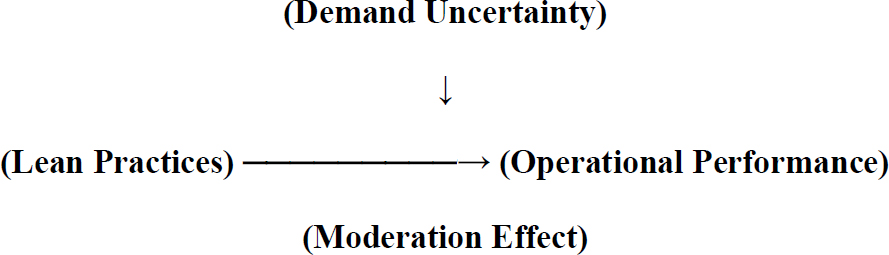
Fig. (1). Conceptual framework showing the moderating role of demand uncertainty on the relationship between lean practices and operational performance. All the constructs are represented as latent variables.
3. METHODOLOGY
3.1. Research Design and Setting
This study adopted a quantitative research design to assess the relationships among lean practices, operational performance, and moderation through demand uncertainty. Quantitative research design would help in comparing these relationships for two firm‑age groups, i.e., young vs established firms, through Multi-Group Analysis (MGA) in the Structural Equation Modelling (SEM).
The study setting is the Malaysian automotive industry, which involves both original equipment manufacturers (OEMs) and automotive components suppliers. Data was gathered from firms having active operations in the vehicle or parts manufacturing, which have adopted or are in the process of adopting the lean practices.
3.2. Participant Details and Sampling
The target population of this study included managers and engineers working in Malaysian automotive engineering firms that have adopted or are familiar with the lean practices. Considering the industry directories and preceding studies, the accessible population was grouped into two firm age categories, i.e., young firms (≤10 years) and established firms (>10 years). Such categorisation reflected the structural and operational differences found in previous literature and links with the median firm age, which is observed in the Malaysian automotive sector.
A total of 395 respondents participated in the study. The respondents were considered from both categories of the firms, making sure that there is adequate representation for the comparative analysis. Moreover, 200 respondents were taken from young firms, whereas 195 respondents were from the established firms.
The composition of the sample included engineers (line and automotive) and managers. All the respondents had at least one year of work experience in their organisations to ensure sufficient familiarity with the lean practices as well as operational performance outcomes.
This study used a stratified sampling technique, in which the population was grouped into two strata depending on firm age.
Young firms (≤10 years)
Established firms (>10 years)
From these stratums, respondents were chosen with the use of simple random sampling, ensuring that all the qualified managers and engineers had an equal chance to be included in the study. The allocation of respondents as per strata (200 vs. 195) was almost proportional and sufficient to conduct Multi-Group Analysis (MGA) with the use of Structural Equation Modelling.
Furthermore, using stratified sampling is justified for three core reasons. It ensured significant representation of both firm ages, which is essential for the meaningful comparison between young and established firms. Moreover, it improved the statistical efficiency along with the precision of estimates with the reduction of sampling bias in heterogeneous populations. Lastly, it is aligned with the methodological recommendations in previous studies like (Makwana et al., 2023), which emphasised stratification in the subgroup analysis (MGA), which is a key objective.
Hence, this sampling approach enhanced the reliability and validity of the key findings and ensured a balanced representation and supported strong comparative analysis across firm age groups.
3.3. Data Collection Tools
Data are collected with the use of a structured questionnaire with the multi-item scales adapted from the prior research of (Guzman, 2024; and Sichinsambwe et al., 2023), to measure lean practices like JIT and Kaizen, operational performance using factors cost, delivery, quality, and flexibility, and lastly, the perceived demand uncertainty. Responses used Likert scales that ranged from strongly disagree as 1 to strongly agree as 5 (Appendix A).
Materials involved the finalised survey questionnaire, having validated constructs, suitable demographic items, consent forms, as well as information sheets which explained the aims and confidentiality measures of the study. SEM software, i.e., SmartPLS, was utilised for the measurement and structural modelling as suggested by (Hair et al., 2025).
3.4. Procedure
After development and expert validation of the questionnaire, a pilot test was conducted to check the reliability, clarity, and timing. Further, a refined survey was distributed to the operation or production managers or even engineers in the chosen firms through online approaches, sharing the reminders issued for improving the response rate. The survey was completed in 4–8 weeks. A total of 800 questionnaires were distributed, out of these, 432 responses were returned, resulting in a response rate ≈ 54%. Passing the screening phase, 37 responses were eliminated because of non-engagement and apparent straight‑lining, which left a suitable sample of 395 usable cases.
Furthermore, missing‑data diagnostics showed that 3.1% of the item responses had been missing (estimating 2.4 items for every respondent on a 78-item instrument). Missingness had been highly random (Little’s MCAR test: χ² = 72.8, df = 68, p = .29), whereas no systematic pattern had been detected. Moreover, missing values were managed through listwise deletion, as each case retained had < 10% missing, whereas the entire missing rate was poor. Outlier screening was done while computing z‑scores for all the variables, i.e., cases having |z| > 3.29 (p < .001) on more than one variable were identified. Additionally, the Mahalanobis distance had been calculated (p < .001) for identifying the multivariate outliers; 8 further cases were excluded before reaching the last valid sample. Normality checks represented skewness values for core constructs that ranged between -1.3 and +1.1, whereas kurtosis values ranged between 0.8 and +1.5, which fell in acceptable bounds for assumptions of SEM. No transformations were needed. For assessing common method bias (CMB), Harman’s single‑factor test, as well as full collinearity VIFs, were conducted. The unrotated prime factor assessed 26.4% of the overall variance (lower than the 50% threshold), and VIFs for the latent constructs were < 3.2, which proposed that CMB was not a main threat. Lastly, the cleaned and coded dataset (N = 395) was subjected to the Multi-Group Analysis (MGA) as well as Structural Equation Modelling (SEM) for testing the hypotheses.
Moreover, the sample was divided into two groups to run SmartPLS 4.0 multi-group analysis (MGA), i.e., firms aged ≤ 10 years (younger firms) as well as firms aged > 10 years (experienced firms). Such dichotomisation was dependent upon the median firm age in the sample, whereas links with preceding literature, which distinguishes between emerging and established firms. While conducting the MICOM procedure, MGA was used to test if the structural path coefficients significantly vary between the two groups.
3.5. Data Analysis Method
Analysis started through demographic analysis, discussing the age, gender, education, position, and firm age. Moving forward, the measurement model was established before the structural model analysis. The measurement model could be developed when the convergent validity and discriminant validity are confirmed (Hair et al., 2017). The loading as well as composite reliability (CR) should be ≥ 0.7, whereas the average variance extracted (AVE) should be ≥ 0.5 for establishing the convergent validity (Hair et al., 2019). Discriminant validity refers to a test for ensuring that empirically, a construct can differ from the other constructs in the research framework. Discriminant validity is confirmed when the values of the Heterotrait-Monotrait (HTMT) ratio are less than 0.9 (Franke & Sarstedt, 2019). Lastly, MGA, i.e., multi-group analysis, and MICOM, i.e., measurement invariance of the composite method in Smart PLS, were run. Multigroup Analysis (MGA) in SmartPLS is the statistical technique that is used for assessing if the relationships between constructs tend to differ across the mentioned groups (Sarstedt et al., 2011). It helps determine when the structural model equivalently holds across such groups, giving insights into group-specific dynamics while ensuring the robustness of the applicability of the model across different segments. On the other hand, MICOM, discussed by (Henseler et al., 2016), was used for establishing the notion of whether MGA should be conducted or not.
4. RESULTS
4.1. Demographic Analysis
Table 1 is a demographic profile that indicates the majority of respondents were from the 26–35 age group (58.5%), followed by 18–25 (27.3%), and 36–45 (14.2%) age groups. Referring to education, most of the participants held a master’s degree (46.1%), bachelor’s (36.2%), and PhD qualifications (17.7%), which suggested a well-educated sample. Moreover, the gender distribution was skewed toward males (73.9%) in comparison to females (26.1%).
Table 1. Respondents’ profile.
| Variable | Category | Frequency (N=395) | Percentage (%) |
| Age | 18-25 | 108 | 27.3 |
| 26-35 | 231 | 58.5 | |
| 36-45 | 56 | 14.2 | |
| Education | Bachelor’s degree | 143 | 36.2 |
| Master’s degree | 182 | 46.1 | |
| PhD | 70 | 17.7 | |
| Gender | Male | 292 | 73.9 |
| Female | 103 | 26.1 | |
| Working Experience | 2 years | 102 | 25.8 |
| 5 years | 84 | 21.3 | |
| 7 years | 72 | +.2 | |
| 10 years | 108 | 27.3 | |
| 15 years | 29 | 7.3 | |
| Position | Line engineers | 176 | 44.6 |
| Automotive engineers | 139 | 35.2 | |
| Managers | 80 | 20.3 | |
| Firm Age | < 5 years | 142 | 35.9 |
| 5–10 years | 55 | 13.9 | |
| 11–20 years | 186 | 47.1 | |
| Above 20 years | 12 | 3.0 |
Referring to work experience, the respondents were distributed across various experience levels, having the biggest group that had 10 years of experience (27.3%), 2 years (25.8%), 5 years (21.3%), 7 years (18.2%), as well as 15 years (7.3%), which indicated a mix of early- to mid-career professionals.
The majority of respondents were engineers, i.e., 79.7%, which includes both line (44.6%) and automotive engineers (35.2%), whereas managers were 20.3% of the sample.
Firm age distribution showed that most of the firms were relatively mature, having 47.1% which were operating for 11–20 years, followed by 35.9% who were under 5 years, 13.9% between 5–10 years, as well as 3.0% above 20 years.
4.2. Reliability and Convergent Validity
Table 2 reports the reliability and convergent validity metrics. The values of Cronbach’s alpha tend to range from 0.805, i.e., for Just in Time and TQM, to 0.905, regarding Demand Uncertainty. It exceeds the common threshold of 0.70 and indicates a good internal consistency. The composite reliabilities are consistently strong, like Kaizen has a value of 0.929, and Demand Uncertainty has a value of 0.927, which even confirms that items reliably measure their constructs. AVE values are above 0.63, which means all the constructs explain variance of their indicators more than 50%, thus it confirms convergent validity. Moreover, all constructs’ item loadings are above the threshold of >0.7; therefore, all of them have been retained. In sum, such metrics give strong evidence that the measurement model is reliable as well as valid, considering the converging on every construct.
Table 2. Reliability and convergent validity.
| – | Item | Item Loadings | Cronbach’s Alpha | Composite Reliability (rho_a) | Composite Reliability (rho_c) | Average Variance Extracted (AVE) |
| Demand Uncertainty | DU1 | 0.86 | 0.905 | 0.909 | 0.927 | 0.678 |
| DU2 | 0.80 | |||||
| DU3 | 0.85 | |||||
| DU4 | 0.81 | |||||
| DU5 | 0.82 | |||||
| DU6 | 0.80 | |||||
| Just in Time | JIT1 | 0.86 | 0.805 | 0.810 | 0.885 | 0.720 |
| JIT2 | 0.88 | |||||
| JIT3 | 0.80 | |||||
| Kaizen | K1 | 0.88 | 0.886 | 0.887 | 0.929 | 0.815 |
| K2 | 0.93 | |||||
| K3 | 0.90 | |||||
| Organisation Performance | OP1 | 0.78 | 0.853 | 0.858 | 0.895 | 0.632 |
| OP2 | 0.82 | |||||
| OP3 | 0.87 | |||||
| OP4 | 0.71 | |||||
| OP5 | 0.78 | |||||
| TQM | TQM1 | 0.79 | 0.805 | 0.806 | 0.886 | 0.721 |
| TQM2 | 0.89 | |||||
| TQM3 | 0.86 |
4.3. Discriminant Validity (HTMT)
Table 3 is of the HTMT matrix, which indicates the Heterotrait‑Monotrait ratios among every pair of constructs, i.e., Demand Uncertainty, Just in Time, Kaizen, Organisation Performance, and TQM. All the values lie below the conservative threshold of about 0.85, between Demand Uncertainty and Just in Time. 0.558 is found between TQM and Demand Uncertainty. The greatest HTMT value found is 0.812, which is between Demand Uncertainty and Organisation Performance, which is under 0.85 and thus, is still acceptable. Overall, the HTMT results tend to strongly support that all the latent constructs are empirically different from the other constructs in the model, which is a needed condition for avoiding the conflating measurement overlap with the structural effects.
Table 3. Discriminant validity.
| – | Demand Uncertainty | Just in Time | Kaizen | Organisation Performance |
| Demand Uncertainty | – | – | – | – |
| Just in Time | 0.591 | – | – | – |
| Kaizen | 0.658 | 0.764 | – | – |
| Organisation Performance | 0.812 | 0.585 | 0.559 | – |
| TQM | 0.558 | 0.617 | 0.570 | 0.567 |
4.4. Path Analysis
Table 4 summarises the path coefficients, p-values, as well as hypothesis decisions regarding H1 (the direct impact of lean practices on operational performance) and H2 (moderation through demand uncertainty).
Table 4. Overall effect (H1 & H2).
| Hypotheses | Path | β | p‑value | Interpretation |
| H1 – Lean practices (JIT, TQM & Kaizen) → Operational Performance in Malaysian automotive firms | JIT → Org Performance | 0.121 | 0.017 | Supported (significant) |
| Kaizen → Org Performance | 0.003 | 0.958 | Not supported (not significant) | |
| TQM → Org Performance | 0.133 | 0.002 | Supported (significant) | |
| H2 – Demand Uncertainty significantly moderates the association between lean practices and organisational performance | DU × JIT → Org Performance | 0.033 | 0.657 | Not supported (not significant) |
| DU × Kaizen → Org Performance | 0.073 | 0.224 | Not supported (not significant) | |
| DU × TQM → Org Performance | –0.148 | 0.007 | Supported (significant) |
For H1: JIT → Operational Performance path (β = 0.121, p = 0.017), whereas TQM → Operational Performance path (β = 0.133, p = 0.002) is significant statistically at the 5% level, thus H1 is supported for such practices. Kaizen → Operational Performance path (β = 0.003, p = 0.958) is insignificant; thus, for Kaizen, this hypothesis is not supported.
For H2: The path of Demand Uncertainty × TQM → Operational Performance represents a significant but negative coefficient (β = –0.148, p = 0.007), which indicates that as demand uncertainty increases, the positive impact of TQM on the operational performance declines. Hence, it partially supports H2. The paths of Demand Uncertainty × JIT (β = 0.033, p = 0.657) as well as Demand Uncertainty × Kaizen (β = 0.073, p = 0.224) are non-significant, thus the moderation is not supported for these paths. Fig. (2 and 3) offers the pictorial representation of the measurement model of the research.
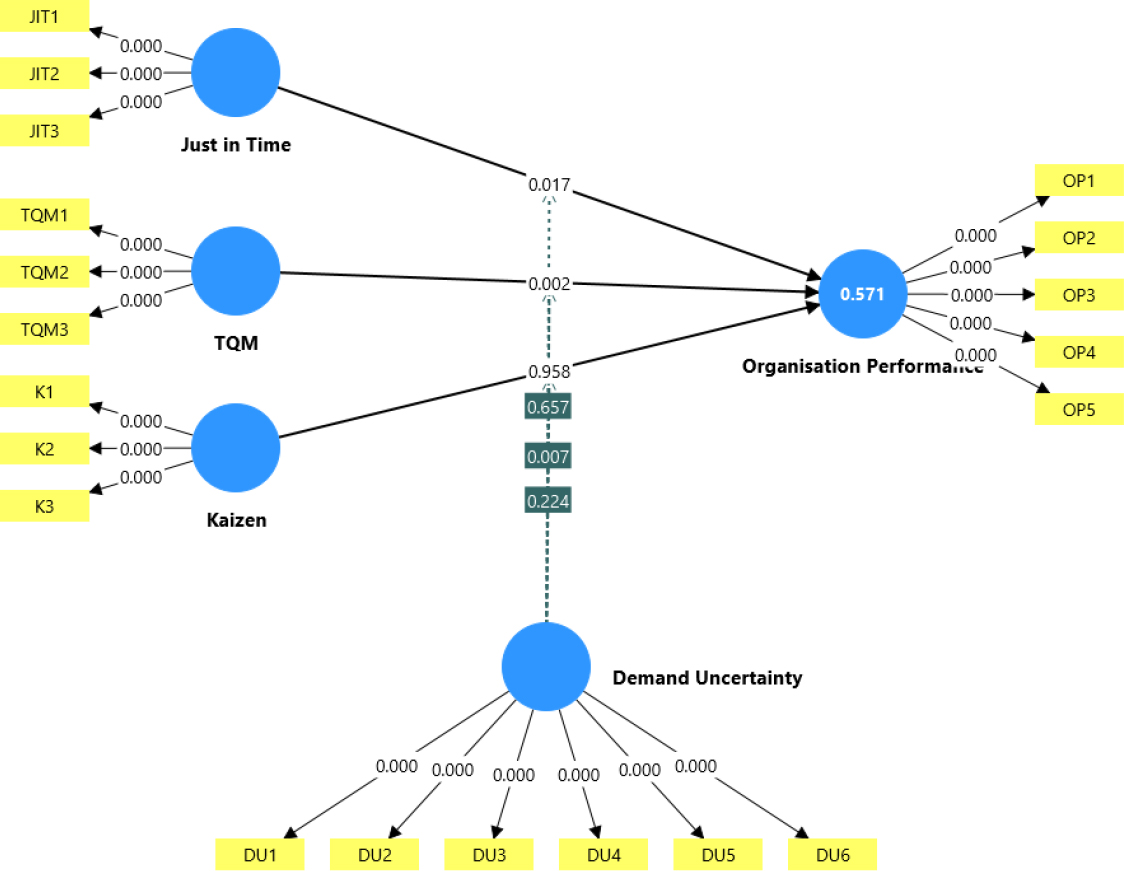
Fig. (2). Initial measurement model.
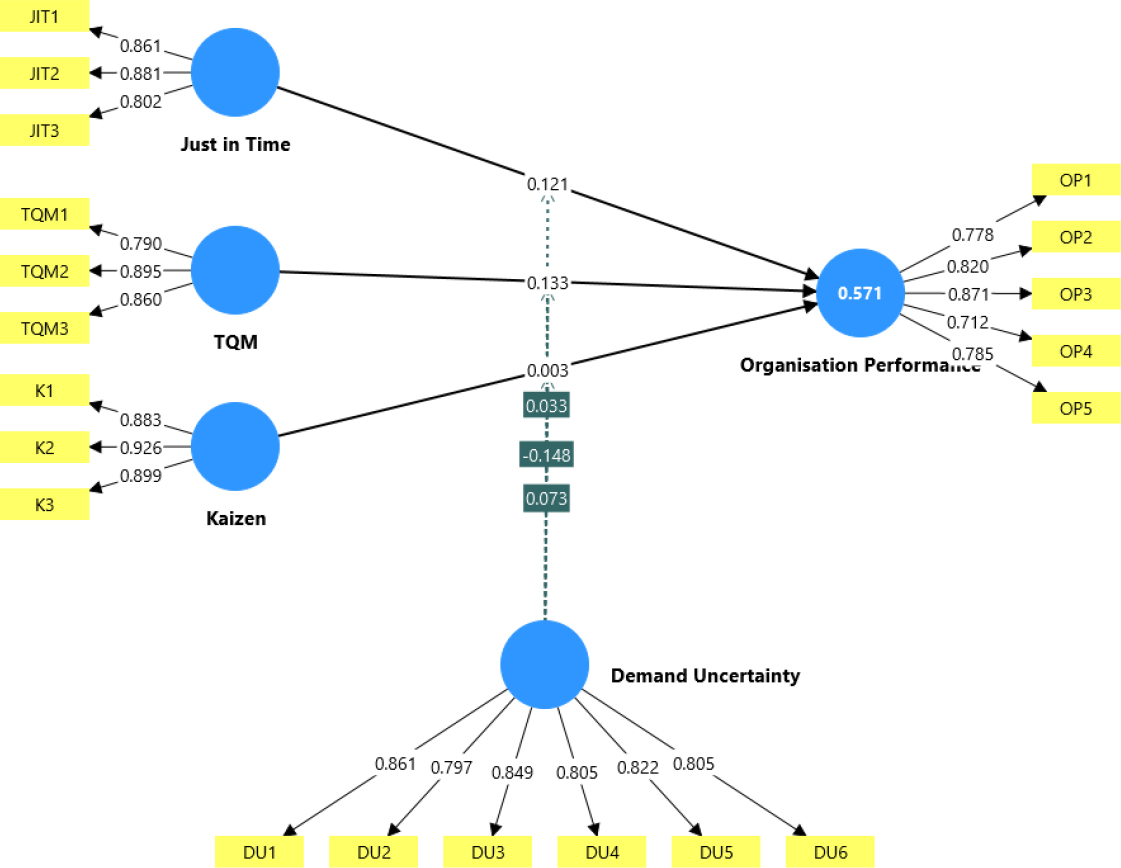
Fig. (3). Final measurement model.
4.5. MICOM
Before running MGA, the measurement invariance should be developed to confirm which kind of MGA can be conducted. The MICOM steps are configural invariance, compositional invariance assessment, as well as equal means and variances (Sarstedt et al., 2011). When just the initial and second tests had been passed, partial measurement variance had been ensured. Thus, the study can only compare the results between the groups. When all three steps were fulfilled, the overall measurement variance was developed, and the study was compared between groups and for http://Table005the entire group.
Table 5 is of MICOM results, which specify that for the mentioned five constructs, the original composite correlations among the groups are quite high, i.e., 0.999 to 1.000, whereas all the corresponding permutation p-values have exceeded the conventional 0.05 threshold that ranges from 0.314 to 0.918. In accordance with it, compositional invariance was attained across groups; thus, the measurement models tend to operate similarly in the sub-samples. As this level of invariance is attained, the consequent multi‐group comparisons of the structural path coefficients (MGA) are valid as per the assumption of the partial measurement invariance, and therefore differences in the structural relationships can be found meaningful and not just artefacts of the measurement differences.
Table 5. MICOM.
| – | C-Value=1 | 5.0% | Permutation p-value | Partial MeasurementInvariance | Difference Composite Mean Value (=0) | Confidence Interval | Permutation p-value | Full Measurement Invariance |
| Demand Uncertainty | 1.000 | 0.999 | 0.314 | YES | -0.204 | [-0.204; 0.189] | 0.910 | YES |
| Just in Time | 1.000 | 0.996 | 0.918 | YES | -0.205 | [-0.205; 0.194] | 0.836 | YES |
| Kaizen | 1.000 | 0.997 | 0.807 | YES | -0.193 | [-0.193; 0.201] | 0.154 | YES |
| Organisation Performance | 1.000 | 0.998 | 0.557 | YES | -0.200 | [-0.200; 0.202] | 0.973 | YES |
| TQM | 0.999 | 0.994 | 0.531 | YES | -0.196 | [-0.196; 0.191] | 0.423 | YES |
4.6. Multi-Group Analysis
Depending upon the hypothesis testing, the results showed no difference in the findings regarding established and young firms. However, the results for Multigroup Analysis (MGA) represented a different view. PLS-MA was done to explore differences in terms of the path coefficients between the established and young firm groups (Table 6).
Table 6. MGA.
| Hypothesis | Relationship | Original (Established Firms) | Original (Young Firms) | Original Difference | Permutation Mean Difference | Permutation p-value | Decision |
| H3a | Just in Time -> Organisation Performance | 0.122 | 0.157 | -0.035 | 0.001 | 0.731 | Insignificant |
| Kaizen -> Organisation Performance | 0.073 | -0.113 | 0.186 | -0.008 | 0.134 | ||
| TQM -> Organisation Performance | 0.116 | 0.143 | -0.027 | -0.003 | 0.766 | ||
| H3b | Demand Uncertainty x Just in Time -> Organisation Performance | -0.068 | 0.159 | -0.227 | 0.001 | 0.139 | Insignificant |
| Demand Uncertainty x Kaizen -> Organisation Performance | 0.128 | -0.012 | 0.140 | -0.009 | 0.257 | ||
| Demand Uncertainty x TQM -> Organisation Performance | -0.149 | -0.133 | -0.016 | 0.007 | 0.908 |
For all the paths under H3a and H3b, permutation p-values are higher than 0.05; thus, none of the differences among the two firm age groups, i.e., established vs young, are statistically significant. Though some values in “Original Difference” may seem moderate, like 0.186 for Kaizen in H3a, statistical significance is dependent upon the permutation test result, not only the magnitude. As the p-values are found < 0.05 (or > 0.95 for two-sided MGA test), such results prove no significant group difference, which means that the impact of lean practices (or its moderation through the demand uncertainty) does not vary significantly between the younger and established firms in this sample.
5. DISCUSSION
The findings of the study are aligned with the existing literature, indicating that lean practices (JIT, TQM & Kaizen) are positively associated with operational performance in the Malaysian automotive context. (H1). For example, (Salleh et al., 2017) paid heed to the importance of the lean principles like decreasing lead times, decreasing operational costs, and enhancing product quality to improve productivity. Similarly, (Rahim et al., 2025) focused on the significant and effective relationship between lean principles and productivity. The results of this research, representing a positive relationship between lean practices and operational performance for JIT and TQM, verify these findings.
Contrary to expectations, H2, i.e., the positive effect of lean practices, would weaken under conditions of high demand uncertainty, and was partially supported. Only the path of demand uncertainty with TQM proved a significant moderating impact (negative coefficient), but the moderations regarding JIT and Kaizen were non-significant. This differs from the broader literature, inferring that demand volatility can affect the efficiency of lean practices. For instance, (Iranmanesh et al., 2019) discussed that in high uncertainty environments, lean practices such as Just-In-Time inventory might pose risks that affect delivery, including flexibility. As the finding tends to support the notion that an uncertain demand can erode the advantages of TQM, the poor significant moderation regarding JIT and Kaizen might stem from the context of Malaysian automotive firms, which have already used lean systems for buffering specific uncertainties.
The multigroup analysis of this study proved that there is no statistically significant difference between the established and younger firms in the effect of lean practices on the operational performance or in the moderation through demand uncertainty. However, (Rose et al., 2022) suggested that younger firms even bring agility with fewer legacy systems, which enables quick adoption of the new manufacturing methods, which might contribute towards the significant impacts observed. In contrast to it, established firms take advantage of the established supply chain networks, including deep process knowledge, that can increase the overall effectiveness of lean practices. The findings specify that in the sample, firm age did not develop meaningful divergence in the link between lean performance. It infers the relative homogeneity between younger as well as established Malaysian automotive firms regarding how lean practices tend to operate under different environmental conditions.
Considering a theoretical standpoint, such results support Contingency Theory as the effectiveness of management practices, such as lean, is dependent upon the external and internal fit. The finding that the effect of TQM is moderated by the demand uncertainty implies that some lean practices might be more sensitive to the context. Similarly, the results also support the Resource-Based View (RBV), as the effectiveness of lean practices seems shaped through the firm-specific resources, including capabilities like experience or systems, instead of only by the firm’s age.
CONCLUSION
This study assesses the impact of lean practices, specifically Just-in-Time (JIT), Kaizen, and Total Quality Management (TQM), on operational performance in the Malaysian automotive industry, while also investigating the moderating effect of demand uncertainty. The findings demonstrate that lean practices have a significant influence on operational performance in both established and young Malaysian firms, particularly in relation to JIT and TQM, which have a notable impact. However, demand uncertainty does not moderate this relationship significantly, inferring that the lean practices tend to maintain their effectiveness irrespective of demand variability. The finding based on MGA implies that firm age might not meaningfully explain how lean practices work in the Malaysian context.
LIMITATIONS
This may have happened due to methodological limitations of the study, such as a cross-sectional design, as well as reliance on self-reported data. Thus, future research must explore the longitudinal effects of supplier networks and discover the other moderators, such as technological readiness.
RECOMMENDATIONS
Referring to the key findings, it is suggested that the policy makers and government agencies provide incentives and support for the automotive firms to adopt the lean practices, identifying their potential to improve the operational performance along with the competitiveness. They have to develop and encourage the industry-wide standards regarding lean practices to ensure consistency and effectiveness across the industry. Policies must be promoted to invest in the research initiatives that explore the incorporation of lean practices with new technologies, like Industry 4.0, for fostering innovation and constant improvement.
For management, they ought to implement different training programs for the employees at every level to ensure a profound understanding of the lean principles and their usage in the daily operations. The mechanisms must be established for daily assessment of the effectiveness of lean practices and making needed adjustments for maintaining optimal performance. The management must recognise the different challenges that are faced by the young firms and propose lean strategies, adaptable to their particular needs, including resource constraints.
Moreover, for academicians, there is a need to critically conduct more studies to explore the significant moderating effects of the demand uncertainty over lean practices in various contexts and industries. Moreover, longitudinal research can be implemented for assessing the long-term effect of lean practices on the operational performance, including sustainability. Lastly, research can be expanded to include comparisons between the automotive industry and other sectors for identifying the universal principles, including sector-based nuances in the lean implementation.
LIST OF ABBREVIATIONS
| JIT | = | Just-in-Time |
| Kaizen | = | Continuous Improvement |
| MGA | = | Multi-Group Analysis |
| RBV | = | Resource-Based View |
| SEM | = | Structural Equation Modelling |
| TQM | = | Total Quality Management |
AUTHOR’S CONTRIBUTION
T.K.E. has contributed to conceptualization, idea generation, problem statement, methodology, results analysis, results interpretation.
ETHICAL STATEMENT & INFORMED CONSENT
Ethical approval was not required for this study as it involved a voluntary, anonymous survey of participants, did not involve any intervention, and did not collect personally identifiable or sensitive personal information, in accordance with the applicable guidelines. Informed consent was obtained from all participants prior to participation.
AVAILABILITY OF DATA AND MATERIALS
The data will be made available on reasonable request by contacting the corresponding author [T.K.E.].
FUNDING
None.
CONFLICT OF INTEREST
The author declares no conflicts of interest, financial or otherwise.
ACKNOWLEDGEMENTS
Declared none.
DECLARATION OF AI
During the preparation of this manuscript, the author used ChatGPT for language polishing. After utilizing this tool, the author carefully reviewed and refined the content as necessary and accept full responsibility for the accuracy and integrity of the published work.
APPENDIX A
Appendix: Questionnaire
Demographic
- Age
- 18-25
- 26-35
- 36-45
- Education
- Bachelor’s degree
- Master’s degree
- PhD
- Gender
- Male
- Female
- Working experience
- 2 years
- 5 years
- 7 years
- 10 years
- 15 years
- Position
- Line engineer
- Automotive engineer
- Manager
- Firm age
- < 5 years
- 5‑10 years
- 11‑20 years
- Above 20 years
| S. No. | Question | Strongly disagree | Disagree | Neutral | Agree | Strongly agree |
| Lean Practices (IV) | ||||||
| Just‑in‑Time (JIT) | ||||||
| 1 | JIT implementation reduces inventory needs and space requirements in Malaysia | |||||
| 2 | JIT improves material flow efficiency in the automotive industry of Malaysia. | |||||
| 3 | In automotive firms, JIT leads to lower inventory levels and less waste because of overproduction. | |||||
| Total Quality Management (TQM) | ||||||
| 4 | In automotive firms, TQM is helpful in reducing defect rates, overall returns, rework, and consistency of the product quality. | |||||
| 5 | Automotive companies use TQM practices to be competitive in the market. | |||||
| 6 | Integration of TQM with lean and other management systems helps in achieving improved outcomes. | |||||
| Kaizen | ||||||
| 7 | In the Malaysian automotive industry, Kaizen has increasingly been adopted by OEMs as well as component suppliers. | |||||
| 8 | Kaizen ensures productivity and a reduction in costs. | |||||
| 9 | The automotive industry succeeds in getting reductions in lead times and delivery delays due to kaizen. | |||||
| Demand Uncertainty (Moderating Variable) | ||||||
| 10 | In the automotive industry, volume fluctuations can take place, which can either increase or decrease vehicle orders or parts demand. | |||||
| 11 | Lean practices such as cellular manufacturing and reductions in setup time can be more challenging if the product mix changes occur frequently. | |||||
| 12 | When forecasts are quite reliable, lean practices create better results. | |||||
| 13 | Demand uncertainty can also be about frequent order changes that result in the reworking of the manufacturing schedules. | |||||
| 14 | Forecast errors are very common in the automotive industry and demand instant change in lean practices. | |||||
| 15 | Over the past two years, my automotive company’s demand has been highly volatile. | |||||
| Operational Performance (DV) | ||||||
| 16 | Cost efficiency is ensured in the industry if JIT is applied, which leads to operational effectiveness. | |||||
| 17 | The automotive industry reduces waste and improves equipment utilization, which improves operational performance. | |||||
| 18 | In automotive manufacturing, shorter cycle times have a greater contribution to higher output and better resource usage. | |||||
| 19 | In the automotive industry, quality is highly critical as defects can lead to recalls. | |||||
| 20 | Reputational damage and inefficiencies in the industry further affect the supply chain performance. | |||||
REFERENCES
Achaka, C. H., Amade, B., Okorochac, K., & Ubani, E. C. (2024). An evaluation of the extent of adoption of lean in offshore facility maintenance projects in the oil and gas industry. PM World Journal, 13(9). Available from: http://pmworldjournal.com/article/an-evaluation-of-the-extent-of-adoption-of-lean
Alaya, L. (2026). A holistic framework for successfully implementing a plant-wide lean pull system: Evidence from an automotive supplier in Tunisia. International Journal of Lean Six Sigma. 17(2), 438-468.
https://doi.org/10.1108/IJLSS-03-2024-0060
Belekoukias, I., Garza-Reyes, J. A., & Kumar, V. (2014). The impact of lean methods and tools on the operational performance of manufacturing organisations. International Journal of Production Research, 52(18), 5346–5366.
https://doi.org/10.1080/00207543.2014.903348
Buer, S.-V., Strandhagen, J. O., & Chan, F. T. S. (2018). The link between Industry 4.0 and lean manufacturing: Mapping current research and establishing a research agenda. International Journal of Production Research, 56(8), 2924–2940.
https://doi.org/10.1080/00207543.2018.1442945
Chandra, N., Kumar Sharma, S., & Singh, R. K. (2026). Exploring the influence of age on the intellectual capital: a moderating role of firm performance. International Journal of Productivity and Performance Management, 75(3), 809-827.
https://doi.org/10.1108/IJPPM-08-2024-0526
De Martini, F. (2021). Supply chains and disruptive events: An inventory management system perspective (Master’s thesis). Università Ca’ Foscari Venezia, p.138. Available from: https://hdl.handle.net/20.500.14247/8078
Franke, G., & Sarstedt, M. (2019). Heuristics versus statistics in discriminant validity testing: A comparison of four procedures. Internet Research, 29(3), 430-447.
https://doi.org/10.1108/IntR-12-2017-0515
Garcia-Buendia, N., Moyano-Fuentes, J., Maqueira, J. M., & Avella, L. (2023). The lean supply chain management response to technology uncertainty: consequences for operational performance and competitiveness. Journal of Manufacturing Technology Management, 34(1), 67-86.
https://doi.org/10.1108/JMTM-07-2022-0250
Gunasekaran, A., Papadopoulos, T., Dubey, R., Wamba, S. F., Childe, S. J., Hazen, B., & Akter, S. (2017). Big data and predictive analytics for supply chain and organizational performance. Journal of Business Research, 70, 308–317.
https://doi.org/10.1016/j.jbusres.2016.08.004
Guzman, L. (2024). Lean Six Sigma approach to improve further processing efficiency using burger manufacturing as a model process (Master’s thesis). Auburn University. Available from: https://etd.auburn.edu//handle/10415/9203
Hair, J. F., Babin, B. J., Ringle, C. M., Sarstedt, M., & Becker, J. M. (2025). Covariance-based structural equation modelling (CB-SEM): A SmartPLS 4 software tutorial. Journal of Marketing Analytics, 13, 709-724.
https://doi.org/10.1057/s41270-025-00414-6
Hair, J. F., Risher, J. J., Sarstedt, M., & Ringle, C. M. (2019). When to use and how to report the results of PLS-SEM. European Business Review, 31(1), 2–24.
https://doi.org/10.1108/EBR-11-2018-0203
Hair, J., Hollingsworth, C. L., Randolph, A. B., & Chong, A. Y. L. (2017). An updated and expanded assessment of PLS-SEM in information systems research. Industrial Management & Data Systems, 117(3), 442–458.
https://doi.org/10.1108/IMDS-04-2016-0130
Henseler, J., Ringle, C. M., & Sarstedt, M. (2016). Testing measurement invariance of composites using partial least squares. International Marketing Review, 33(3), 405–431.
https://doi.org/10.1108/IMR-09-2014-0304
Hibadullah, S. N., Fuzi, N. M., Desa, A. F. N. C., Zamri, F. I. M., & Habidin, N. F. (2013). Lean manufacturing practices and environmental performance in the Malaysian automotive industry. Asian Journal of Finance & Accounting, 5(1), 462.
https://doi.org/10.5296/ajfa.v5i1.2864
Iranmanesh, M., Zailani, S., Hyun, S. S., Ali, M. H., & Kim, K. (2019). Impact of lean manufacturing practices on firms’ sustainable performance: Lean culture as a moderator. Sustainability, 11(4), 1112.
https://doi.org/10.3390/su11041112
Iteng, R., & Ahmad, M. A. (2017). The impact of technically-oriented lean production practices on operational performances in Malaysian manufacturing industries. Journal of Technology and Operations Management, 12(1), 56–66. Available from: https://e-journal.uum.edu.my/index.php/jtom/article/view/jtom2017.12.1.7
Kache, F., & Seuring, S. (2017). Challenges and opportunities of digital information at the intersection of Big Data Analytics and supply chain management. International Journal of Operations & Production Management, 37(1), 10–36.
https://doi.org/10.1108/IJOPM-02-2015-0078
Khairani, N. S., Kasim, E. S., Rajamanoharan, I. D., & Misman, F. N. (2017). Critical success factors of green supply chain management: Case evidence of a Malaysian automotive manufacturer. Asia-Pacific Management Accounting Journal (APMAJ), 12(2), 1–23. Available from: https://ir.uitm.edu.my/id/eprint/29717
Lee, K. L., & Xing, Q. T. (2021). The effect of lean and agile practices on supply chain operational performance in the Malaysian manufacturing industry. International Journal of Industrial Management, 12(1), 319–340.
https://doi.org/10.15282/ijim.12.1.2021.6639
Makwana, D., Engineer, P., Dabhi, A., & Chudasama, H. (2023). Sampling methods in research: A review. International Journal of Trend in Scientific Research and Development, 7(3), 762–768. Available from: https://www.ijtsrd.com/papers/ijtsrd57470.pdf
Marodin, G. A., Frank, A. G., Tortorella, G. L., & Fetterman, D. C. (2019). Lean production and operational performance in the Brazilian automotive supply chain. Total Quality Management & Business Excellence, 30(3–4), 370–385.
https://doi.org/10.1080/14783363.2017.1308221
Mohammed, I. A., & Mandal, J. (2024). The impact of lead time variability on supply chain management. International Journal of Supply Chain Management, 9(6), 25–39.
https://doi.org/10.47604/ijscm.3075
Naeem, M., Ahmad, N., Hussain, S., Nafees, B., & Hamid, A. (2021). Impact of lean manufacturing on the operational performance: Evidence from the textile industry. Humanities & Social Sciences Reviews, 9(3), 951–961.
https://doi.org/10.18510/hssr.2021.9393
Noordin, M. A., & Mohtar, S. (2014). Age: Does it matter for firms to perform? International Journal of Academic Research in Business and Social Sciences, 4(3), 252–260. http://dx.doi.org/10.6007/IJARBSS/v4-i3/704
Patel, S., & Patyrykin, K. (2025). Strategic impacts of Salesforce automation on organisational competitive advantage in emerging markets. Journal of Posthumanism, 5(12), 357–372.
https://doi.org/10.63332/joph.v5i12.3782
Phadnis, S., Sheffi, Y., & Caplice, C. (2022). Strategic planning for dynamic supply chains. Palgrave Macmillan.
https://doi.org/10.1007/978-3-030-91810-1
PR NewsWire. (2024). Malaysia auto industry shifts gears: 73% of workforce gears up for automation & skills challenges: Ken Research. PR Newswire. Available from: https://www.epicos.com/article/811547/malaysia-auto-industry-shifts-gears-73-workforce-gears-automation-skills-challenges
Qin, Z., & Chen, P. K. (2022). Enhancing the resilience of sustainable supplier management through the combination of win–win lean practices and auditing mechanisms—An analysis from the resource-based view. Frontiers in Environmental Science, 10, 962008.
https://doi.org/10.3389/fenvs.2022.962008
Rahim, M. H. A., Khan, M. R. B., Lean, C. P., & Purnshatman, T. (2025). Investigating the effectiveness of lean manufacturing principles in improving productivity for a Malaysian automotive company. Malaysian Journal of Business, Economics and Management, 4(1), 85–92.
https://doi.org/10.56532/mjbem.v4i1.48
Rahimi, A., & Alemtabriz, A. (2022). Providing a model of LeAgile hybrid paradigm practices and its impact on supply chain performance. International Journal of Lean Six Sigma, 13(6), 1308–1345.
https://doi.org/10.1108/IJLSS-04-2021-0073
Rose, A. N. Md., Deros, B. M., & Ab Rahman, M. N. (2013). A Study on Lean Manufacturing Implementation in the Malaysian Automotive Component Industry. International Journal of Automotive and Mechanical Engineering, 8, 1467-1476.
https://doi.org/10.15282/ijame.8.2013.33.0121
Sahwan, M. A., Ab Rahman, Md. N., & Deros, B. M. (2012). Barriers to implementing lean manufacturing in the Malaysian automotive industry. Jurnal Teknologi (Sciences & Engineering), 59(2).
https://doi.org/10.11113/jt.v59.2571
Sahwan, M. A., Rahman, M. N. A., & Deros, B. M. (2013). Case studies on the implementation of lean manufacturing in automotive Malaysian companies. Applied Mechanics and Materials, 465-466, 1180–1184.
https://doi.org/10.4028/www.scientific.net/amm.465-466.1180
Salleh, N. A. M., Kasolang, S., Jaffar, A., & Halim, N. H. A. (2015). Lean TQM leadership management practices in automotive Malaysian companies. Jurnal Teknologi (Sciences & Engineering), 76(6), 1-6.
https://doi.org/10.11113/jt.v76.5663
Salleh Hudin, N., Abdul Hamid, A. B., Chin, T. A., & Habidin, N. F. (2017). Exploring supply chain risks among Malaysian automotive SMEs. International E-Journal of Advances in Social Sciences, 3(8), 666-674.
https://doi.org/10.18769/ijasos.337330
Sarstedt, M., Henseler, J., & Ringle, C. M. (2011). Multigroup analysis in partial least squares (PLS) path modeling: Alternative methods and empirical results. Advances in International Marketing, 22, 195–218.
https://doi.org/10.1108/S1474-7979(2011)0000022012
Sichinsambwe, C., Simasiku, P. L., Sikombe, S., & Nyimbili, H. (2023). Kaizen practices and performance improvement in Zambian manufacturing companies. Cogent Engineering, 10(1), 2183590.
https://doi.org/10.1080/23311916.2023.2183590
Sin, M. S., Anbarasen, S., Yew, T. S., & Yuan, W.Z. (2024). Effect of economic factors on the automotive industry in Malaysia. Journal of Sustainability Science and Management, 19(2), 108–123.
https://doi.org/10.46754/jssm.2024.02.006
Tao, J., Aamir, M., Shoaib, M., Yasir, N., & Babar, M. (2025). Bridging the gap between supply chain risk and organizational performance conditioning to demand uncertainty. Sustainability, 17(6), 2462.
https://doi.org/10.3390/su17062462
Thunyachairat, A., Jangkrajarng, V., Theeranuphattana, A., & Ramingwong, S. (2023). Lean practices, perceived environmental uncertainty, and business performance: a quantitative study of SMEs in Thailand. International Journal of Professional Business Review, 8(5), 1-16.
https://doi.org/10.26668/businessreview/2023.v8i5.2137
Tortorella, G. L., Fogliatto, F. S., Galeazzo, A., Furlan, A., & Nascimento, D. (2025). Lean production-based organizational resilience and operational performance of manufacturers during disruptive events. IEEE Transactions on Engineering Management, 72, 800-814.
https://doi.org/10.1108/JMTM-07-2022-0250
Wahab, S. N., Othman, N., Hossain Uzir, M. U., & Yanamandra, R. (2024). Revolutionizing operational excellence: Advancing the automotive industry through lean principles. Environment-Behaviour Proceedings Journal, 9(27), 273–279.
https://doi.org/10.21834/e-bpj.v9i27.5568
Wamba, S. F., Gunasekaran, A., Akter, S., Ren, S. J.-F., Dubey, R., & Childe, S. J. (2017). Big data analytics and firm performance: Effects of dynamic capabilities. Journal of Business Research, 70, 356–365.
https://doi.org/10.1016/j.jbusres.2016.08.009