

- ABSTRACT
- 1. INTRODUCTION
- 2. LITERATURE REVIEW
- 3. METHODOLOGY
- 4. RESULTS
- 5. DISCUSSION
- CONCLUSION
- LIMITATIONS AND FUTURE DIRECTIONS
- POLICY IMPLICATIONS
- LIST OF ABBREVIATIONS
- AUTHOR'S CONTRIBUTION
- ETHICAL STATEMENT & INFORMED CONSENT
- AVAILABILITY OF DATA AND MATERIALS
- FUNDING
- CONFLICT OF INTEREST
- ACKNOWLEDGEMENTS
- DECLARATION OF AI
- APPENDIX A
- REFERENCES
Impact of Job Autonomy on Employee Creativity in the Tech Industry: Moderating Effect of Leadership Support: Evidence from the Philippines
 DOI:
DOI:
 PDF
PDF
⬇ Downloads: 7
1Jubail Industrial College, Jubail, Saudi Arabia
Received: 08 February, 2026
Accepted: 13 June, 2026
Revised: 20 March, 2026
Published: 03 July, 2026
ABSTRACT
Introduction: This study sought to evaluate how job autonomy affects employee creativity within the Philippine technology sector and to examine leadership support as a direct predictor and a moderator of this relationship.
Methodology: The study used a quantitative research design, collecting primary data through a survey questionnaire. A sample of 300 full-time employees in technology-related organisations in the Philippines was used to collect the data. Measurement scales were used, and responses were recorded on a five-point Likert scale. SPSS was used to analyse the data using hierarchical multiple regression.
Results: The study findings show that Job Autonomy is positively and statistically significantly related to the level of Employee Creativity (β = 0.783, p < 0.001). The results also illustrate that Leadership Support is significantly and positively related to employee creativity (β = 0.540, p < 0.001). Importantly, the interaction term shows a statistically significant role in the predictive association between job autonomy and employee creativity (β = 0.060, p = 0.030) and confirms the hypothesis that leadership support moderates the relationship between job autonomy and employee creativity by enhancing the positive relationship with autonomy under stronger levels of leadership support.
Conclusion: The results suggest that organisations attempting to improve creativity should combine job designs that enhance autonomy with leadership practices that offer encouragement, feedback, and recognition. Increase supportive leadership behaviours combined with job autonomy may help innovation capability in technology-driven workplaces. These results can be used by managers and policymakers in a bid to enhance innovation ability among technology-driven organisations.
Keywords: Job autonomy, leadership support, employee creativity, hierarchical regression, tech industry, moderating effect.
1. INTRODUCTION
The technology sector has turned out to be a pillar of economic development through digitalisation in most emerging economies, such as the Philippines (Zhang et al., 2022). With the growing need to be in a dynamic and innovation-oriented environment of operation, employee creativity has become a key determinant of organisational competitiveness and long-term sustainability. Creative employees can be used to come up with new ideas, enhance practices, and come up with solutions that help organisations be responsive to the rapid changes in the market and technology (Aithal, 2023). According to (Ye et al., 2025), although creativity is a strategically significant aspect, several technology companies are still grappling with the inability to create organisational environments that competently produce creative performance amongst employees. Job autonomy is one of the most effective organisational aspects that can be linked to employee innovation. Job autonomy can be defined as the freedom, independence, and discretion that employees have with regard to scheduling work and also in the methods employed to carry out the job (Khoshnaw & Alavi, 2020). Autonomy can be especially relevant in technology-intensive jobs where a worker can face complicated issues and constantly be under the pressure of change. Empirical evidence, however, indicates that job autonomy may not necessarily be enough to ensure a steady flow of creative results (Shen & Zhang, 2024). According to previous researchers, the degree of autonomy success is extremely dependent on situational and social variables in the workplace (Alam et al., 2024). Among these factors, one more factor is leadership support, which has been getting increasing attention in the field of organisational behaviour. Leadership support indicates how employees perceive that their employers appreciate their input, are concerned about their well-being, and offer guidance and encouragement to them where required (Adams et al., 2020). Supportive leaders can open up an enabling environment where employees are motivated to develop new ideas and take risks creatively. In theory, leadership support can act as a moderating factor that determines the level of the relationship between job autonomy and employee creativity. In particular, high leadership support could enhance the degree to which autonomy has a positive relationship with creative behaviour. On the other hand, the absence of high levels of supervisory support in an environment can lead to ambiguity, stress, or disengagement in autonomy, which compromises the positive predictive relationship of autonomy with employee creativity (Kivrak et al., 2025). The job autonomy and the creativity and leadership support- creativity relationships have extensive empirical support, but most have been focused on the Western or developed economy context, and less research has focused on whether the relationships can be replicated in emerging economy technology-focused settings like those in the Philippines. The organisation structures, leadership behaviours, and resource state in emerging economies vary in such a way that affects job and social resource practises. Specifically, the employees in the technology sector in the environment of emerging economies tend to have various managerial expectations and work restrictions, so that replication in context is required to determine whether the relations developed are consistent. The high growth rate of the technology industry in the Philippines, especially through software development, digital services, and technology-based businesses, has increased the challenge of attracting skilled and innovative employees.
Employee creativity is a major advancement that has attracted a lot of research in the literature of organisational behaviour and human resource management because of its significant contribution to innovation and organisational performance. However, previous literature by (Kivrak et al., 2025) identifies job autonomy and leadership support as significant antecedents of creativity. Most research has treated these variables as independent predictors but has not investigated their interaction in predicting creative outcomes. Accordingly, although moderation models are well known in the wider literature, fewer studies are available regarding leadership support as a boundary condition to strengthen the autonomy-creativity relationship, especially in the context of the emerging economy technology sector. Besides, previous research on employee creativity has mainly been carried out in Western and developed economies that are often typified by comparatively small power distance and individualistic cultural orientations (Wen et al., 2023). Therefore, there is still a dearth of empirical studies that are based on emerging economies, including the Philippines. The analysis of the inter-variable dependencies between job autonomy, leadership support, and employee creativity in this context can be considered an addition to the strengthening of the external validity of the existing results to evaluate how well the perspectives apply to various organisational settings. Based on this, the current research places the technology-sector employees as its main focus and identifies a predictive relationship between job autonomy and employee creativity, as emporia evidence in a non-Western context, that is Philippines.
The literature on the field of organisational behaviour has widely studied the work design and leadership that is involved in creativity; nevertheless, little replication is present that is contextual and sector-specific in the settings of Southeast Asia and specifically, the Philippines. Further, technology-sector employees have not been well represented in empirical studies in emerging economies to support their growing economic and innovation importance. The research is innovative in that it applies some of the established autonomy-creativity and leadership models to the employees of the technology sector in the Philippines to enhance the external validity and provide sector-specific data on the direct and moderating types of relationships that define the creativity of the employees.
Accordingly, this study fills these gaps by investigating the relationship between job autonomy and leadership support as antecedents of employee creativity in the technology industry surveyed in the Philippines and testing leadership support as a boundary condition influencing the relationship between job autonomy and creativity. Drawing on Job Characteristics Theory and Social Exchange Theory, the data analysis mainly provides replication evidence for relationships well established in the literature and provides additional boundary condition evidence through moderation testing to extend the external validity of both theoretical frameworks in an emerging economy technology sector, underrepresented context.
Consequently, the current research examines the relationship between job autonomy and employee creativity and explores the moderating role of leadership support in the technology-sector employees surveyed in the Philippines in this study. This study, based on a hierarchical multiple regression model, could be seen as a contextual replication of earlier research and an extension study that assesses established autonomy, creativity and leadership support relationships and conditions leadership support as a boundary condition. This study, therefore, is contribution-based in that it introduces sector-based replication support related to job autonomy and leadership support as predictors of employee creativity within the framework of an emerging economy technology-sector studies, and leadership support as a boundary condition to shape the autonomy-creativity relation. In practice, the findings will be valuable to managers and leaders who want to direct the design of jobs and leadership practice so as to induce employee creativity in the technology-driven organisation. This research hence adds value by providing industry-specific regeneration of the autonomy-creativity and leadership-creativity associations in the technological sector of the emerging economy, which fits an underrepresented context. It similarly determines that leadership support is a boundary condition that reinforced the association of autonomy-creativity, which explains under what cases job resources could be converted into employee creativity. The findings also present viable recommendations on ways that managers and leaders are required to design jobs and apply supportive leadership behaviours to develop creativity, innovation, and proactive problem-solving of employees in technology-based companies in a systematic manner.
2. LITERATURE REVIEW
2.1. Job Autonomy, Employee Creativity, and Leadership Support
According to (Polat & Ozdemir, 2021), job autonomy refers to the level at which a job provides employees with discretion and independence in planning, executing and scheduling work activities. Whereas the adoption of autonomy is usually associated with positive effects, (Pagdonsolan et al., 2020) warn that the benefits of autonomy are conditional, but not universal, unless autonomy is coupled with a supportive structure or clarity. Hence, high autonomy can result in role ambiguity and stress that diminish its effectiveness, as suggested by (Ye et al., 2025) as well. (Siyal, 2023), on the other hand, explains employee creativity as the creation of new and useful ideas within a workplace. Creativity is not a routine performance; it involves cognitive flexibility and the risk-taking that transcends the set tasks, and thus, it is discretionary and sensitive to individual and environmental conditions, as (Ohemeng et al., 2020) propose as well. (Kivrak et al., 2025) define leadership support as those behaviours on the part of supervisors aimed at guiding, providing resources, recognition, and encouraging their subordinates. Hence, it can be said that leadership support is not to be confused with general positivity, but instead, depends on its ability to offset non-routine work-related uncertainties, as well as to allow employees to take advantage of job resources such as autonomy. Together, these variables describe unique but interacting job and relational conditions which influence creative performance in organisations.
2.2. Theoretical Framework
This current work is based on the Job Characteristics Theory (JCT) and Social Exchange Theory (SET) to infer the interactions between job autonomy, leadership support, and creativity in employees. According to (Polat & Ozdemir, 2021), the Job Characteristics Theory was presented by Hackman and Oldham in 1975 and argues that certain components of job design, especially autonomy, amplify such critical psychological conditions as perceived responsibility and intrinsic motivation to work, which then result in positive effects of work, including creativity. In the given framework, job autonomy helps the employees to have discretion and control over the working processes and, therefore, it leads to experimentation, solution of problems, and creative behaviour. In line with JCT, another theoretical concept that can offer a conceptual framework for the role played by leadership support is Social Exchange Theory. According to SET, employees are prone to reciprocal relationships with their supervisors on the basis of perceived support, care, and recognition (Zeb et al., 2023). Employees are more likely to exhibit positive attitudes and discretionary behaviours, including creativity, when leaders provide them with both emotional support and instrumental support. They can thus be empowered to use job autonomy positively with the support of leadership (Ye et al., 2025). Based on these theories, job autonomy is conceptualised as a job design resource that supports creative performance; whereas, leadership support is conceptualised as a relational resource that may strengthen (or weaken) the extent to which autonomy is associated with employee creativity. Accordingly, leadership support is considered a boundary condition rather than a mediating mechanism, and the focus of the study is on the testing of direct and indirect relationships under moderation of leadership role. This complementary set of theories provides a consistent theoretical framework for investigating the direct and interactive relationship of job autonomy and leadership support with employee creativity.
Besides, although the premise of both Job Characteristics Theory and Social Exchange Theory presupposes motivational and psychological processes, namely intrinsic motivation, perception of responsibility, and mutual attitudes, the current study does not explicitly model or test these internal processes. These theories are used as the basis upon which the proposed relationships are justified as opposed to testing causal psychological pathways. Based on this, the current study purposely sets aside such processes as background theory and addresses relationships among study variables that are observable. In particular, the empirical model focuses on the direct relationship between job autonomy and employee creativity and the mediation of leadership support in this association. Instead, leadership support is being considered as a boundary condition, not a mediating variable and no psychological or motivational construct is added to the analysis framework and hypothesis testing.
2.3. Hypotheses Development
2.3.1. Job Autonomy and Employee Creativity
Employee creativity has been widely cited as a key source of innovation, especially within the technology sector, where employees must constantly keep pace with rapid technological change and the complexity of problem-solving requirements. Creativity is a notion that depicts the production of new and productive ideas concerning work processes, products or services (Mwantu et al., 2021). Employee creativity has gained importance in organisational competitiveness and sustainability in the Technology-sector employees surveyed in the Philippines, which has experienced augmented growth in software development, IT services, and digital start-ups (Abell et al., 2021). One of the antecedents of creative behaviour has always been found to be job autonomy, which can be defined as the level of freedom and discretion the employees enjoy when they are arranging their work schedules and determining how the tasks ought to be carried out (Kivrak et al., 2025). Job Characteristics Theory revealed that autonomy increases employees’ sense of responsibility and intrinsic motivation, which are essential psychological requirements for creativity (Cavanagh et al., 2020). Employees who have control over the ways of working and decision-making are more likely to investigate the different options, experiment with innovative ideas, and take up creative problem-solving (Madrid & Patterson, 2020). The Philippine technology sector situation is characterised by a growing digital transformation and increasing demand for innovation-oriented work. Nevertheless, flexibilities and project-based working structures have been embraced more in the technology sector, especially in agile work structures and startup contexts (Koski, 2024).
With these changes, job autonomy has become quite relevant because employees are supposed to take charge of things on their own, come up with new solutions and react swiftly to the emerging requirements of the clients or the projects. Empirical research done within an Asian setting indicates that autonomy has a positive correlation to creative performance, particularly in situations involving a skilful set of knowledge workers who can apply it appropriately. Besides, according to (Pagdonsolan et al., 2020), autonomy at the Philippine workplace can be an indication of trust and empowerment; hence, employees can be encouraged to do more than what their job entails. Job autonomy can lead to job ownership of individuals working in technology firms, where innovative work sometimes relies on initiative. Although the autonomy creativity relationship is well established, testing the robustness of the relationship in emerging economy technology-sector contexts is important to strengthen the external validity. Following the Job Characteristic Theory and previous research findings, it is predicted that increased job autonomy increases the creativity of employees working in the Philippine technology sector. Hence, the hypothesis is as follows, supported by (Pagdonsolan et al., 2020), who find that job autonomy is positively and statistically significantly related to employee creativity.
H1: Job autonomy is positively and statistically significantly related with employee creativity.
2.3.2. Leadership Support and Employee Creativity
Leadership support is a very important organisational resource which it can affect employee attitudes and behaviours in a variety of contexts (Akanji et al., 2020). The concept of leadership support means the fact that the employees feel they are appreciated, their well-being is taken care of, and guidance and help are given when they need them (Winston, 2022). Supportive relationships between leaders and followers can influence motivation and discretionary behaviour of employees by conveying recognition, concern and encouragement, which can be especially important in work environments with demands for uncertainty and risk-taking. The Social Exchange Theory is a handy theory that can be used to comprehend the correlation between leadership support and employee creativity. Under this theory, gratitude by leaders results in expectations by the employees to give back through good behaviours, among which creativity is included (Ohemeng et al., 2020). Being creative also presents some aspect of risk-taking and uncertainty because innovative ideas can weaken the norms. Having leaders who are supportive and encouraging instead of critical and punitive, employees are more inclined to become creative. Employees working in the Philippine technology sector are often faced with new technologies, changing project requirements, and deadlines (Albert et al., 2020).
The various challenges may be resolved with the help of supportive leadership, which ensures that the employees are free to experiment, get constructive feedback, and get praise for their hard work. According to a prior study by (Siyal, 2023), in the Asian organisational context, the leadership assistance improves the level of psychological safety and trust in leaders, which is a crucial factor to promote creative engagement. Prior research suggests that supportive leadership has the potential to produce an enabling interpersonal climate in which employees have a greater willingness to generate and share ideas, in line with SET expectations of reciprocal discretionary behaviour. Accordingly, leadership support is expected to be positively related to employee creativity through encouragement of discretionary effort, exchange of ideas and persistence under uncertainty. Supportive leaders can support innovative behaviour by communicating that innovation is appreciated and encouraged. The provision of this support can directly relate to an increase in the creative deliverables in technology-related organisations.
H2: Leadership support is positively and statistically significantly related with employee creativity.
2.3.3. Moderating Role of Leadership Support
Further, although job autonomy and leadership support have independent relationships with employee creativity, recent studies support the role of studying the interaction of moderator forces (Kivrak et al., 2025). Autonomy gives employees the option to decide on the way of doing the work, and leadership support influences how employees view the options to decide whether it is safe and worth the effort to use this freedom creatively. Autonomy gives you discretion, but you still need support from the leadership that may influence whether employees feel encouraged to use this discretion in creative, risk-taking ways. This is consistent with JCT’s emphasis on job design resources as well as SET’s emphasis on relational reciprocity and support. Under the Job Characteristics theory, autonomy causes intrinsic motivation, but this depends on the contextual messages that can show that one should undertake the use of creativity (Purisima, 2025). Such signals are delivered by leadership support through instilling trust, lessening negative assessment fear, and sanctioning experimentation. In work environments characterised by uncertainty, employing people may be more likely to use autonomy in creative ways as long as the supervisors provide encouragement and mitigate perceptions of interpersonal risk. In that regard, the positive effect of autonomy on creativity could be multiplied by leadership support. Social Exchange Theory also elaborates such a moderating mechanism. Thus, leadership support is expected to moderate the positive relationship between autonomy and creativity by acting as a boundary condition that increases employees’ willingness to express autonomy in the context of creative behaviour.
On the contrary, in low leadership support, the employees are reluctant to make use of their autonomy creatively, as they suffer a lack of approval or direction, thus undermining the autonomy-creativity relationship. This finding is supported by empirical evidence in the organisational research of Asian countries on leadership behaviours as influencing the responsiveness of employees to job design characteristics. Research by (Ye et al., 2025) indicates that autonomy may best bring out creativity with supportive leadership. Testing this moderation relationship in an emerging economy and technology sector context adds to the replication of this moderation relationship in a context of antecedent conditions that offer replicability evidence for established predictions of the theory. This paper, therefore, holds that leadership support enhances the desirable relationship that exists between job autonomy and employee creativity. This results in the hypothesis as follows, which is supported with the arguments of (Ye et al., 2025) as well. Also, grounded on the above arguments emerging from the literature review, the following conceptual framework of the study is depicted in Fig. (1).
H3: Leadership support moderates the relationship between job autonomy and employee creativity.
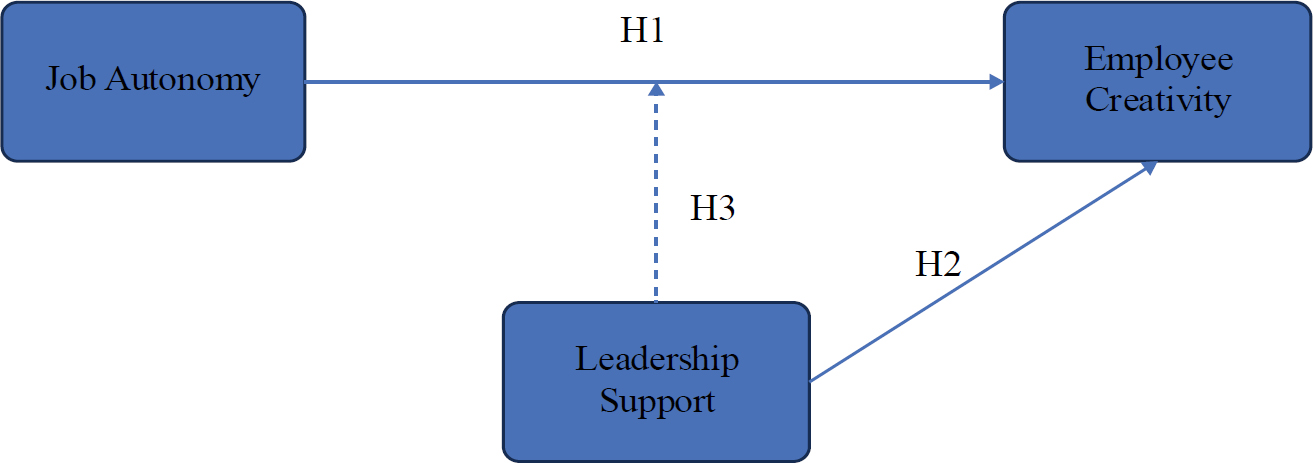
Fig. (1). Conceptual framework.
3. METHODOLOGY
The current research utilised a quantitative and cross-sectional research design to determine the predictive association of job autonomy with employee creativity and the moderating role of leadership support among technology-sector employees surveyed in the Philippines. The data collection for the current study was conducted using a structured survey questionnaire with closed-ended questions aimed at measuring the core research constructs, i.e., job autonomy (Fida & Najam, 2019), leadership support, and employee creativity, as measured by (Khassawneh et al., 2022). The constructs were operationalised using existing multi-item scales and measured on a five-point (Appendix A) Likert scale from 1 (strongly disagree) to 5 (strongly agree), a common practice in behavioural and organisational research, as stated by (Crick et al., 2025). The target population consisted of full-time employees who work in organisations with technology-related jobs in the Philippines, specifically software development organisations, IT service providers, and other technology-based organisations. To increase clarity and reference to the study’s context, the term “technology-sector employees” is used to identify study respondents employed in companies in which software development, digital platforms, IT-enabled services, and other technology-based business activities are the main operational functions. Because the study requires respondents who could meaningfully make an evaluation of job autonomy, supervisory support and creative behaviour, a purposive sampling strategy was used. Purposive sampling can be used when conducting organisational research when the participants are expected to have a certain level of experience at work, relevant to the constructs being measured, and also when a full sampling frame is not available (Ahmad & Wilkins, 2025). The survey has been circulated in professional networks, organisations and online to reach employees working in the sector. Given the use of online and network-based distribution, the study did not use a single identifiable sampling list to create the research, which makes the computation of an exact organisational response rate difficult; therefore, findings should be interpreted as reflecting the surveyed segment of technology sector employees.
In order to determine the needed sample size, an a priori approach using a power-balanced design, which is appropriate for hierarchical regression models with interaction terms, was followed. In accordance with conventional standards, the significance level was set at alpha level = .05, and statistical power was set at .80 (Baker et al., 2021). Because interaction effects are often small in organisational studies, a small effect size (f2 = 0.03) was assumed consistent with the effect size guidelines and methodological recommendations for detecting the moderation effects in regression models (Lorah, 2020). Based on these parameters and the use of a three-predictor model (job autonomy, leadership support and their interacting effect) recommended minimum sample size was about 264 respondents. In order to achieve better statistical precision and to compensate for the possible loss of data, a larger sample was aimed for. There were fewer responses in the analysis than initially received, but not all were suitable for analysis. Data cleaning: Incomplete questionnaires and responses with significant missing values were removed, along with patterned or inconsistent response behaviour. After screening, a final working sample of 300 valid responses was left and used in statistical analysis. Although the sample is representative of employees in the organisations and networks contacted in the survey, it is possible that because of the use of purposive sampling and online distribution, organisations were under or over-represented in terms of size and type, and therefore any conclusions should only be drawn from the population sampled.
Ethical considerations were taken into careful consideration throughout the research process. Participation was voluntary, the respondents were told of their right to withdraw at any time, and anonymity and confidentiality were ensured through de-identification of responses. Ethical clearance was sought from the appropriate institutional authority, and all procedures adhered to accepted guidelines for ethical research in order to protect the rights and well-being of the study participants. Data analysis was conducted using IBM Statistics with the use of IBM-SPSS Statistics. First, the demographic and descriptive statistics were employed to summarise the demographic characteristics of the respondents. Second, internal consistency reliability was measured with Cronbach’s alpha and values higher than .70 were considered an index of reliability, as indicated by (Nawi et al., 2020). Third, Pearson correlations were calculated to investigate the distribution of variables and preliminary relationships. Fourth, Exploratory factor analysis (EFA) was performed to examine construct validity through examining the factor loadings and the underlying measurement structure, recognising that reliability does not establish validity (Howard, 2023). Because the current study is based on the self-reported measures obtained at a single point in time and typical method bias was determined, the statistical test of Harman’s single-factor test, which was used for survey-based organisational research by (Polas, 2025), as the typical method for identifying common method bias in this study, was employed. Harman’s single-factor test showed the first unrotated factor explained 49.634% variance, which is less than the conventional 50% threshold. This suggests that common method variance is unlikely to be the dominant relationship background to the relations among the study variables, although the proximity of the value to the threshold is a cause for cautious interpretation. Finally, the hypotheses have been tested using hierarchical multiple regression analysis. First, job autonomy was entered as the predictor of employee creativity in order to test their direct associations (H1). The interaction term (job autonomy * leadership support) was entered in order to test the moderating role of leadership support (H2). Predictor variables had been mean-centred before the interaction term was created in order to minimise multicollinearity, and model explanatory power was measured using R2 and changes in explained variance (ΔR²). Multicollinearity diagnostics-Variance inflation factors (VIF) & Tolerance values, etc., diagnostics were performed.
4. RESULTS
4.1. Demographics Analysis
The demographics profile of the study participants is presented in Table 1. As shown in Table 1, the sample is predominantly female (65%), indicating a higher representation of women in the surveyed workforce. The age structure shows a comparatively young-to-mid-career population, with more than three-quarters in the 26-35 age group, suggesting the population is in active career development phases. This is supported by patterns of job tenure shown in Table 1, with the largest percentage of respondents (34.7%) reporting 7-10 years of organisational experience, indicating that the individual is quite familiar with the organisation and their jobs are fairly stable. Nonetheless, almost a third of the respondents had a tenure of less than three years, which shows that an impressive number of early-career or new employees are present as well. Regarding the organisational context, most respondents (58.3%) were employed in medium-sized to large organisations (501-1000 employees), though the very small organisations were barely represented. The demographic profile indicates that the findings are best applicable to the mid-career employees who work in larger organisational contexts, and this should be taken into account when interpreting and generalising results.
Table 1. Demographics analysis.
| Variable | Category | n | % |
| Gender | Male | 105 | 35 |
| Female | 195 | 65 | |
| Age | 20–25 | 16 | 5.3 |
| 26–30 | 115 | 38.3 | |
| 31–35 | 96 | 32 | |
| 36–40 | 30 | 10 | |
| 41+ | 43 | 14.3 | |
| Job Tenure | < 1 year | 53 | 17.7 |
| 1–3 years | 61 | 20.3 | |
| 4–6 years | 55 | 18.3 | |
| 7–10 years | 104 | 34.7 | |
| 10+ years | 27 | 9 | |
| Organisation Size | < 50 | 6 | 2 |
| 51–250 | 5 | 1.7 | |
| 251–500 | 76 | 25.3 | |
| 501–1000 | 175 | 58.3 | |
| 1000+ | 38 | 12.7 |
4.2. Construct Reliability
The reliability and preliminary validity evidence of the measurement scales used in this study are presented in Table 2. Cronbach’s alpha, job autonomy (alpha = .812), leadership support (alpha = .832), and employee creativity (alpha = .810) are all highly above the commonly accepted minimum threshold of .70 as stated by (Meh et al., 2021), indicating substantial internal consistency reliability. These results suggest the items in each of the constructs are sufficiently interrelated and that they are measuring coherent latent constructions, which makes the scales suitable for inferential analysis. Importantly, Cronbach’s alpha gives evidence of reliability rather than validity; therefore, further evidence was included to support the structure of the constructs. As shown in Table 2, factor extraction resulted in a cumulative variance explanation of 82.023%, which indicates that the extracted components are a reasonable representation of the underlying measurement structure of the survey instrument. Overall, the results in Table 2 show that the measurement model does show good levels of internal consistency; good levels of variance explanation (all factors); and no serious signs of single source response bias, meaning that the study could now be moved to hypothesis testing using regression analysis.
Table 2. Construct reliability.
| Construct | Items | Cronbach’s α | Cumulative Variance Explained (%) | Harman Single Factor (%) |
| Job Autonomy | 5 | 0.812 | 82.023 | 49.634 |
| Leadership Support | 5 | 0.832 | 82.023 | – |
| Employee Creativity | 6 | 0.81 | 82.023 | – |
4.3. Validity-Inter-Item Correlations
The inter-item correlation matrix, Table 3, shows that there are low to moderate positive correlations between items in each construct, although the general range of correlation is between 0.278 and 0.757, which is acceptable internal consistency. Job autonomy items present consistent correlations without an unnecessarily high degree of correlation, implying consistency and not redundancy. The inter-correlations between leadership support items are relatively higher, especially between LS2, LS3 and LS4, which is good support for construct convergence. The items of employee creativity are also indicative of stable and significant associations. Cross-construct correlations are not as high as within-construct correlations, which is evidence of satisfactory discriminant validity. In general, the correlation trends indicate that the measurement scales are valid because the items correlate better within their own constructs and are different enough across variables to be included in the multivariate analysis.
Table 3. Construct validity.
| Inter-Item Correlation Matrix | ||||||||||||||||
| – | JA1 | JA2 | JA3 | JA4 | JA5 | LS1 | LS2 | LS3 | LS4 | LS5 | EC1 | EC2 | EC3 | EC4 | EC5 | EC6 |
| JA1 | 1.000 | 0.686 | 0.566 | 0.321 | 0.380 | 0.369 | 0.570 | 0.500 | 0.439 | 0.495 | 0.566 | 0.321 | 0.380 | 0.369 | 0.570 | 0.500 |
| JA2 | 0.686 | 1.000 | 0.644 | 0.278 | 0.369 | 0.410 | 0.531 | 0.508 | 0.383 | 0.416 | 0.644 | 0.278 | 0.369 | 0.410 | 0.531 | 0.508 |
| JA3 | 0.566 | 0.644 | 1.000 | 0.291 | 0.424 | 0.355 | 0.414 | 0.480 | 0.444 | 0.445 | 1.000 | 0.291 | 0.424 | 0.355 | 0.414 | 0.480 |
| JA4 | 0.321 | 0.278 | 0.291 | 1.000 | 0.654 | 0.491 | 0.255 | 0.214 | 0.262 | 0.298 | 0.291 | 1.000 | 0.654 | 0.491 | 0.255 | 0.214 |
| JA5 | 0.380 | 0.369 | 0.424 | 0.654 | 1.000 | 0.654 | 0.278 | 0.290 | 0.363 | 0.360 | 0.424 | 0.654 | 1.000 | 0.654 | 0.278 | 0.290 |
| LS1 | 0.369 | 0.410 | 0.355 | 0.491 | 0.654 | 1.000 | 0.365 | 0.346 | 0.341 | 0.278 | 0.355 | 0.491 | 0.654 | 1.000 | 0.365 | 0.346 |
| LS2 | 0.570 | 0.531 | 0.414 | 0.255 | 0.278 | 0.365 | 1.000 | 0.745 | 0.652 | 0.509 | 0.414 | 0.255 | 0.278 | 0.365 | 1.000 | 0.745 |
| LS3 | 0.500 | 0.508 | 0.480 | 0.214 | 0.290 | 0.346 | 0.745 | 1.000 | 0.757 | 0.520 | 0.480 | 0.214 | 0.290 | 0.346 | 0.745 | 1.000 |
| LS4 | 0.439 | 0.383 | 0.444 | 0.262 | 0.363 | 0.341 | 0.652 | 0.757 | 1.000 | 0.477 | 0.444 | 0.262 | 0.363 | 0.341 | 0.652 | 0.757 |
| LS5 | 0.495 | 0.416 | 0.445 | 0.298 | 0.360 | 0.278 | 0.509 | 0.520 | 0.477 | 1.000 | 0.445 | 0.298 | 0.360 | 0.278 | 0.509 | 0.520 |
| EC1 | 0.566 | 0.644 | 1.000 | 0.291 | 0.424 | 0.355 | 0.414 | 0.480 | 0.444 | 0.445 | 1.000 | 0.291 | 0.424 | 0.355 | 0.414 | 0.480 |
| EC2 | 0.321 | 0.278 | 0.291 | 1.000 | 0.654 | 0.491 | 0.255 | 0.214 | 0.262 | 0.298 | 0.291 | 1.000 | 0.654 | 0.491 | 0.255 | 0.214 |
| EC3 | 0.380 | 0.369 | 0.424 | 0.654 | 1.000 | 0.654 | 0.278 | 0.290 | 0.363 | 0.360 | 0.424 | 0.654 | 1.000 | 0.654 | 0.278 | 0.290 |
| EC4 | 0.369 | 0.410 | 0.355 | 0.491 | 0.654 | 1.000 | 0.365 | 0.346 | 0.341 | 0.278 | 0.355 | 0.491 | 0.654 | 1.000 | 0.365 | 0.346 |
| EC5 | 0.570 | 0.531 | 0.414 | 0.255 | 0.278 | 0.365 | 1.000 | 0.745 | 0.652 | 0.509 | 0.414 | 0.255 | 0.278 | 0.365 | 1.000 | 0.745 |
| EC6 | 0.500 | 0.508 | 0.480 | 0.214 | 0.290 | 0.346 | 0.745 | 1.000 | 0.757 | 0.520 | 0.480 | 0.214 | 0.290 | 0.346 | 0.745 | 1.000 |
4.4. Descriptive Statistics
Descriptive statistics for the main study variables are shown in Table 4. Respondents indicated moderately high perceptions of job autonomy (M = 3.49, SD = 0.812) and leadership support (M = 3.48, SD = 0.795), which implies that employees in the technology organisations sampled in the Philippines generally have meaningful decision-making discretion and supportive supervisory behaviours. Employee creativity showed a moderate mean score as well (M = 3.52, SD = 0.724), which indicates that the respondents are reporting involvement in innovative and creative work behaviours at a level higher than the midpoint of the scale. Variability of all constructs ranged from moderate (SD < 1.00), suggesting that there is sufficient dispersion in the answers (reducing the likelihood of restricted range effects, which may weaken statistical associations). Collectively, Table 3 leads us to speculate that the sample exhibits a favourable organisational climate for both autonomy and support, which is consistent with expectations for the technology sector, where innovation and flexible work design are not out of the ordinary. These descriptive patterns also offer a preliminary rationale for investigating the question of whether leadership support enhances the creativity benefits of job autonomy.
Table 4. Descriptive analysis.
| Variable | Min | Max | M | SD |
| Job Autonomy | 1 | 5 | 3.49 | 0.812 |
| Leadership Support | 1 | 5 | 3.48 | 0.795 |
| Employee Creativity | 2 | 5 | 3.52 | 0.724 |
4.5. Correlation Analysis
The Pearson correlation coefficients analysis between job autonomy, leadership support and employee creativity are provided in Table 5. All the correlations are positive and significant at the 0.01 level, which is the initial evidence of the hypothesised relationships. Job autonomy has a positive correlation with employee creativity (r =.783, p <.001), which means that the higher the discretion and freedom of work performance, the higher the creativity reported. Supportive leadership has a strong relationship with the creativity of the employees (r =.817, p < .001), which also depicts the role of the supportive leadership style and encouragement in an environment where innovation is important. Job autonomy and leadership support also show a high level of correlation with one another (r = 0.617, p = 0.001). High correlation levels are theoretically predicted as job autonomy and leadership support are complementary job and social resources that frequently go together in favourable organisational conditions, especially in knowledge-based work with technologies. The patterns of these correlations align with the current literature on organisational behaviour and imply coherence in the relational framework of the variables of the study. Therefore, the hierarchical regression analysis was conducted to determine the independent contribution of job autonomy and leadership support, taking into consideration the shared variance. This method of analysis increases the level of trust in the later testing of hypotheses and the interpretation of the effects of interactions reported.
Table 5. Correlation analysis.
| Correlations | ||||
| – | Job Autonomy | Leadership Support | Employee Creativity | |
| Job Autonomy | Pearson Correlation | 1 | .617** | .783** |
| Sig. (2-tailed) | 0.000 | 0.000 | ||
| N | 300 | 300 | 300 | |
| Leadership Support | Pearson Correlation | .617** | 1 | .817** |
| Sig. (2-tailed) | 0.000 | 0.000 | ||
| N | 300 | 300 | 300 | |
| Employee Creativity | Pearson Correlation | .783** | .817** | 1 |
| Sig. (2-tailed) | 0.000 | 0.000 | ||
| N | 300 | 300 | 300 | |
Note: **. Correlation is significant at the 0.01 level (2-tailed)
4.6. Variance Inflation Factor
Collinearity diagnostics, as depicted in Table 6, suggested no problems with multicollinearity for the regression models. For variance inflation factors (VIF), values were below 3.3, as indicated by (Arabameri et al., 2020). In addition, condition index values were not out of limits, confirming the stability and reliability of the regression coefficients.
Table 6. Multicollinearity diagnostic.
| Predictor | VIF |
| Job Autonomy | 1.648 |
| Leadership Support | 1.635 |
| Interaction | 1.09 |
4.7. Hierarchical Regression Analysis
The results of hierarchical multiple regression are presented in Table 7, and the corresponding model explanatory power is presented in the table 7. In Model 1 (Table 6), job autonomy was a significant predictor of employee creativity (B = 0.567, β = 0.783, p < 0.001) and explained 61.2% of the variance in creativity (R² = 0.612). This gives good support for H1 as job autonomy is found to be a significant predictor of creativity in this sample of participants. The magnitude of this relationship suggests that autonomy is a particularly important resource within technology organisations, where behaviours that are related to innovation may depend heavily on discretion, flexibility and self-directed problem-solving. In Model 2, leadership support was added to the regression equation. As shown in Table 7, this addition resulted in a significant increase in explained variance (ΔR²= 0.181, p <.001) for a total variance explained of 79.3%. Both job autonomy (β = .450, p < 0.001) and leadership support (β = 0.540, p < 0.001) were still statistically significant, and added greater robustness to H1 and H2 under multivariate testing. Notably, the standardised relationship of job autonomy declined from (Model 1) = .0783 to (Model 2) = 0.450, suggesting that the decrease in the standardised coefficient reflects a shared explanatory variance between job autonomy and leadership support, whereas both show statistically significant unique associations with creativity. However, autonomy was significant, which means that it plays a unique role in creativity despite the contribution of supervisory support. Leadership support was found to be the stronger predictor of creativity H2, implying that supportive leadership behaviours is particularly influential social resource that promotes idea sharing, experimentation and innovation in organisational settings. In Model 3, the moderating role of the interaction between job autonomy and leadership support was tested by introducing the interaction term (job autonomy x leadership support), validating H3. Moreover, while controlling for demographic variables, the results show that Age depicts a small, though significant, positive relationship with employee creativity, which indicates that older employees tend to show higher creative behaviour. Further, Job tenure was found to have a modest negative relationship with employee creativity, which highlighted that longer tenure is associated with decreased creativity. Gender was found to have a significant relationship with employee creativity, signifying differences in reported creativity within the groups. Lastly, organisation size was found to hold a robust positive and significant association with employee creativity, specifying that employees in bigger organisations show considerably greater levels of creativity, probably due to higher resources and innovation support.
Table 7. Hierarchical regression analysis.
| Model | Predictor | B | SE | β | t | p | R² | ΔR² |
| 1 | Job Autonomy (JA_c) | 0.567 | 0.026 | 0.783 | 21.698 | < .001 | 0.612 | 0.612 |
| 2 | Job Autonomy (JA_c) | 0.326 | 0.024 | 0.45 | 13.407 | < .001 | 0.793 | 0.181 |
| – | Leadership Support (LS_c) | 0.391 | 0.024 | 0.54 | 16.096 | < .001 | – | – |
| 3 | Job Autonomy (JA_c) | 0.333 | 0.024 | 0.46 | 13.664 | < .001 | 0.796 | 0.003 |
| – | Leadership Support (LS_c) | 0.397 | 0.024 | 0.548 | 16.339 | < .001 | – | – |
| – | JA × LS (JA_LS) | 0.039 | 0.018 | 0.06 | 2.175 | 0.03 | – | – |
| 4 | Age | 0.052 | 0.022 | 0.084 | 2.363 | 0.019 | – | – |
| 5 | Job Tenure | -0.046 | 0.020 | -0.085 | -2.300 | 0.022 | – | – |
| 6 | Gender | -0.115 | 0.053 | -0.078 | -2.169 | 0.031 | – | – |
| 7 | Organization Size | 0.580 | 0.036 | 0.641 | 16.111 | 0.000 | – | – |
As shown in Table 8, the interaction accounted for a statistically significant increase in the amount of variance explained (difference in R² = 0.796, p = 0.030). Fig. (2) shows a visual way of representing the relationship between job autonomy and employee creativity in terms of the level of perceived support by the leader. The fitted line shows that job autonomy has a positive relationship with employee creativity such that the higher the job autonomy, the higher the score of creativity is. The plotted points, in turn, seem to indicate that the greater the leadership support, the higher the associated creativity outcomes, especially in moderate to high job autonomy; conversely, lower levels of leadership support often result in lower scores for creativity outcomes.
Table 8. Model explanatory power.
| Model | R | R² | Adjusted R² | F Change | p |
| 1 | 0.783 | 0.612 | 0.611 | 470.782 | < .001 |
| 2 | 0.89 | 0.793 | 0.792 | 259.085 | < .001 |
| 3 | 0.892 | 0.796 | 0.794 | 4.729 | 0.03 |
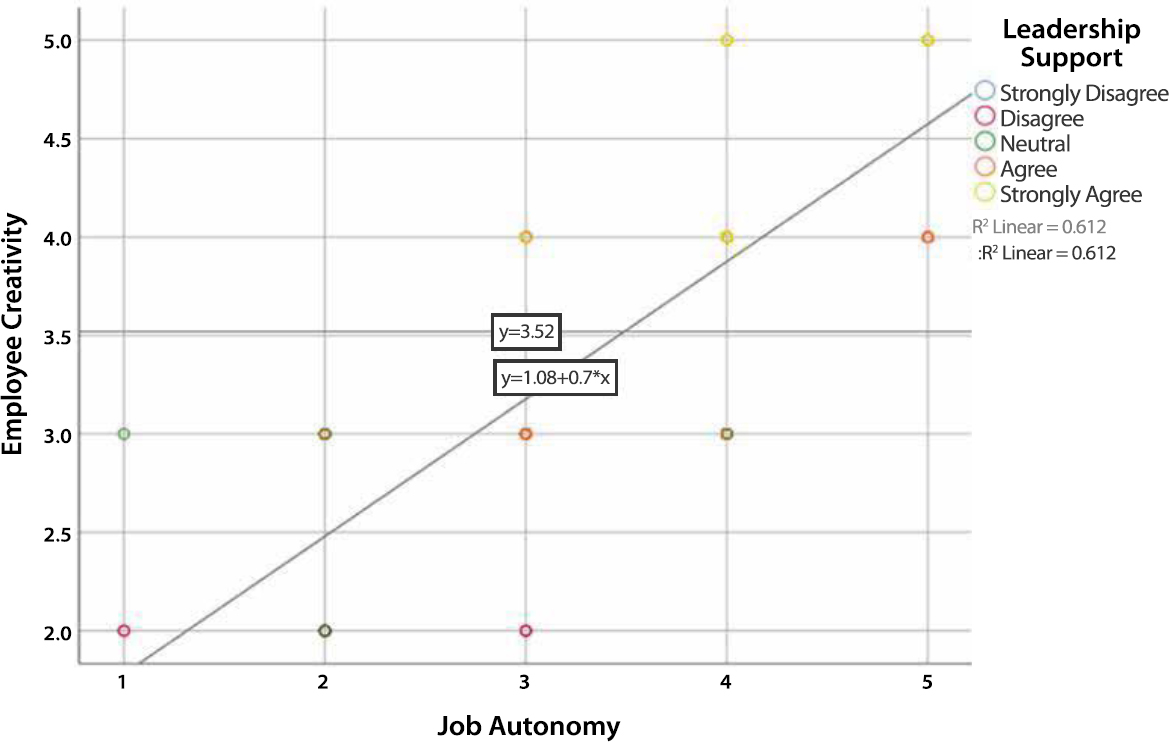
Fig. (2). Interaction plot: Job autonomy & employee creativity as a function of levels of leadership support.
Overall, the Fig. (2) is consistent with the regression results because it shows increased creativity with job autonomy and that creativity values show higher levels of creativity when leadership support is rated more positively. This pattern is consistent with the interpretation that leadership support conditions the relationship between autonomy and creativity, although the regression interaction term and the plot should be interpreted together. Although the interaction helps to explain a modest increase in variance, the effect (which was statistically significant) suggests that leadership support moderates the strength of the autonomy-creativity relationship. Therefore, the interaction effect should be taken as having meaning and being theoretically relevant even if modest in magnitude.
5. DISCUSSION
This study has examined the predictive association of job autonomy and the creativity of the employees and has evaluated whether leadership support strengthens this relationship in the technology-sector employees surveyed in the Philippines. The study shows that, across the “technology-sector employees surveyed in the Philippines, employee creativity is transformed by both job-level and the quality of supervisory support, which signifies the practical interdependence of job autonomy and leadership resources. The results are in favour of a direct positive relationship between job autonomy, leadership support and creativity (H1 and H2 accepted) and a significant moderating relationship between leadership support and autonomy and creativity (H3 accepted). Together, these outcomes support contemporary views that creativity is not only a matter of the discretion above (accessible to the job position/incorporated in the job description) but also whether the social environment created by leaders legitimises experimentation and encourages employees to act upon their autonomy.
Consistent with the results of the study, the moderation role is shown in Fig. (2) (interaction plot), which provides a clear understanding of the direction of the interaction by demonstrating the differences in the relationships between job autonomy and employee creativity under the conditions of low and high levels of leadership support. The positive relationship between job autonomy and creativity observed in this study aligns with prior findings in knowledge-intensive and innovation-oriented work settings. Importantly, the replication of this relationship within an emerging economy technology sector suggests that autonomy functions as a robust job resource beyond Western organizational contexts. This strengthens confidence in the generalizability of autonomy–creativity relationships across different institutional and sectoral environments. This finding is consistent with research that shows that autonomy is one of the contributors to higher job effectiveness by boosting employee control, motivation, and proactive behaviour (Khoshnaw & Alavi, 2020).
It also supports the argument that creative output in modern work settings is strongly related to discretionary control over the way in which tasks are carried out, rather than simply what tasks are done. Evidence from autonomy-focused work research also supports this relationship to show that environments that support autonomy enhance employee emotions and creative performance, particularly in knowledge-based jobs (Ye et al., 2025). Similarly, studies which emphasise control over work processes and time indicate that the more discretion employees have over their work processes, the more able they are to handle problem-solving demands associated with innovation (Madrid & Patterson, 2020).
Collectively, these research findings support the case that autonomy is a prerequisite of creativity in technology-based work. Leadership support was also shown to be a meaningful predictor of employee creativity, which supports the Social Exchange Theory and confirms H2. Creativity is, by definition, uncertain for employees and requires them to invest their discretionary effort into idea generation, experimentation, and the possibility of failure. The high predictive relationship of the leadership support shows that the creative involvement of employees can be significantly impacted by supervisory behaviour in technology-based work. This implies that in the context of roles that are highly technical, relational leadership is still relevant in facilitating a creative workforce, which supports the validity of the practical significance of supportive supervision in an innovation-driven context. This is consistent with social exchange arguments, by which employees value the interaction with supportive treatment by providing forgoing them, for example, creative behaviours that go above the barriers of the formal requirements of the position (Zeb et al., 2023). Supporting this reasoning, research shows that positive leadership enhances inclusion and well-being, which creates conditions where employees are more willing to actively participate and engage in constructive innovation (Adams et al., 2020).
Consistent with this literature, leadership support, in the current study, is seen as an enabling supervisory resource that encourages the sharing of ideas and persistence in the face of uncertainty; however, psychological mechanisms such as psychological safety or trust were not directly tested, and therefore, they should be considered as theory-consistent interpretations of leadership support, rather than as empirically demonstrated mechanism pathways. These results confirm the perspective that supportive leadership is not just a contextual advantage, but one of the drivers of creative behaviour at will. Importantly, the moderation results provide theoretical and empirical evidence for leadership support as a boundary condition leading to the strengthening of the association between autonomy and creativity. The acceptance of H2 suggests that autonomy is more strongly related to creativity when employees experience high levels of leadership support. This finding implies that autonomy is not necessarily transformed into creative output, because employees could be deterred from engaging in experimentation and expression when leadership is indifferent or supportive.
The moderation role shows that job autonomy cannot always elicit creativity. Instead, autonomy provides more creative performance in the context of an encouraging leadership setting. This observation explains the most effective period of autonomy, making leadership support a crucial boundary situation, allowing employees to do as they please. This interpretation is greatly supported by previous studies. For instance, as per (Imam et al., 2020), authentic leadership has been found to boost creativity by mechanisms such as empowerment and commitment to supervisors, which means leadership resources enhance the willingness of employees to engage in creativity-driven behaviour. In a similar vein, (Wen et al., 2023) unveiled that empowering leadership leads to increased engagement through psychological empowerment, and leadership practices can influence whether job resources are translated into proactive and innovation-oriented outcomes.
It has also been shown recently that the relationships between job autonomy and creativity are context-sensitive and can be moderated by support from the supervisor and other conditions of work, indicating the existence of the kind of moderation effect found in the present work (Kivrak et al., 2025). Overall, the interaction effect must be considered as additional boundary condition evidence as opposed to the central theoretical contribution of the manuscript. The main theoretical value of the study is the establishment of contextually replicable evidence of the established independence of autonomy-creativity and support for creativity-autonomy relationships in an underrepresented emerging economy technology sector context, whereas the moderation finding moves forward in understanding when the autonomy-creativity relationship is enhanced. It is also consistent with modern organisational research that proposes the most effective way to explain creativity is through multi-resource frameworks of a combination of job design and relational leadership factors (Siyal, 2023). From a practical point of view, the findings indicate that organisations wishing to enhance creativity seek strategies that address both job design and leadership capability. Giving employees autonomy without supportive leadership minimises the willingness to take creative risks or share innovative ideas, while having supportive leadership without meaningful autonomy limits the ability of employees to implement creative solutions (Nili & Tadanori, 2022).
Therefore, organisational interventions should combine efforts to increase the level of autonomy through job redesign and build the effectiveness of leadership support through training and development. Mentoring and leadership development programmes are relevant, as they support leaders to use supportive supervisory behaviours that can strengthen engagement, motivation and innovation outcomes, as also unveiled by (Slemp, 2021). Such strategies are particularly important in the context of technology-sector employees surveyed in the Philippines working under the mantle of rapid innovation, in which creative performance is directly linked to organisational competitiveness. Altogether, this research is valuable because it offers sector-specific replication of well-known relations of autonomy and creativity in a small-represented emerging economy technology framework. By showing the conditional nature of leadership support, the results bring new insight into when job autonomy has the best chances of promoting creativity, providing a theoretical clarification as well as practical advice to technology-pushing organisations.
CONCLUSION
This research investigates the relationship between job autonomy and creativity of employee creativity and determines if leadership support enhances the relationship between job autonomy and employee creativity in the Technology-sector employees surveyed in the Philippines. The findings confirm that job autonomy has a positive relationship with creativity, which indicates that discretion in task execution, decision-making, and planning work allows employees to engage in novel and more useful idea generation. Leadership support was also found to foster creativity, indicating the importance of supervisors who encourage creativity, value employee contributions and offer constructive guidance. Importantly, the results also indicate that leadership support reinforces the relationship between autonomy and creativity, indicating that autonomy is likely most effective when employees work within a supportive supervisory context that encourages experimentation and mitigates interpersonal risk. These findings make a contribution to the literature by illustrating how job design and leadership resources mutually influence employee creativity in technology-sector organizations. The paper combines both the findings of the Job Characteristics Theory and Social Exchange Theory to show that job autonomy and leadership support are complementary structural and relational resources that influence creative behaviour. The study provides empirically context-specific evidence in an emerging economy technology environment to enhance the external validity of known relationships between autonomy and creativity and leadership and creativity. In practise, the results indicate that organisations in need of innovative-based performance ought to harmonise autonomy-based job design with leadership development programmes that encourage supportive supervisory practises, which consequently lead to organisational setups in which employees are more ready and capable of taking part in creative problem solving.
LIMITATIONS AND FUTURE DIRECTIONS
Despite the contributions, the present study has limitations. First, the cross-sectional design limits the inferences that can be drawn regarding causality between job autonomy, leadership support and creativity. Future research needs to use a longitudinal or experimental research design to test whether increases in autonomy and leadership support have sustained change in creative behaviour over time. Second, the research was based on self-report survey responses, and the answers from the current study might be subject to social desirability effects and common method variance. Future research could further bolster validity by drawing on multi-source information, such as creativity as rated by supervisors, peers or more objective measures of innovation. Third, the research was focused on the technology industry from one national context, and this could restrict the generalisability of the findings to other industries. Future studies should attempt to replicate the model in other sectors and regions – especially other developing economies that are in the process of being digitally transformed. Furthermore, considering more explanatory mechanisms like psychological safety, empowerment, or engagement also adds to the comprehension of the role of leadership support in building autonomy-driven creativity. Finally, future studies can focus on the testing of alternative moderators on the relationship between diversity and creativity, such as innovation climate or leader-member exchange quality, and determine if other relational dynamics further affect the outcomes of creativity. Finally, cultural explanations of the results are also restricted, since no direct measurement or integration of cultural values, norms and power distance orientations was conducted to be included in the research design. Mentioning of national or organisational culture is merely background information, and no actual data was gathered to support culturally specific explanations of patterns of observed relationships.
POLICY IMPLICATIONS
The results have implications for organisational policy and workforce development for the Philippine technology sector. Organisations should make job design policies which will ensure that employees have meaningful autonomy, particularly in jobs that require adaptive problem-solving and innovation. At the same time, development of leadership roles should be given priority, as supportive supervision helps to increase the effectiveness of autonomy by fostering encouragement, trust and psychological safety. Firms could benefit from running mentoring and coaching programmes that assist supervisors to enhance their abilities to recognise contributions, provide feedback, and enable them to experiment. At an institutional level, industry associations and national innovation agencies may integrate leadership capability-building efforts and technical upskilling efforts in efforts to help build innovation-readiness across the workforce. Both job autonomy and leadership support have the potential to contribute to higher organisational creativity, innovation capability and competitive advantage in the long-term in the digital economy.
LIST OF ABBREVIATIONS
EFA | = | Exploratory Factor Analysis |
JCT | = | Job Characteristics Theory |
SET | = | Social Exchange Theory |
VIF | = | Variance Inflation Factors |
AUTHOR’S CONTRIBUTION
G.T. has contributed to conceptualization of study, development of idea, methodology, analysis of result and interpretation of result.
ETHICAL STATEMENT & INFORMED CONSENT
The study was conducted in accordance with the Declaration of Helsinki and approved by the Quality Department of Jubail Industrial College (RS-00-01, 10 Nov 2025). Participation in the study was voluntary, and informed consent was obtained from all participants prior to data collection. Participants were informed of their right to withdraw at any time. Responses were anonymised to protect participant confidentiality, and no personally identifiable information was disclosed.
AVAILABILITY OF DATA AND MATERIALS
The datasets generated and analysed during the current study are available from the corresponding author upon reasonable request. [G.T.]
FUNDING
None.
CONFLICT OF INTEREST
The author declares that there are no conflicts of interest regarding the publication of this article.
ACKNOWLEDGEMENTS
Declared none.
DECLARATION OF AI
During the preparation of this manuscript, the author used ChatGPT for language assistance. The content was subsequently reviewed, edited, and verified by the author, who take full responsibility for the final content of the publication.
APPENDIX A
QUESTIONNAIRE
Section A: Demographic Information
| Variable | Question | Response Options |
| Gender | What is your gender? | Male Female |
| Age | What is your age group? | 20–25 26–30 31–35 36–40 41+ |
| Job Tenure | How long have you been working in your current organization? | <1 year 1–3 years 4–6 years 7–10 years 10+ years |
| Organization Size | How many employees does your organization have? | <50 51–250 251–500 501–1000 1000+ |
Section B: Job Autonomy (Independent Variable)
Source: Hackman & Oldham’s Job Diagnostic Survey (1980).
(1 = Strongly Disagree, 2 = Disagree, 3 = Neutral, 4 = Agree, 5 = Strongly Agree)
| No. | Statement | 1 | 2 | 3 | 4 | 5 |
| JA1 | I have significant autonomy in determining how I do my job. | |||||
| JA2 | I can decide the order in which I complete my tasks. | |||||
| JA3 | I am allowed to make decisions on my own while performing my job. | |||||
| JA4 | My job gives me the freedom to schedule my own work. | |||||
| JA5 | I have control over the methods I use to complete my work. |
Section C: Leadership Support (Moderator Variable)
Source: (Eisenberger et al., 2002) – Perceived Supervisor Support Scale
| No. | Statement | 1 | 2 | 3 | 4 | 5 |
| LS1 | My supervisor really cares about my well-being. | |||||
| LS2 | My leader appreciates any extra effort I put into my work. | |||||
| LS3 | My supervisor is willing to help me when I need a special favor. | |||||
| LS4 | My leader shows concern for my opinions and suggestions. | |||||
| LS5 | My supervisor provides useful feedback that helps me improve my performance. |
Section D: Employee Creativity (Dependent Variable)
Source: (Zhou & George, 2001) – Employee Creativity Scale
| No. | Statement | 1 | 2 | 3 | 4 | 5 |
| EC1 | I suggest new ways to achieve goals or objectives. | |||||
| EC2 | I come up with creative solutions to problems. | |||||
| EC3 | I often propose new approaches to performing work tasks. | |||||
| EC4 | I seek out new technologies or methods to improve performance. | |||||
| EC5 | I generate original ideas that can benefit my team or organization. | |||||
| EC6 | I am recognized by others for being innovative in my job. |
REFERENCES
Abell, T., Husar, A., & May-Ann, L. (2021). Cloud computing is a key enabler for tech start-ups across Asia and the Pacific.Sustainable Development Working Papers, 79, 1-38.
http://dx.doi.org/10.22617/WPS210253-2
Adams, B. G., Meyers, M. C., & Sekaja, L. (2020). Positive leadership: Relationships with employee inclusion, discrimination, and well-being. Applied Psychology, 69(4), 1145–1173. https://doi.org/10.1111/apps.12230
Ahmad, M., & Wilkins, S. (2025). Purposive sampling in qualitative research: A framework for the entire journey. Quality & Quantity, 59(2), 1461–1479.
https://doi.org/10.1007/s11135-024-02022-5
Aithal, P. S. (2023). How to create business value through technological innovations using ICCT underlying technologies. International Journal of Applied Engineering and Management Letters, 7(2), 232–292.
https://doi.org/10.5281/zenodo.8136520
Akanji, B., Mordi, C., Itamar, A., Adisa, T. A., & Ajonbadi, H. (2020). The influence of organisational culture on leadership style in higher education institutions. Personnel Review, 49(3), 709–732.
https://doi.org/10.1108/PR-08-2018-0280
Alam, M. Z., Rafiq, M., Alafif, A. M., Nasir, S., & Bashir, J. (2024). Success comes before work only in a dictionary: Role of job autonomy for intrapreneurial behaviour using trait activation theory. International Journal of Innovation Science, 16(6), 1100–1116.
https://doi.org/10.1108/IJIS-04-2023-0085
Albert, J. R. G., Tabunda, A. M. L., David, C. P. C., Francisco, K. A., Labina, C. S., Cuenca, J. S., & Vizmanos, J. F. V. (2020). Future S&T human resource requirements in the Philippines: A labour market analysis (PIDS Discussion Paper Series No. 2020-32). Philippine Institute for Development Studies. Available from: https://pidswebs.pids.gov.ph/CDN/PUBLICATIONS/pidsdps2032.pdf
Arabameri, A., Asadi Nalivan, O., Chandra Pal, S., Chakrabortty, R., Saha, A., Lee, S., Pradhan, B., & Tien Bui, D. (2020). Novel machine learning approaches for modelling the gully erosion susceptibility. Remote Sensing, 12(17), 2833.
https://www.mdpi.com/2072-4292/12/17/2833
Baker, D. H., Vilidaite, G., Lygo, F. A., Smith, A. K., Flack, T. R., Gouws, A. D., & Andrews, T. J. (2021). Power contours: Optimising sample size and precision in experimental psychology and human neuroscience. Psychological Methods, 26(3), 295–314.
https://doi.org/10.1037/met0000337
Cavanagh, T. M., Kraiger, K., & Henry, K. L. (2020). Age-related changes on the effects of job characteristics on job satisfaction: A longitudinal analysis. The International Journal of Aging and Human Development, 91(1), 60–84.
https://doi.org/10.1177/0091415019837996
Crick, J. M., Hamzah, M. I., & Crick, D. (2025). Managing an entrepreneurial marketing orientation in turbulent competitive business environments. Journal of Strategic Marketing, 33(2), 239–253.
https://doi.org/10.1080/0965254X.2024.2445655
Eisenberger, R., Stinglhamber, F., Vandenberghe, C., Sucharski, I. L., & Rhoades, L. (2002). Perceived supervisor support: Contributions to perceived organizational support and employee retention. Journal of Applied Psychology, 87(3), 565–573.
https://doi.org/10.1037/0021-9010.87.3.565
Fida, M. K., & Najam, N. (2019). Construction and validation of Fida and Najam job autonomy scale for employees. Pakistan Journal of Psychological Research, 34(3), 511–527.
https://psycnet.apa.org/record/2020-67340-004
Howard, M. C. (2023). A systematic literature review of exploratory factor analyses in management. Journal of Business Research, 164, 113969.
https://doi.org/10.1016/j.jbusres.2023.113969
Imam, H., Naqvi, M. B., Naqvi, S. A., & Chambel, M. J. (2020). Authentic leadership: Unleashing employee creativity through empowerment and commitment to the supervisor. Leadership & Organization Development Journal, 41(6), 847–864.
https://doi.org/10.1108/LODJ-05-2019-0203
Khassawneh, O., Mohammad, T., & Ben-Abdallah, R. (2022). The impact of leadership on boosting employee creativity: The role of knowledge sharing as a mediator. Administrative Sciences, 12(4), 175.
https://doi.org/10.3390/admsci12040175
Khoshnaw, S., & Alavi, H. (2020). Examining the interrelation between job autonomy and job performance: A critical literature review. Multidisciplinary Aspects of Production Engineering, 3(1), 606–616. Available from: https://www.researchgate.net/publication/344030473_Examining_the_Interrelation_Between_Job_Autonomy_and_Job_Performance_A_Critical_Literature_Review
Kivrak, F. H., Arslan, M., & Adarves-Yorno, I. (2025). The impact of job autonomy on employee creativity: Examining perceived supervisor support as a mediator and job difficulty as a moderator. Global Business Review.
https://doi.org/10.1177/09721509251313909
Koski, H. (2024). Defining agile organisational infrastructure in traditional project management context: Organisational culture perspective on utilizing agile ways of working (Master’s thesis). Available from: https://osuva.uwasa.fi/server/api/core/bitstreams/b22dc866-9e7e-45fd-8755-c15f5cf7dc48/content
Liu, C., Li, L., Li, H., Bruk-Lee, V., Ma, J., & Liu, Y. (2023). Supervisor-employee task conflict and supervisor ostracism: The moderating effect of interpersonal harmony values. Applied Psychology, 72(3), 971–997.
https://doi.org/10.1111/apps.12416
Lorah, J. A. (2020). Interpretation of main effects in the presence of non-significant interaction effects. The Quantitative Methods for Psychology, 16(1), 33–45.
https://doi.org/10.20982/tqmp.16.1.p033
Lovakov, A., & Agadullina, E. R. (2021). Empirically derived guidelines for effect size interpretation in social psychology. European Journal of Social Psychology, 51(3), 485–504.
https://doi.org/10.1002/ejsp.2752
Madrid, H. P., & Patterson, M. G. (2020). How and for whom does time control matter for innovation? The role of positive affect and problem-solving demands. Applied Psychology, 69(1), 93–119.
https://doi.org/10.1111/apps.12194
Meh, K., Jurak, G., Sorić, M., Rocha, P., & Sember, V. (2021). Validity and reliability of IPAQ-SF and GPAQ for assessing sedentary behaviour in adults in the European Union: A systematic review and meta-analysis. International Journal of Environmental Research and Public Health, 18(9), 4602.
https://doi.org/10.3390/ijerph18094602
Mwantu, E. N., Supji, M. P., Aimuamwosa, I., Oluwafemi, O. O., & Itse, Y. I. (2021). Employee creativity and workplace technological innovation on problem-solving in twenty-first-century organisations. NIU Journal of Social Sciences, 6(4), 155–166. Available from: https://www.kampalajournals.ac.ug/ojs/index.php/niujoss/article/view/1088
Nawi, F. A. M., Tambi, A. M. A., Samat, M. F., & Mustapha, W. M. W. (2020). A review on the internal consistency of a scale: The empirical example of the influence of human capital investment on Malcolm Baldrige quality principles in TVET institutions. Asian People Journal, 3(1), 19–29.
https://doi.org/10.37231/apj.2020.3.1.121
Nili, F., & Tasavori, M. (2022). Linking an autonomy-supportive climate and employee creativity: The influence of intrinsic motivation and company support for creativity. European Business Review, 34(5), 666–688.
https://doi.org/10.1108/EBR-06-2021-0146
Ohemeng, F. L., Obuobisa Darko, T., & Amoako-Asiedu, E. (2020). Bureaucratic leadership, trust building, and employee engagement in the public sector in Ghana: The perspective of social exchange theory. International Journal of Public Leadership, 16(1), 17–40.
https://doi.org/10.1108/IJPL-05-2019-0018
Pagdonsolan, M. M. H., Balan, D. J. S., Mariscal, K. D., & Chiu, J. L. (2020). Impact of continuous performance management on job autonomy, motivation, and turnover intent of employees in multinational companies within Metro Manila. Review of Integrative Business and Economics Research, 9(2), 63–89. Available from: http://buscompress.com/uploads/3/4/9/8/34980536/riber_9-2_04_k19-071_63-89.pdf
Polas, M. R. H. (2025). Common method bias in social and behavioural research: Strategic solutions for quantitative research in doctoral research. Journal of Comprehensive Business Administration Research, 1-12.
https://doi.org/10.47852/bonviewJCBAR52024285
Polat, Ş., & Özdemir, M. (2021). An examination of relationship between job characteristics and work-life balance according to the teachers’ opinions. Education and Science, 46(205), 207–219.
https://doi.org/10.15390/EB.2020.7944
Purisima, J. K. A. (2025). Dynamism and ethos of educational leaders on teachers’ motivation: A thematic literature review in the Philippine setting. International Journal of Research Studies in Education, 14(9), 203–226. Available from: https://www.researchgate.net/profile/Jasper-Kent-Purisima-2/publication/391727163_Dynamism_and_ethos_of_educational_leaders_on_teachers’_motivation_A_thematic_literature_review_in_the_Philippine_setting/links/682e91d6be1b507dce8d4e2e/Dynamism-and-ethos-of-educational-leaders-on-teachers-motivation-A-thematic-literature-review-in-the-Philippine-setting.pdf
Shen, Y., & Zhang, X. (2024). The impact of artificial intelligence on employment: The role of virtual agglomeration. Humanities and Social Sciences Communications, 11(1), 122.
https://doi.org/10.1057/s41599-024-02647-9
Siyal, S. (2023). Inclusive leadership and work engagement: Exploring the role of psychological safety and trust in leader in multiple organisational contexts. Business Ethics, the Environment & Responsibility, 32(4), 1170–1184.
https://doi.org/10.1111/beer.12556
Slemp, G. R., Lee, M. A., & Mossman, L. H. (2021). Interventions to support autonomy, competence, and relatedness needs in organizations: A systematic review with recommendations for research and practice. Journal of Occupational and Organizational Psychology, 94(2), 427–457.
https://doi.org/10.1111/joop.12338
Wen, J., Huang, S. S., & Teo, S. (2023). Effect of empowering leadership on work engagement via psychological empowerment: Moderation of cultural orientation. Journal of Hospitality and Tourism Management, 54, 88–97.
https://doi.org/10.1016/j.jhtm.2022.12.012
Winston, B. E. (2022). Relationship of servant leadership, perceived organisational support, and work-family conflict with employee well-being. Servant Leadership: Theory & Practice, 9(1), 2. Available from: https://csuepress.columbusstate.edu/sltp/vol9/iss1/2/
Ye, L., Li, Y., & Zhang, N. (2025). The impact of autonomy-supportive organisational environments on employees’ emotions and creative performance: A self-determination theory perspective. PLoS ONE, 20(5), e0322184.
https://doi.org/10.1371/journal.pone.0322184
Zeb, A., Goh, G. G. G., Javaid, M., Khan, M. N., Khan, A. U., & Gul, S. (2023). The interplay between supervisor support and job performance: Implications of social exchange and social learning theories. Journal of Applied Research in Higher Education, 15(2), 429–448.
https://doi.org/10.1108/JARHE-04-2021-0143
Zhou, J., & George, J.M. (2001). When Job Dissatisfaction Leads to Creativity: Encouraging the Expression of Voice. Academy of Management Journal, 44, 682-696.
http://dx.doi.org/10.2307/3069410
Zhang, J., Zhao, W., Cheng, B., Li, A., Wang, Y., Yang, N., & Tian, Y. (2022). The impact of digital economy on the economic growth and the development strategies in the post-COVID-19 era: Evidence from countries along the “Belt and Road.” Frontiers in Public Health, 10, 856142.
https://doi.org/10.3389/fpubh.2022.856142