

- 1. THEORY AS THE INTELLECTUAL FOUNDATION OF EMPIRICAL RESEARCH
- 2. THE EXPLANATORY ROLE OF THEORY
- 3. COMMON THEORETICAL WEAKNESSES IN EMPIRICAL STUDIES
- 4. FROM THEORETICAL POSITIONING TO THEORETICAL CONTRIBUTION
- 5. PRACTICAL GUIDANCE FOR THEORY-DRIVEN EMPIRICAL RESEARCH
- CONCLUSION
- EDITORIAL DISCLAIMER
- FUNDING
- CONFLICT OF INTEREST
- ACKNOWLEDGEMENTS
- DECLARATION OF AI
- REFERENCES
Editorial Note: Enhancing Theoretical Contribution Through Theory-Driven Empirical Research
 DOI:
DOI:
 PDF
PDF
⬇ Downloads: 10
1Spectrum International University College, Selangor, Malaysia
1. THEORY AS THE INTELLECTUAL FOUNDATION OF EMPIRICAL RESEARCH
The role of empirical research has grown in the frontiers of economics, sustainability, management, entrepreneurship and innovation studies. This development is useful as the empirical evidence allows researchers to challenge their assumptions, analyse the real-life phenomena, and produce findings applicable to organisations, policymakers and society. Meanwhile, the blistering development of empirical research has developed a problem that needs to be scrutinised by the editorial team. With the availability of more data and the level of sophistication in statistical tools, empirical studies can be characterised by methodological rigour and, at the same time, be theoretically underdeveloped (Kar & Dwivedi, 2020; Sparrowe & Mayer, 2011). This issue can be seen through a variety of review studies that show that about 19 % to 53 % of the empirical studies that are studied do not apply any specific theoretical framework (Ellili & Seow, 2025; Seow, 2025c, 2026b, 2026c; Seow & Chua, 2026). This is of relevance especially in research topics like sustainability and innovation, where the social, organisational, institutional, and environmental phenomena tend to be multidimensional and context dependent (Sharfman & Dean, 1991). These spheres include conflicting interests of stakeholders, the institutional difference, and long-term societal consequences that cannot be sufficiently explained by using statistical connections only (Chen et al., 2023). Therefore, empirical research in such areas needs more than technical implementation. They need conceptual clarity, reasoning that is informed theoretically, and interpretation of context (Seow, 2025a).
Most empirical studies seem to be focused on data availability, statistical methods, and model complexity rather than on theoretical foundations, despite the significance of theory. One of the weaknesses that has been evident is the nature of using theory as a formalised requirement and not the intellectual underpinning of the investigation. In other manuscripts, the theoretical grounding is not provided even in cases where the study explores the relationships among already existing constructs (Seow, 2026c). In other studies, theories have been either referenced in a summary form or provided as a catalogue, but with no explanation of the way it assists in supporting the logic, scope or contribution of the study (Seow, 2025c). These practices undermine the explanatory unity of empirical investigation and diminish theory to the symbolic component of the manuscript form.
This is a problem immediately impacting the academic worth of empiricism. Statistically significant relationship alone fails to provide answers to the question of why the relationship exists, whether it represents a significant mechanism, or how it contributes to the current body of knowledge (Miller & Rodgers, 2008; Wasserstein & Lazar, 2016). Therefore, there is a risk that such studies with minimal theoretical underpinning can become descriptive, fragmented and incremental. They can reproduce known relations, insert marginal variables or apply old models in new situations without giving a clear understanding of the conceptual meaning of the action. As Whetten (1989) argues, a good theoretical work should be able to explain how and why the relationships proposed should happen, in addition to saying what is under study is happening. Likewise, Sutton and Staw (1995) point out that references, variables, diagrams, and hypotheses are not a theory unless interrelated by a coherent explanatory logic.
These issues give the impetus to this editorial note. It does not mean that it should dishearten empirical research, but it is a reestablishment of the significance of theory to create significant and defensible scholarship. This makes this issue especially important to a journal with an interest in economic sustainability and innovation since the study in these fields often deals with complex and context-specific phenomena. This complexity cannot be dealt with by methodological sophistication alone. It involves a theoretically based rationale that can provide explanations about mechanisms, contextual variation and broader implications. As such, this editorial note aims to promote more robust theory-informed empirical research and to elucidate how theory can be used to turn empirical findings based on data reporting into knowledge generation. There should be no use of variables to seek justification before beginning quality empirical scholarship. Rather, it needs to start with a serious theoretical issue, formulate a logical explanatory thesis, and apply empirical data to test, correct, or elaborate that thesis.
2. THE EXPLANATORY ROLE OF THEORY
Theory is important in empirical research since it offers the explanatory logic, which relates evidence to knowledge (Martin & Simmons, 1998). Empirical results can show patterns, correlations or differences between groups, but they are constrained until they are put into a coherent theoretical perspective (Okhuysen & Bonardi, 2011). In this respect, theory assists scholars in explaining why a certain relationship is anticipated to occur, how the relationships work, and under what circumstances the relationship can occur. This explanatory role is especially significant in the areas of economics, sustainability, management, entrepreneurship, and innovation research, where the empirical phenomena are often manifestations of intricate interactions among the firms, markets, institutions, stakeholders, and society.
To be more precise, theory supplies the conceptual framework that empirical investigation needs to be based on. It aids researchers to discover pertinent constructs, to explain connections among variables and to come up with conjectures that are founded on previous knowledge as opposed to the statistical convenience (Sparrowe & Mayer, 2011). It also helps to design empirical models because it explains what mechanisms are to be investigated and what conditions of the context might influence the measured relationships (Miller et al., 1991). As Wacker (2008) argues, theory aids in research by bringing about coherence in ideas, articulation of relationships and aiding in prediction. Similarly, Whetten (1989) outlines that a theoretical contribution must be clear about what factors one is studying and how and why these factors should be related. This is because theory cannot be introduced after producing empirical results. Rather, it ought to influence the study between the formulation of the problem and the interpretation.
Further, theory facilitates the empirical studies to add to the cumulative knowledge. Research that only proves the existence of a relationship that has already been reported elsewhere in previous studies might not have much scholarly importance unless it can describe how the result improves, elaborates, or contradicts current theoretical knowledge (Richardson, 2018). Empirical studies can play a role by revealing an unappreciated mechanism, elucidating a theory in a situation where assumptions may vary, explaining the boundaries, or combining views that elucidate a complex phenomenon better (Martin & Simmons, 1998; Wacker, 2008). Particularly in sustainability and innovation research, this argument is particularly applicable, which is that institutional settings, stakeholder demands, resource limitations and technological variability can change the operation of previously developed theories depending on the context. Thus, robust theory enables empirical studies to go beyond imitation and to imbue the conceptual progress.
In addition, theory enhances the explanation of empirical findings such as unforeseen or contradictory findings. In case the results are different from previous studies, theory assists the researchers to clarify whether the variation was due to contrast of contexts, variations of measurements, an alternative mechanism, or constraints of the current assumptions (Bamberger, 2008). In the absence of such theoretical exegesis, the dialogue can become a mere reiteration of findings and not a contribution to comprehension. Sutton and Staw (1995) warn that variables, references, diagrams and hypotheses alone cannot form a theory unless they are connected by explanatory arguments. The observation is still very pertinent since most empirical studies provide complex models but explain the concepts sparingly (Seow, 2025c). Accordingly, the value of theory lies not in its decorative presence but in its ability to discipline the research process and deepen the interpretation of evidence.
These are the reasons why theory can be considered to be the mental background of the empirical research and not an additional part of a manuscript. It provides sense to the study, supporting the plausibility of the empirical model, and explaining the value of the findings. More to the point, it assists in turning the results of empirical observations into some coherent academic knowledge. This is the reason why theory is at the heart of good empirical investigation, and the journal, more generally, is dedicated to conceptually based research.
3. COMMON THEORETICAL WEAKNESSES IN EMPIRICAL STUDIES
Despite the fundamental role of theory in empirical inquiry, its application in most empirical research is unequal. A weakness that is often associated is the symbolic representation of theory, in which a theoretical framework is added to the manuscript, not to influence the logic of the study, but to comply with the manuscript requirements. In these instances, theory can be found in the literature review, but it is not tightly linked to the research questions, hypotheses, empirical design or findings discussion. This undermines the explicatory coherence of the study since there is no theory employed to explain the existence of the relationships that are being examined or how the obtained results add to the current knowledge base. As Sutton and Staw (1995) argue that theory is not created simply by listing references, variables, diagrams, or hypotheses. It requires coherent reasoning that explains relationships among concepts.
The second weakness is the blind following of the known theories. Stakeholder theory, legitimacy theory, institutional theory, and agency theory are theories that are popular in the studies of sustainability, as well as in economics, finance, and innovation (Seow, 2024; Seow & Chua, 2026). These theories are useful, and their repetition does not necessarily create a contribution to theory. The problem with this is that when the authors bring in the familiar theories, they do not articulate the reason as to why this particular theory is proper, how the assumptions applied are applicable to the context of the study and what the study is trying to refine about the theory. Therefore, theory is a name and not an instrument of analysis. This is particularly worrisome when research projects purport to have theoretical value but provide mere empirical validation. The contribution is usually methodological or contextual, rather than truly theoretical, in such instances.
The third common weakness is the mismatch between the theory, variables and the level of analysis. Other studies pick up a theory that is designed at the organisational level, but they test the relationship with individual-level indicators, industry-level indicators or country-level proxies without adequate justification (Davidson & Carlin, 2008). Others pool variables due to the availability of data as opposed to the conceptual basis of the relationships. This produces models that can be statistically complete but of theoretical weakness. Whetten (1989) reminds researchers that to have a contribution which is theoretical, it must be clear on what factors are incorporated, how they relate, and the reasons why these relationships ought to be anticipated. Without this alignment, the empirical models are likely to turn into bundles of variables as opposed to consistent theoretical arguments.
The fourth weakness is that they have a habit of constructing models that are too complex by lacking theoretical discipline. Multiple mediators, moderators, and interaction terms and robustness checks are increasingly found in empirical studies. These additions can enhance a study if they are conceptually valid. However, they also have the ability to cause needless complexity when added primarily to add novelty or statistical sophistication. The presence of a complex model does not imply a high contribution. When the logic of each relationship is not well worked out, the complexity of the models can hide instead of enlightening theoretical knowledge. In this connection, selectivity is necessary in theoretical rigour. The authors ought to describe why each construct is needed, why each relationship is important, and how the entire model is more beneficial to the knowledge than previous research.
A fifth weakness is a lack of focus on the boundary conditions. Tacit in many empirical studies is the assumption that the relationship between theory and practice is homogeneous across industry and country, organisational form and institutional context. Such an assumption can hardly be maintained in sustainability and innovation studies, where the context frequently influences organisational behaviour, stakeholder demands, regulatory, and strategic reactions. An example would be a theory designed in developed market economies, which may not be as effective in emerging markets, family firms, small and medium-sized firms, or heavily regulated industries. Thus, robust empirical studies ought to explain in which situations a theory is likely to be relevant, when its premises might vary, and why context variations are important. In that way, the empirical results can make the theory more refined and not just confirm or disprove it.
Such weaknesses are significant as they restrict the ability of empirical research to produce cumulative knowledge. Empirical evidence becomes more difficult to interpret and less useful in the development of theory when theory is symbolic, uncritical, misconceived, too complicated, or underdeveloped in a context (Sklair, 1988). To this, the way of enhancing theoretical rigour is not through incorporating more theories by the authors (Sutton & Staw, 1995). Instead, it asks authors to be more cautious, selective and critical in their use of theory. Thus, this editorial note would urge authors to shift their gears beyond theory citation and to theory engagement. This kind of engagement demands a good explanation of the way theory helps explain the research problem, empirical model, interpretation and contribution to scholarly research. This is the same direction in which the larger purpose of the editorial note is to advance greater theoretical rigour and substantive empirical scholarship in the research of economic sustainability and innovation.
4. FROM THEORETICAL POSITIONING TO THEORETICAL CONTRIBUTION
The first stage in strong theoretical empirical research is theoretical positioning. Contrary to the practice where authors try to fit the theory into their research after its formulation, the authors should identify the theory which is the most suitable for their research. More than identifying the theory, this requires a profound comprehension and knowledge of its premises, core concepts, scope of explanation, and suitability in empirical circumstances. Wherein there is proper theoretical positioning, readers understand clearly the significance of the research and the importance of chosen relationships and connections; further, based on the results, the current state of theoretical knowledge in that area gets enriched. For instance, Seow (2025b) research on the effect of performance feedback on ESG disclosures builds on the behavioral theory of the firm and performance feedback theory to explain that managerial responses to aspiration-performance gaps induce environmental, social, and governance reporting actions; this differs from previous explanations made by legalists (methodological view), stakeholders and legitimacy perspectives. Similarly, Seow (2026a) research uses the theories of socio-emotional wealth and corporate life cycle to analyze the impact of family efforts in maintaining socio-economic wealth and different developmental phases on family firm’s ESG transparency.
The second requirement of a good empirical study is defining the problem of the study in terms of the gap in the theory. There is no reason for a gap in the study because of the argument that there is a lack of attention to the topic in the particular country, industry or sample. A new environment can be valuable; however, it becomes more interesting when it is connected to the theoretical issue. For example, one can study whether the proposed facts apply to other institutions, why the previous outcomes are based on a hidden mechanism, or what sustainable and innovative problems arise from the study which have not been sufficiently addressed by previous research (Jayaraman et al., 2025). In this case, the empirical environment becomes a place of learning through theories.
Moreover, the best research creates theories or hypotheses for research through logical theories (Sparrowe & Mayer, 2011). Each potential linkage identified should contain a detailed reason for such relationship and its connection to the argument presented in the paper. This becomes especially necessary when mediators, alternatives or any other aspect is suggested by the authors themselves. They are not supposed to complicate the model or introduce any aspect that is not familiar to modellers but should contribute to an explanation of mechanisms or ways in which one can proceed. According to Whetten (1989) a theoretical contribution implies the identification of variables under consideration, how they interrelate, and why they need to interrelate.
Additionally, research, in this case being theory-driven and empirical, moves beyond mere statistical significance (Miller & Rodgers, 2008). A discussion section is more than merely stating reasons that the hypothesis is supported. The finding must explain what the finding means for the theory and why it upsets the theory, as well as the significance of having a surprising finding (Wacker, 2008). When the findings are different from previous studies, researchers must consider whether this is because of differences in context, measurement, theoretical weaknesses, or some other factor. Here, empirical findings become more than just products of science; they become part of a broader scientific discourse.
Finally, there should be a clear and proportional theoretical contribution in positive papers. A theoretical contribution is not required to write a paper for any empirical study. Many research studies contribute to narrowing down, complementing, or clarifying an existing theory and explaining mechanisms that are not properly developed (Brammer et al., 2012; Seow, 2026d). The question is whether it advances the theory in a conceptual way. Authors must show how the theory construction goes beyond just collecting data and constructing a grounded theory to become a useful part of an informative process of the study and thus lead to the formulation of a clear and persuasive theory. As for the journals, this aspect helps separate technically perfect empirical research from valuable research which advances sustainable economic development. Table 1 comparing theoretical dimensions in empirical studies is given below.
Table 1. Weak and strong theoretical dimensions in empirical studies.
| Dimension | Weak Theoretical Dimension | Strong Theoretical Dimension |
| Research gap | Framed mainly around an underexamined country, sector, sample, or period. | Framed around an unresolved theoretical tension, an untested mechanism, boundary condition, or limitation in existing theory. |
| Use of theory | Theory is mentioned briefly or used as a symbolic requirement. | Theory provides the intellectual foundation of the research problem, model, hypotheses, and interpretation. |
| Literature review | Reviews prior studies descriptively and lists theories without critical engagement. | Analyzes critically the assumptions of theories, their power of explanation, weaknesses, and contextual relevance. |
| Theoretical positioning | Uses familiar theories without explaining why they are suitable. | Provides an explanation for the choice of the particular theoretical perspective and highlights its relevance within the empirical context. |
| Multiple theories | Presents several theories separately, creating a fragmented explanation. | Integrates theories coherently by explaining how they complement one another or address different mechanisms. |
| Hypothesis development | Hypotheses are driven by variable availability, prior empirical association, or statistical convenience. | Hypotheses are developed from clear theoretical reasoning and linked closely to theoretical assumptions. |
| Model design | Adds variables, mediators, moderators, or interactions mainly to increase novelty. | Includes constructs only when they clarify mechanisms, boundary conditions, or alternative explanations. |
| Unit of analysis | Applies theory across individual, firm, industry, or country levels without sufficient justification. | Aligns theory with the unit of analysis, variable measurement, and empirical setting. |
| Interpretation of findings | Restates results and reports whether hypotheses are supported. | Explains what findings reveal about theory and how they refine, extend, or challenge prior understanding. |
| Theoretical contribution | Claims contribution without demonstrating how knowledge is advanced. | Demonstrates contribution through argument, evidence, and interpretation. |
| Overall scholarly value | Produces technically competent but conceptually thin empirical evidence. | Converts empirical evidence into meaningful, cumulative scholarly knowledge. |
5. PRACTICAL GUIDANCE FOR THEORY-DRIVEN EMPIRICAL RESEARCH
The enhancement of theoretical rigor is not dependent on authors’ effort to produce empirical work of unnecessarily greater complexity. The idea behind enhancing theoretical rigor is to establish closer linkages between the problem, theory, methods of investigation, and analysis of findings. Therefore, it is essential that authors recognize the problem from a theoretical perspective which becomes the subject of the study in question in order to define the variables and model used (Sparrowe & Mayer, 2011). Lack of attention to certain geographical locations, industry, sample or period of research may not provide sufficient justification for research gaps, particularly when the research is presented to top-level journals (Locke & Golden-Biddle, 1997; Talay et al., 2018).
Explanatory logic in regard to the chosen constructs needs to be given by authors before the actual process of data collection or building of models takes place. It includes justification for existence of the relationship, expectations about relation or mechanism, and the cases under which the relation increases or decreases or changes direction. This approach is useful in research where interaction effects, mediation or nonlinearity analysis is used. These choices do not necessarily need to be made because of novelty or statistics. Rather, these choices need to be based on theories and applied to enrich the explanation in the research (Hopwood et al., 2022). In this way, theoretical-based research can be conducted without having an empirical model being nothing but an arbitrary combination of variables (Flynn et al., 1990).
In model development, the authors should try to ensure that the theory chosen is appropriate for the unit of analysis, the measurement of the variables and the empirical setting. For example, an organisational theory of behaviour must not be used for relationships between individuals, industries or countries without strong substantiation. Likewise, the research based on a combination of several theories needs to articulate why it is important to combine the theories and how the theories are complementary (Cornelissen & Durand, 2014; Shepherd & Suddaby, 2017). The purpose is not to give more theories, but to use the most suitable theory precisely. With prudence adequate to theoretical considerations, empirical design becomes more coherent and the outcomes of the study easier to interpret.
Once the appropriate theories have been found, the next step is to review the theory as part of the literature review in the article. A review of a theoretical framework cannot have enough words to simply provide a list of theories associated with an area of study without discussing any other points about the theories. Instead, it examines their underlying assumptions, limitations, areas of weakness in explaining phenomena, and the events in that situation. This would show the relevance of the theory to the topic of discussion and the location of the study in previous literature. Moreover, such a literature review might even point out inconsistencies or unexplained aspects of the phenomena being studied and thus create a need for the study. Hypotheses can now be developed based on this knowledge and not just from the availability of variables and statistical conveniences (Sparrowe & Mayer, 2011). The hypotheses must be stated in terms of a causal relationship between certain factors according to the reasoning of the theory behind the hypotheses as to why this phenomenon may occur and how it might be influenced under different circumstances.
When more than one theory has been utilized in research, then these should not be considered interchangeable means of explaining phenomena related to the subject under discussion. The literature review needs to show the need for integrating theories, as well as why these address distinct aspects of the problem in the research and how these are relevant to the discussion. This requires careful deliberation regarding the logic underlying the evidence assumed, explanatory powers and limitations of, complementarity and potential conflicts between the theories used. Doing a thorough multi-theoretical review does not simply require stating the theories used in instruction. Rather, the author has to provide an example as to how these theories together give a more thorough explanation than a single theory would do. Therefore, it is vital for authors to differentiate the theories based on their explanations of mechanisms, levels of analysis, different contexts, and reconciling these differences due to their limitations. It should also develop a cohesive theory in relation to the theories and hypotheses that the researcher proposes. Otherwise, the application of a number of theories appear to be disorganized, complex, or even inconsistent in terms of its meaning. It can be used to enhance the discussion and make it more consistent rather than adding to its complexity without any analytical significance.
Moreover, the discussion part is expected to move beyond the reiteration of findings and should not only make statements regarding whether or not hypotheses were confirmed or disconfirmed. The discussion needs to have a theoretical essence in the findings, to establish the theoretical essence of the effects found, in comparison with the previous expectations and the meaning behind the unanticipated effects. First of all, the findings need to be discussed theoretically before discussing any implications (Bamberger, 2008; Corley & Gioia, 2011). It is also helpful to first consider the findings from the perspective of the theories in place and then proceed to their significance.
In a broader sagacity, instead of being concerned about whether their narrative is new according to statistics, authors should be concerned about providing a conceptual perspective of their work. Even though the use of cutting-edge techniques, massive amounts of data, and sophisticated models can improve a certain study, they cannot replace a good conceptual framework. Decent research may still be an incomplete project in terms of making explicit the implications of the results for theoretical knowledge. On the contrary, good empirical research can be meaningful when focused on a specific theoretical topic, provided that it allows for a sound analytical approach and development of concepts based on the data collected. By doing so, the academic contribution to the theoretical importance of the studies conducted looks stronger (Fig. 1). Theory-driven research should always provide an argument based on empirical facts and data interpretation rather than making claims (Corley & Gioia, 2011; Sutton & Staw, 1995).
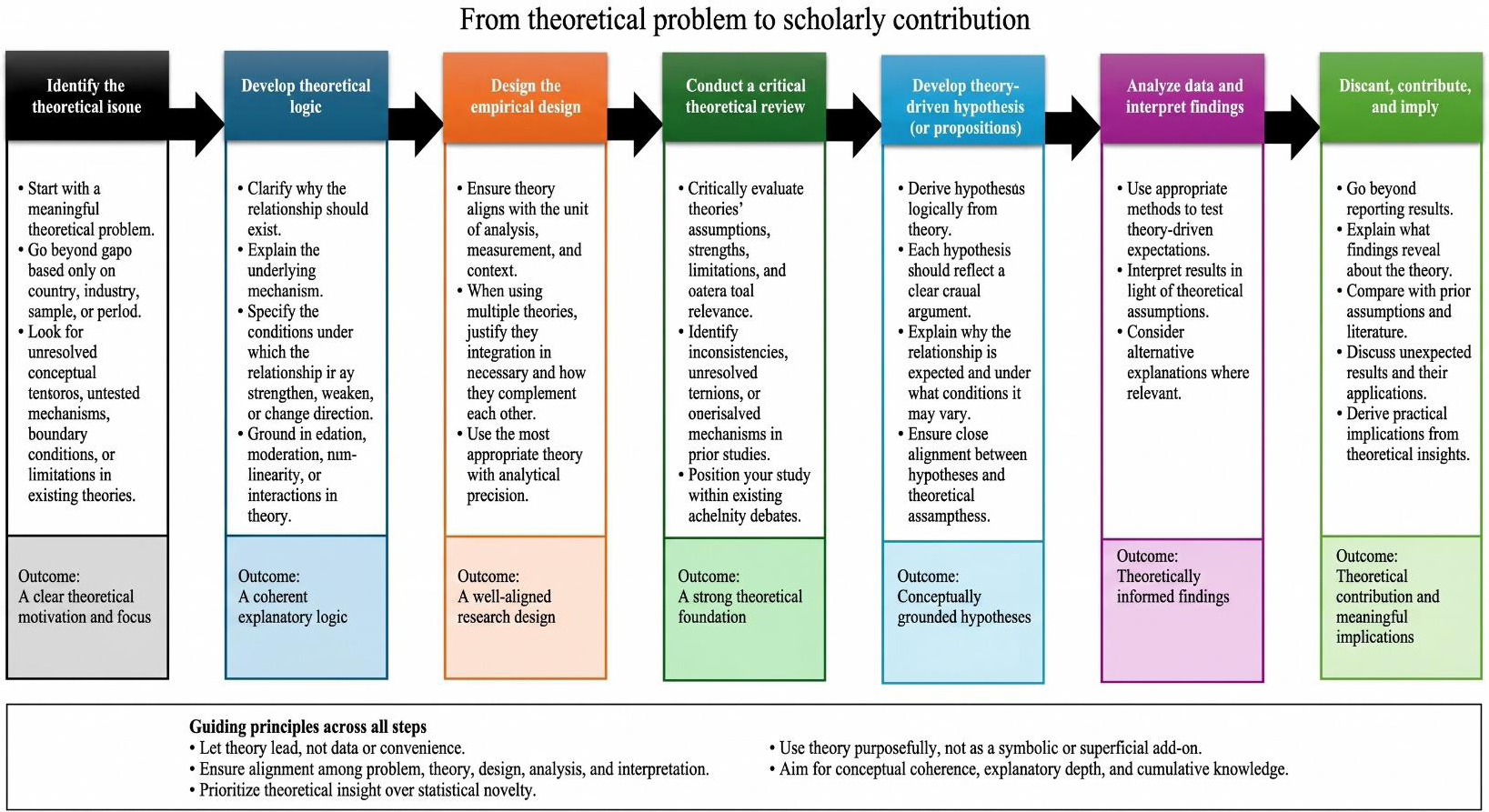
Fig. (1). A theory-driven pathway for high-quality empirical research.
CONCLUSION
This editorial note highlights that theory is crucial in making empirical research credible and meaningful. As empirical research methods and techniques become more complex, the need to articulate a sound theoretical basis becomes more crucial as well. While advanced techniques can serve to strengthen the relevance of evidence obtained in research, they cannot substitute for a full explanation that connects the relevance of the evidence to the question being addressed. Therefore, rigour in empirical research and theoretical research should be considered complementary rather than competing concepts.
It becomes especially important to consider in relation to research in economic sustainability and innovation. This research is concerned with analyzing complex interactions among firms, market institutions, actors, and more widely social systems. This level of complexity requires something beyond empirical correlation in terms of theory. Theory, in this sense, does not impose unnecessary limitations on empirical research. Theory provides guidance for empirical investigation.
Therefore, it is more advantageous for there to be competent theoretical and conceptual papers that can attract the attention of academic editors and reviewers. The research process must begin with the articulation of the research problem within the theoretical perspective, an evaluation of existing theoretical perspectives, an articulation of hypotheses in relation to the theoretical perspective, and conclude with an interpretation of the findings and revision/reconstruction of conclusions drawn from the existing theoretical perspective. The judicious use of theory together with the evidence can result in empirical studies that provide analytically powerful and cumulatively valuable information. An essential feature of any theoretical contribution is the articulation of the theory through an argument based on the evidence.
EDITORIAL DISCLAIMER
“The author has included several self-citations which have been reviewed and deemed necessary for the scientific continuity and methodological integrity of this study.”
FUNDING
None.
CONFLICT OF INTEREST
Dr. Richard Yeaw Chong Seow serves as the Editor-in-Chief of the International Journal of Economic Sustainability and Innovation. The author declares no other competing financial or non-financial interests related to this editorial.
ACKNOWLEDGEMENTS
Declared none.
DECLARATION OF AI
During the preparation of this work, the author used ChatGPT to improve the language and readability of the paper. After using this tool/service, the author reviewed and edited the content as needed and takes full responsibility for the content of the publication.
REFERENCES
Bamberger, P. (2008). From the Editors: Beyond Contextualization: Using Context Theories to Narrow the Micro-Macro Gap in Management Research. Academy of Management Journal, 51(5), 839–846.
https://doi.org/10.5465/amj.2008.34789630
Brammer, S., Jackson, G., & Matten, D. (2012). Corporate Social Responsibility and Institutional Theory: New Perspectives on Private Governance. Socio-Economic Review, 10(1), 3–28.
https://doi.org/10.1093/SER/MWR030
Chen, V. Z., Duran, P., Sauerwald, S., Hitt, M. A., & van Essen, M. (2023). Multistakeholder Agency: Stakeholder Benefit Alignment and National Institutional Contexts. Journal of Management, 49(2), 839–865.
https://doi.org/10.1177/01492063211054403
Corley, K. G., & Gioia, D. A. (2011). Building Theory About Theory Building: What Constitutes A Theoretical Contribution? Academy of Management Review, 36(1), 12–32.
https://doi.org/10.5465/amr.2009.0486
Cornelissen, J. P., & Durand, R. (2014). Moving Forward: Developing Theoretical Contributions in Management Studies. Journal of Management Studies, 51(6), 995–1022.
https://doi.org/10.1111/joms.12078
Davidson, A. J., & Carlin, J. B. (2008). What A Reviewer Wants. Pediatric Anesthesia, 18(12), 1149–1156.
https://doi.org/10.1111/j.1460-9592.2008.02813.x
Ellili, N. O. D., & Seow, R. Y. C. (2025). Mapping Environmental, Social, and Governance Controversies and Corporate Financial Performance: Insights from Bibliometric and Content Analyses. Business Strategy & Development, 8(2), 1–20.
https://doi.org/10.1002/bsd2.70125
Flynn, B. B., Sakakibara, S., Schroeder, R. G., Bates, K. A., & Flynn, E. J. (1990). Empirical Research Methods in Operations Management. Journal of Operations Management, 9(2), 250–284.
https://doi.org/10.1016/0272-6963(90)90098-X
Hopwood, C. J., Bleidorn, W., & Wright, A. G. C. (2022). Connecting Theory to Methods in Longitudinal Research. Perspectives on Psychological Science, 17(3), 884–894.
https://doi.org/10.1177/17456916211008407
Jayaraman, J. D., Smita, R., & Nilakantan, N. (2025). The Impact of Board Gender Diversity on Firm Performance: Does Critical Mass Matter? Journal of Applied Accounting Research, 26(1), 249–277.
https://doi.org/10.1108/JAAR-12-2022-0336
Kar, A. K., & Dwivedi, Y. K. (2020). Theory Building with Big Data-Driven Research Moving Away from the “What” Towards the “Why.” International Journal of Information Management, 54, 102205.
https://doi.org/10.1016/j.ijinfomgt.2020.102205
Locke, K., & Golden-Biddle, K. (1997). Constructing Opportunities for Contribution: Structuring Intertextual Coherence and “Problematizing” in Organisational Studies. Academy of Management Journal, 40(5), 1023–1062.
https://doi.org/10.5465/256926
Martin, L. L., & Simmons, B. A. (1998). Theories and Empirical Studies of International Institutions. International Organisation, 52(4), 729–757.
https://doi.org/10.1162/002081898550734
Miller, C. C., Glick, W. H., Wang, Y., & Huber, G. P. (1991). Understanding Technology-Structure Relationships: Theory Development and Meta-Analytic Theory Testing. Academy of Management Journal, 34(2), 370–399.
https://doi.org/10.5465/256447
Miller, J. E., & Rodgers, Y. van der M. (2008). Economic Importance and Statistical Significance: Guidelines for Communicating Empirical Research. Feminist Economics, 14(2), 117–149.
https://doi.org/10.1080/13545700701881096
Okhuysen, G., & Bonardi, J.-P. (2011). The Challenges of Building Theory by Combining Lenses. Academy of Management Review, 36(1), 6–11.
https://doi.org/10.5465/amr.36.1.zok006
Richardson, A. J. (2018). The Discovery of Cumulative Knowledge: Strategies for Designing and Communicating Qualitative Research. Accounting, Auditing & Accountability Journal, 31(2), 563–585.
https://doi.org/10.1108/AAAJ-08-2014-1808
Seow, R. Y. C. (2024). Determinants of Environmental, Social, and Governance Disclosure: A Systematic Literature Review. Business Strategy and the Environment, 33(3), 2314–2330.
https://doi.org/10.1002/bse.3604
Seow, R. Y. C. (2025a). Clarifying CSR and ESG: Causes of Conflation, Consequences, and Pathways to Conceptual Clarity. Journal of Environmental Management, 394, 127468.
https://doi.org/10.1016/j.jenvman.2025.127468
Seow, R. Y. C. (2025b). The Dynamics of Performance Feedback and ESG Disclosure: A Behavioural Theory of the Firm Perspective. Corporate Social Responsibility and Environmental Management, 32(2), 2598–2615.
https://doi.org/10.1002/csr.3083
Seow, R. Y. C. (2025c). Transforming ESG Analytics with Machine Learning: A Systematic Literature Review Using TCCM Framework. Corporate Social Responsibility and Environmental Management, 32(6), 7358–7389.
https://doi.org/10.1002/csr.70089
Seow, R. Y. C. (2026a). Evolving Transparency: How Family Control Shapes ESG Disclosure Across Corporate Life Cycle. Sustainable Development, 34(2), 2279–2299.
https://doi.org/10.1002/sd.70441
Seow, R. Y. C. (2026b). Navigating the Convergence of SDGs and ESG: Insights from A Systematic Literature Review. The European Journal of Development Research, 38, 289–324.
https://doi.org/10.1057/s41287-026-00742-y
Seow, R. Y. C. (2026c). Unfolding ESG Research in SMEs: A Comprehensive Systematic Review Integrating SPAR-4-SLR, Bibliometrics, and TCCM Framework. Entrepreneurship Research Journal, 16(2), 249-295.
https://doi.org/10.1515/erj-2025-0182
Seow, R. Y. C. (2026d). Unravelling the Impact of Family Governance on ESG Disclosure in Family Firms. Corporate Governance: The International Journal of Business in Society, 26(3), 616–644.
https://doi.org/10.1108/CG-02-2025-0108
Seow, R. Y. C., & Chua, J. T. (2026). The Rise of ESG in Emerging Economies: A Systematic Mapping of ASEAN’s Sustainability Trajectory. Journal of Economic Surveys, 1–35.
https://doi.org/10.1111/joes.70108
Sharfman, M. P., & Dean, J. W. (1991). Conceptualising and Measuring the Organisational Environment: A Multidimensional Approach. Journal of Management, 17(4), 681–700.
https://doi.org/10.1177/014920639101700403
Shepherd, D. A., & Suddaby, R. (2017). Theory Building: A Review and Integration. Journal of Management, 43(1), 59–86.
https://doi.org/10.1177/0149206316647102
Sklair, L. (1988). Transcending the Impasse: Metatheory, Theory, and Empirical Research in the Sociology of Development and Underdevelopment. World Development, 16(6), 697–709.
https://doi.org/10.1016/0305-750X(88)90176-3
Sparrowe, R. T., & Mayer, K. J. (2011). Publishing in AMJ—Part 4: Grounding Hypotheses. Academy of Management Journal, 54(6), 1098–1102.
https://doi.org/10.5465/amj.2011.4001
Sutton, R. I., & Staw, B. M. (1995). What Theory is Not. Administrative Science Quarterly, 40(3), 371.
https://doi.org/10.2307/2393788
Talay, C., Oxborrow, L., & Brindley, C. (2018). An exploration of power asymmetry in the apparel industry in the UK and Turkey. Industrial Marketing Management, 74, 162–174.
https://doi.org/10.1016/j.indmarman.2018.03.008
Wacker, J. G. (2008). A Conceptual Understanding of Requirements for Theory‐Building Research: Guidelines for Scientific Theory Building. Journal of Supply Chain Management, 44(3), 5–15.
https://doi.org/10.1111/j.1745-493X.2008.00062.x
Wasserstein, R. L., & Lazar, N. A. (2016). The ASA Statement on P-Values: Context, Process, and Purpose. The American Statistician, 70(2), 129–133.
https://doi.org/10.1080/00031305.2016.1154108
Whetten, D. A. (1989). What Constitutes A Theoretical Contribution? Academy of Management Review, 14(4), 490–495.
https://doi.org/10.5465/amr.1989.4308371