

- ABSTRACT
- 1. INTRODUCTION
- 2. LITERATURE REVIEW
- 2.1. Theoretical Framework
- 2.2. Machine Learning enabled Market and Trends Forecast Tools' Effect on Agricultural Marketing Performance
- 2.3. Big Data Analytics (BDA) for Price and Demand Forecasting and Agricultural Marketing Performance
- 2.4. Digital Connectivity and Market Integration Effect on Agricultural Marketing Performance
- 2.5. Challenges in Adopting AI-Enabled Marketing Platforms in Agriculture
- 2.6. Research Gaps
- 3. METHODOLOGY
- 4. RESULTS
- 5. DISCUSSION
- CONCLUSION AND RECOMMENDATION
- POLICY IMPLICATIONS
- LIMITATIONS AND FUTURE DIRECTION
- LIST OF ABBREVIATIONS
- AUTHOR'S CONTRIBUTION
- ETHICAL STATEMENT & INFORMED CONSENT
- AVAILABILITY OF DATA AND MATERIALS
- FUNDING
- CONFLICT OF INTEREST
- ACKNOWLEDGEMENTS
- DECLARATION OF AI
- APPENDIX B: AHP QUESTIONNAIRE
- APPENDIX C: QUESTIONNAIRE
- REFERENCES
Integrating AI-Enabled Platforms in Agricultural Marketing in Jordan’s Agriculture Sector to Connect Agriculture with Technology
 DOI:
DOI:
 PDF
PDF
⬇ Downloads: 7
1College of Business Studies, Arab Open University- KSA, Dammam, Saudi Arabia
Received: 25 December, 2025
Accepted: 29 April, 2026
Revised: 22 April, 2026
Published: 09 May, 2026
ABSTRACT
Introduction: This study examined how Artificial Intelligence (AI) platforms are applied in agricultural marketing and the issues faced by stakeholders and their input on marketing performance.
Methodology: The mixed-methods design was applied, where in the first stage, in-depth qualitative interviews were conducted with farmers, agribusiness managers, and marketers (n=10), and the themes that were identified include AI integration, barriers to the adoption of AI, and the effect of AI on the performance of agricultural marketing. Second, the Analytic Hierarchy Process (AHP) was utilised with five agricultural economics experts to rank the most significant challenges, noting limited technical assistance and unreliable internet connectivity as the most important hindrances. Third, a quantitative survey of 290 respondents evaluated the association between AI adoption, the utilisation of AI-powered tools, and marketing performance, and estimated these associations using regression models.
Results: Results indicated that ML-enabled market and trend forecasting (β = -0.104, p = 0.072), big-data analytics for price and demand forecasting (β = 0.155, p = 0.029), and digital connectivity and market integration (β = 0.384, p < 0.001) significantly affected agricultural marketing in Jordan.
Conclusion: The research adds to the literature by connecting qualitative findings, expert rankings, and quantitative verification, providing useful policy implications.
Keywords: AI platforms, agricultural marketing, challenges, AHP, Jordan, technology.
1. INTRODUCTION
Agriculture has been recognised as the most significant sector for a long time, to sustain international food security, rural development, and livelihoods (Kannan, 2022). In recent years, the swift advancement of digital and Artificial Intelligence (AI)-enabled technologies has now offered novel ways to bridge conventional agricultural practices with contemporary AI-enabled marketing platforms, as reflected by (Akintoye et al., 2023; and Soni et al., 2025) as well. As indicated by (Fitriyani & Nasir, 2025), to improve agricultural marketing transparency, efficiency, and competitiveness, AI-based systems, including predictive analytics, smart marketplaces, and intelligent supply-chain tools, are already being deployed in various parts of the world. In this global trend, Jordan has a new case. Despite being a relatively small economy with little natural resources, particularly water, the country’s agricultural sector is significant for food security, employment, and exports, as (Abaddi, 2025) suggests as well. According to (Qazinform, 2025), in 2024 the sector registered growth of 6.9, an upsurge of 5.8 in 2023, and exports of agricultural products also rose to JD 1.5 billion, (Jordan News Agency, 2025), an increase of 39% to 2023. The sector’s GDP contribution also rose to 7% in 2024, driven by a significant increase in trade in the last quarter of the year, as revealed by Trade. (Gov, 2024). These economic benefits indicate the sector’s potential and strength, despite farmers’ difficulties in ensuring that agricultural products are widely marketed.
Further, as reflected by (Al-Taha’at et al., 2025), the marketing issues facing the agricultural sector in Jordan are complex. For example, farmers lack effective, timely market data, including price dynamics, consumer preferences, and demand predictability. According to (Sott et al., 2020; and Bhat & Huang, 2021), these issues create a gap between demand and supply, excessive production of agricultural products that expire and go to waste, and unfulfilled consumer preferences. On the other hand, the stated marketing information gap leaves farmers susceptible to exploitation by intermediaries, who frequently capture disproportionate profit shares, and to fluctuations in demand, as highlighted by (Araújo et al., 2021; and Birner et al., 2021). Moreover, as noted by (Anbar et al., 2020; and Devlet, 2021), government initiatives, such as the Sustainable Agriculture Plan and the Economic Modernisation Vision in Jordan, emphasise modernisation, yet the implementation of digital platforms and AI-driven solutions in agricultural marketing remains limited. The challenges signify numerous research gaps. For instance, while AI is increasingly analysed in agricultural production, few studies, such as (Beithou et al., 2022; and Mohammad et al., 2025), have examined its potential role in agricultural marketing, particularly in developing economies in the Middle East, such as Jordan. Moreover, there is a lack of empirical evidence on how AI-enabled platforms work. Moreover, there is little empirical evidence on how AI-enabled platforms can redesign agricultural marketing practices to address market information asymmetries, improve demand forecasting, predict consumer preferences, and enhance competitiveness in domestic and export markets. In addition, limited research, such as (Ali & Salhab, 2025; and Fitriyani & Nasir, 2025), explored the application of AI-enabled marketing, which is critical for optimising marketing strategies and processes in Jordan’s agricultural sector. Bridging these gaps is important to advance both academic understanding and practical policy interventions in Jordan’s agricultural sector. Furthermore, previous studies did not utilise AHP analysis, which could have indicated the prioritisation of challenges in implementing AI.
The current study makes three primary contributions. First, the theoretical contribution is the expansion of pre-existing models of digital agriculture by introducing the role of an AI-based marketing platform within the marketing process and by emphasising local contextual conditions, including infrastructure and regulatory systems. Second, the empirical study contributes novel evidence on farmers’ perceptions, adoption, and marketing outcomes of AI-based products in Jordan, thereby filling a significant literature gap. Third is the policy and industry contribution to making recommendations to policymakers, industry regulators, and agribusiness stakeholders for practical implementation to ensure AI adoption, whether through infrastructure investments or capacity-building programmes.
2. LITERATURE REVIEW
2.1. Theoretical Framework
The research is based on the Technology Acceptance Model (TAM) and the Resource-Based View (RBV), which, in association, make a multi-level theoretical framework for analysing AI-based platform integration in agricultural marketing. The existing literature (Dissanayake et al., 2022; Mohr & Kuhl, 2021) on digital agriculture mostly focuses on the functionality of technology and performance outcomes, whereas few studies directly combine the behavioural adoption theory with the strategic competitiveness theory in developing-country agricultural settings. Therefore, by situating this study within the relevant literature, this study uses TAM and RBV jointly to focus on individual- and sector-level competitive advantage. As suggested by (Ma & Zhang, 2022), TAM describes technology adoption in terms of perceived usefulness and perceived ease of use. Farmers and other stakeholders use AI-enabled platforms in the agricultural marketing sphere when they see concrete advantages, such as better price forecasting, market access, and demand forecasting, and when the system is user-friendly and can be integrated with stakeholders’ digital functionality, as indicated by (Fitriyani & Nasir, 2025) as well. In scenarios such as Jordan, where digital literacy and infrastructural differences remain evident, ease of use is a decisive factor in behavioural intention.
In addition to TAM, RBV assumes that sustainable competitive advantage is attained by firms with valuable, rare, inimitable, and non-substitutable resource (Permono & Kurniati, 2024; Petcu et al., 2024). The vision for AI-based marketing sites is to develop strategic digital tools that enhance market intelligence, operational efficiency, and value chain coordination. In contrast to previous literature, such as (Beithou et al., 2022), which assumes that technology is an operational instrument, the current study frames AI platforms as strategic resources that determine the sector’s competitiveness. The framework connects adoption behaviour to strategic impact, filling the gap between TAM and RBV, solidifying the current literature, and situating AI-oriented agricultural marketing in the context of Jordan.
2.2. Machine Learning enabled Market and Trends Forecast Tools’ Effect on Agricultural Marketing Performance
Forecasting tools that utilise Machine Learning (ML) are becoming widely acknowledged at increasing agricultural marketing because they convert intricate datasets into market insights that can be acted upon. According to (Adegbola, 2025; Alice & Ebuka, 2024) ML allows to identify growth trends, possible supply chain inefficiencies, and seasonal changes and makes more proactive and data-driven choices. Nevertheless, these studies focus on predictive accuracy and strategic responsiveness, but are mostly conceptual, and do not take into account contextual limitations to implementation. On the contrary, the article by (Dissanayake et al., 2022) presents empirical evidence through the AgriAutoMark platform and proves that conversion rates and repeat purchases are significantly improved. Nonetheless, their conclusions are founded on their small-scale application, which makes their results questionable concerning applicability and scaling to heterogeneous agricultural systems like Jordan.
This difference between theoretically positive results and context-based empirical constraints points to the significant discrepancy in the literature. The current study is prioritized on the performance of technological aspects at the expense of behavioural and structural adoption variables. Perceived usefulness and ease of use are key constructs in the eyes of Technology Acceptance Model (TAM); nevertheless, these constructs are seldom empirically investigated among farmers in developing economies. Furthermore, the relationship between the technological capability and user preparedness is not well evidenced. As a result, the necessity of conducting context-specific empirical research, which combines the performance result with adoption behaviour to assess the feasibility of using ML-enabled marketing tools in practice, is evident. These arguments lead to the formulation of the following hypothesis;
H1: There is a significant positive effect of Machine Learning-enabled market and trends forecast tools on Agricultural Marketing Performance in Jordan’s agriculture sector.
2.3. Big Data Analytics (BDA) for Price and Demand Forecasting and Agricultural Marketing Performance
Big Data Analytics (BDA) has been emerging as a disruptive instrument in agriculture marketing especially in improving price and demand forecasting by incorporating extensive market data. (Giannakopoulos et al., 2024) reveal that agroeconomic indexes (AEIs) contain several indexes branded traffic and search visibility that are strongly related to digital marketing performance indicators through advanced analysis tools such as regression models, fuzzy cognitive mapping, and artificial neural networks. Likewise, (Ma & Zhang, 2022) have found significant beneficial changes in turnover and profitability of BDA-powered smart marketing models in the fruit market in China. These results so far indicate that BDA is capable of aligning marketing strategies with macroeconomic indicators and boosting the performance of firms.
Although (Giannakopoulos et al., 2024) use a small sample of big business, their results might not be indicative of the realities of small and medium-sized agricultural businesses, which predominate in the economies of developing countries. (Ma & Zhang, 2022) on the other hand, provide optimistic results derived out of estimated models instead of strong empirical validation, casting doubts on reliability and generalisability. This deviation refers to a disjunction of the analytical and the practically applicable.
According to the Resource-Based View (RBV), BDA can be conceptualized as a strategic competence that have the ability to create competitive advantage by way of better forecasting and decision-making. Though, the success of such capabilities is conditional upon the absorptive capacity of firms that has not been investigated in empirical studies. Moreover, the current literature does not pay much attention to the interpretation, trusting, and use of data-driven insights by farmers. Thus, context-specific studies to unify analytical performance and organisational preparedness with user-level adoption are required to determine the actual effect of BDA within the agricultural marketing systems. Based on these literature arguments, the second hypothesis, H2 of the study, is postulated.
H2: The application of Big Data Analytics (BDA) for price and demand forecasting significantly improves the Agricultural Marketing Performance of the agricultural sector in Jordan
2.4. Digital Connectivity and Market Integration Effect on Agricultural Marketing Performance
The use of Advanced Networking Technologies (ANT) is also seen as improving agricultural marketing by increasing digital connectivity and real-time information sharing, as well as better integrating farmers and the market. (Soni et al., 2025) show that AI-based mobile applications can enhance the involvement and productivity of smallholder farmers to a significant degree as they can gain access to market information and financial services. These results indicate that ANT is able to minimize information asymmetry and enhance market participation at an individual level. On a larger level, (Eshbayev et al., 2024) theorize the concept of agricultural markets as networked systems by stating that digital integration would improve supply-chain coordination and regional competitiveness by aligning stakeholders.
Notwithstanding these positive findings, there are significant inconsistencies in the literature. Though (Soni et al., 2025) provide empirical evidence related to better performance at the farm level, they base their study on a small-scale pilot version, which restricts generalisability. On the other hand, (Eshbayev et al., 2024) take a rather system-level approach, but rely on conceptual modelling extensively, without empirically proving practical applicability. This difference is indicative of a gap between empirical results on a micro level and theoretical constructs on a macro level.
Perceived usefulness in terms of better access to the market and efficiency and perceived ease of use in terms of accessible and easy to use platforms are among the factors behind ANT adoption (Technology Acceptance Model (TAM)). Nevertheless, previous researchers such as (Eshbayev et al., 2024; Soni et al., 2025) pay inadequate attention to the impact of barriers such as digital illiteracy, the infrastructural constraints, and the uneven technological diffusion on adoption. This makes it necessary to conduct integrated empirical studies that would fill the gap in research that focus across individual user behaviour on one hand and systemic market transformation on the other to further comprehend the role of ANT in agricultural marketing. Grounded on these literature arguments, the following hypothesis H3 of the study is formulated;
H3: Digital connectivity and market integration significantly and positively influence Agricultural Marketing Performance in Jordan’s agriculture sector
2.5. Challenges in Adopting AI-Enabled Marketing Platforms in Agriculture
A growing body of research points out that the use of artificial intelligence (AI) in agriculture is limited by a number of technological challenges. The first of them is the lack of digital skills, particularly regarding the smallholder farmers of the developing world who struggle to use refined platforms and applications, which is also supported by (Tiwari et al., 2021) in their findings. As reflected by (Dhillon & Moncur, 2023), the training programmes exist, and they are usually provided in a form that is not suitable in the local context, which strengthens inequality in the adoption of technology. On the other hand, (Ma & Zhang, 2022) are of the opinion that the second barrier is the limited availability of smartphones and AI tools, as the cost and maintenance of infrastructure remain limiting the use of smartphones and AI tools in rural settings. Empirical evidence provided by (Mishra et al., 2023) indicates in this view that rural users incur a relatively higher cost of connecting than their urban peers and can afford to use digital resources in the long run. It is also crucial that financing and subsidies are not provided, as farmers tend to lack sufficient access to financing or government subsidies to meet the initial expense of acquiring smartphones, subscriptions, and AI programmes mentioned in the discussion of (Ali et al., 2024). In the cases where the tools exist, the lack of certainty in ROI prevents their usage, as the evidence of the increase in profitability has not yet been provided (Giannakopoulos et al., 2024). Together, these obstacles make it a cycle of exclusion in the sense that the farmers are unwilling to invest in the technologies that seem to be uncertain, expensive, and not supported by finance sources.
The policy and institutional obstacles are also a major impediment to AI adoption in agriculture, as per (Permono & Kurniati, 2024). Of the greatest importance is the fact that the regulatory environment is poor, with no clearly defined policies on data ownership, digital compliance, and accountability, which restricts the trust in digital platforms and prevents their use on a large scale. In this perspective, (Fitriyani & Nasir, 2025) also believe that in the absence of these specially designed aid programmes, higher, more affluent stakeholders are favoured in adoption. All these institutional shortcomings make the integration of AI more gradual, which continues to perpetuate structural inequalities in agricultural markets.
According to (Alice & Ebuka, 2024), the extent to which farmers embrace AI technologies is more or less based on socio-cultural factors. Among the significant barriers, one should mention the lack of confidence in digital platforms, as farmers are inclined to trust more traditional intermediaries and traditional relations than new digital systems. The issues of credibility, disinformation, and transparency further limit acceptance. Another situation that keeps recurring is resistance to change, where the generation and mindset gap is an obstacle to the diffusion of innovation in rural areas, as suggested by (Ma & Zhang, 2022). Finally, there is a barrier to access due to language, with most of the sites being written in international or national languages and thus not accessible to the rural areas, as the majority of the population speaks local languages, as recommended by (Ahmad et al., 2024; and Alice & Ebuka, 2024) as well. These socio-cultural issues highlight the importance of trust-building, local, and inclusion-based designs and communications to digital agriculture.
Infrastructure bottlenecks remain the key obstacles to successful AI implementation in agriculture. In this context, (Tiwari et al., 2021) argued that poor internet connectivity continues to limit farmers’ access to digital channels, especially in rural regions where network coverage is low and unreliable. There are rare chances to have real-time market data, weather forecasts, and digital advisory services without frequent connectivity. Limited technical assistance is another primary limitation, as the majority of farmers lack access to on-the-ground troubleshooting or training on how to use AI-enabled instruments. Such a lack of continuous support impedes long-term use of digital technologies. Moreover, unstable power sources create barriers to adoption, with frequent blackouts preventing device charging and making it more difficult to ensure the proper functionality of platforms in developing countries, as (Alice & Ebuka, 2024) also revealed. These structural obstacles create the digital divide, and the focus is on investments in connectivity, energy accessibility, and support systems to enhance transformations in agriculture through AI.
2.6. Research Gaps
Despite the growing scholarly interest in the use of AI in agricultural marketing, where much remains to be done, especially in the Jordanian setting, at first most existing research is theoretical or simulation-based. (Adegbola, 2025; and Khalili, 2024) do point to predictive intelligence and agent-based simulation, though little empirical data depict the actual performance of these technologies in low-resource settings like Jordan, where small-scale farmers are the rule and infrastructural challenges persist. Second, research findings developed cannot be generalised. AgriAutoMark was forwarded by (Costa et al., 2023) on only 12 agri-businesses; in contrast, (Giannakopoulos et al., 2024) tested five large firms, abandoning the fact that in Jordan, over 90% of farms are small-scale and that they are experiencing problems with the lack of marketing channels, low digital competencies, and financial capacities, as unveiled in the findings of (Anbar et al., 2020). Third, despite the fact that the technological potential of ML allowing market and trends forecast, BDA price and demand forecasting, and digital connectivity and market integration are being recognised, there is a scarcity of research on the barriers, such as low digital literacy, lack of access to smartphones and AI tools, the privacy issue of data, and mistrust in AI recommendations. These challenges are particularly important in Jordan, where adoption relies significantly on affordability, usability, and trust (Araújo et al., 2021; Birner et al., 2021). Lastly, while research examines these challenges, there is no systematic prioritisation of the most important barriers to address. The lack of systematic evaluation procedures, e.g., the Analytic Hierarchy Process (AHP), means policymakers and stakeholders do not receive evidence-based advice on which technical, economic, infrastructural, institutional, or socio-cultural problems should be prioritised first to optimise adoption and effectiveness.
3. METHODOLOGY
The study is based on the mixed method research design. It involves three phases in which the research purpose is addressed. Firstly, the study conducts qualitative interviews with the farmers, agri-business managers, and agri-marketers. It involves a sample of 10 respondents in which 4 were agri-business managers, 4 were agri-marketers and 2 were farmers. The research has used purposive sampling to identify the respondents who have first-hand experience in agricultural marketing and the adoption of AI platforms. The reason why ten participants were selected was that they are some of the most important stakeholders in the agricultural value chain; they are agri-business managers, Agri-marketers, and farmers who will provide distinct information about the adoption of AI and its marketing performance. In qualitative studies, emphasis is laid on rich and in-depth information as opposed to huge sample sizes. The chosen respondents have a professional background that is pertinent to the research aims, which allows studying the issues of AI integration and its effects in a meaningful way. Further, ten participants are sufficient in qualitative research since at this stage the researcher can achieve thematic saturation in that no new thematic information can be gained through further interviews. The sample size is consistent with the qualitative study of (Che et al., 2020; and Kendall et al., 2022). (Braun & Clarke, 2021) have also explained that in qualitative research, smaller purposive samples are adequate when participants have specialised knowledge of the phenomenon being studied. These studies have suggested that thematic saturation can be attained with 6-12 interviews in focused qualitative design. Furthermore, (Creswell & Poth, 2016) illustrated that qualitative research focuses on exploring experiences, meanings, and perspectives in depth, but its findings are context-specific and not broadly generalisable. The small sample is also explained by the narrow scope of the study and the homogeneity of the sample, with all participants having a relevant background knowledge in agricultural marketing and AI adoption. This specificity minimises the size of the necessary samples as significant patterns can be revealed faster. Moreover, semi-structured, in-depth interviews yield rich, detailed information, which can be analysed in depth using thematic methods, that is, more in keeping with the qualitative research traditions.
Additional rigor of the methodology is reflected in the elaborate participant selection and validation. As an example, agri-business managers were chosen according to their role in strategic marketing decisions, whereas agri-marketers were directly familiar with digital tools and AI platforms, and farmers provided their practical experience of usability and adoption barriers. Such triangulation of views increases the validity of results.
These respondents were asked questions regarding the integration of AI platforms, challenges faced in integrating AI platforms and impact of AI on agricultural marketing performance. The interview questions are attached in Appendix A. These themes were analysed using thematic analysis using the approach of (Braun & Clarke, 2023). The demographic profile of respondents is presented in Table 1.
Table 1. Demographic profile.
| Respondent ID | Role | Gender | Age (Years) | Education Level | Years of Experience |
| R1 | Agri-business Manager | Male | 42 | Master’s in Agronomy | 15 |
| R2 | Agri-business Manager | Female | 38 | Bachelor’s in Business | 12 |
| R3 | Agri-business Manager | Male | 50 | MBA | 20 |
| R4 | Agri-business Manager | Female | 35 | Bachelor’s in IT | 10 |
| R5 | Agri-Marketer | Male | 29 | Bachelor’s in Marketing | 5 |
| R6 | Agri-Marketer | Female | 33 | Master’s in Economics | 8 |
| R7 | Agri-Marketer | Male | 40 | Bachelor’s in Agriculture | 12 |
| R8 | Agri-Marketer | Female | 31 | MBA | 7 |
| R9 | Farmer | Male | 45 | High School | 20 |
| R10 | Farmer | Female | 52 | Primary Education | 25 |
In second phase, AHP analysis was conducted to highlight most prioritised challenges. The AHP process involves weighing the different criteria developed based on the interviews. The questionnaire was formed in the form of pairwise comparison and distributed to the five agricultural economics experts involved in designing market models, pricing, demand forecasts, value chain analysis, and business cases for farmers. Pairwise comparisons are applied to consider the decision factors by considering the relationship between criteria and sub-criteria. The first stage to define the priorities of elements in the decision problem is making the pairwise comparison on the provided criteria to obtain a useful scale while comparing two components. Pairwise comparison is provided in matrix form. The AHP questionnaire (Appendix B) is developed on a 1 to 9 scale to assess the degree of importance of elements compared to other elements. The scoring is considered as in Table 2.
Table 2. AHP questionnaire sample.
| The Fundamental Scale for Pairwise Comparison | ||
| Intensity of Importance | Definition | Explanation |
| 1 | Equal Importance | Two criteria are contributing equally to the objective |
| 3 | Moderate Importance | Experience and judgement moderately favour one criterion over another. |
| 5 | Strong Importance | One criterion is favoured strongly over another; its dominance is demonstrated practically. |
| 7 | Very Strong Importance | The evidence favours the one criterion on another which has the possibility of affirmation. |
| 9 | Extreme Importance | One category is favoured against another at the highest level. |
Note: Intensities of 2,4,6, and 8 are used for expressing the immediate values
Scale values from 1 to 9 are assigned to compare the pairs at each level of the hierarchy. The validity will be evaluated using the consistency test. If the consistency test results are smaller than 0.1, then the results are obtained to be consistent. The formula for measuring the consistency ratio is as follows.
Consistency Index (CI) = λmax – n / n – 1
The consistency ratio is measured as:
Consistency Ratio = CI/RI
The third phase involved identifying the impact of AI on the agricultural marketing performance using the quantitative analysis. The variables identified from literature, validated form qualitative analysis and the challenge most prioritised in the AHP has been used as the independent variable to evaluate their impact on agricultural marketing performance. The questionnaire survey (Appendix C) was distributed to farmers, agri-business managers, and agri-marketers. The survey was distributed to 600 respondents out of which 300 responses were received completed. After cleaning for the missing data and outliers, 290 responses were left. The regression analysis using SPSS was used to analyse the impact of AI on the agricultural marketing.
Several processes were implemented in order to deal with reliability and validity. Qualitative validity was enhanced by having theme verification and consistent cross-checking of coded interview transcripts to have consistency in interpretation. Cronbach alpha was used to test quantitative reliability of the survey constructs to ensure an internal consistency among measurement items. Moreover, construct validity was also achieved through the adaptation of survey tools and measurement items based on the well-established and peer-reviewed literature. In order to reduce possible bias of the researcher, the responses on interviews were coded in a systematic manner based on a pre-determined thematic analysis process. The coding and interpretations were checked and counterchecked with the original transcripts several times, and the results were presented in such a way that they represented the perceptions of the participants correctly and provided the transparency of the analysis. Data triangulation across qualitative, AHP and quantitative stages also enhanced methodological rigor and increased credibility and consistency of findings. Transparency was ensured by means of clear audit trails, standardized protocols and iterative validation. Also, measures like reducing interviewer bias, anonymity of respondents and use of uniform measurement procedures were among the factors which made the results robust and credible.
4. RESULTS
4.1. Interview Analysis
Table 3 summarises the results obtained from the interview analysis in a tabular form.
Table 3. Thematic table.
| Themes | Codes | Sub-Codes | Keywords |
| Integration of AI Platforms | Market access | Pricing transparency | Market price, negotiation, confidence |
| Decision-support | Productivity | Crop prediction, guidance, planning | |
| Hybrid adoption | Digital + traditional | App use, local trader, verification | |
| Institutional support | Ecosystem support | Training, subsidies, adoption | |
| Challenges Faced by Farmers | Technological | Digital literacy | Lack of skills, fast training, experiential learning |
| Limited access to tools | Simple phone, smartphone cost | ||
| Data security concerns | Sensitive info, storage, trust | ||
| Reliability of AI outputs | Unrealistic prices, seasonality, demand | ||
| Economic | High internet/platform costs | Internet cost, affordability | |
| Lack of financing/subsidies | Subscription fees, credit, government subsidy | ||
| Uncertain ROI | Proof of profit, adoption hesitation | ||
| Institutional/Policy | Weak regulation | Laws, compliance, policy gaps | |
| Lack of government support | No tangible help, adoption difficulty | ||
| Limited coordination | Silos, lack of joint plan, scaling issues | ||
| Socio-cultural | Low trust in platforms | Trust in middlemen, skepticism of apps | |
| Resistance to change | Old ways, risk aversion | ||
| Language barriers | Local language, understanding terms | ||
| Infrastructural | Poor internet connectivity | Weak network, app not loading | |
| Limited technical support | No help, slowed operations | ||
| Unreliable power supply | Power cuts, phone charging issues | ||
| Impact of AI on agricultural marketing performance | Predictive intelligence | ML-based planning | Storage planning, avoid losses |
| Competitiveness | Big Data Analytics (BDA) | Consumer trends, market signals, dashboards | |
| Connectivity | Actor-Network Theory (ANT) | Real-time updates, buyer linkage | |
| Trust in AI systems | Accuracy & reliability | Accuracy, unbiased information |
4.1.1. Integration of AI Platforms
The interviews revealed the adoption of AI platforms in farm marketing is gradually taking shape but not equally well with stakeholders. Farmers, agri-business firms, and agri-marketers all provided opinions that reflect both benefits and constraints of the technologies. Among the prevailing themes was the use of AI platforms to access markets better and usher in pricing transparency. Farmers explained that having the ability to get revised prices in real-time makes them confident in their interactions with traders because they are not as reliant on middlemen. One farmer explained that;
“Now I can check the market price before selling,” one farmer explained. It makes me more confident to negotiate better.”
Agri-marketers too concurred with this view, noting that AI-based price forecasts are becoming increasingly useful in bridging sellers and buyers, though they noted that the forecasts are not always aligned with ground-level market forces.
The second trend that came through was the application of AI to facilitate decision-support as well as boost productivity. Agri-businesses noted how predictive analytics allow for the forecasting of demand, optimising supply chains, and direction of input use. One agri-business executive commented,
“AI helps us predict what crops will be needed next season so we can guide farmers on that.”
Farmers similarly reported being guided on planting calendars and on crop care, although a few questioned the validity of such guidance when weather is unpredictable. Integration normally takes the form of a hybrid system which is a combination of digital and traditional practises. Most farmers said that they used AI platforms as the initial source of information but finalised the judgement using conventional networks. One explained,
“I check the prices on the app; however, I always check it with the local trader.”
Another observation by Agri-marketers was that adoption was often gradual with farmers beginning with basic features like price updates and progressing to the more sophisticated features like predictive analysis or supply chain optimisation.
Lastly, institutional and ecosystem support was also found to be a significant factor that assisted in the promotion of integration. Agri-marketers and agri-businesses emphasised that pilot projects, trainings and subsidies are essential towards persuading farmers to use AI tools. One agri-marketer states that,
“Farmers will not even attempt these platforms without training sessions and subsidies.”
It is concluded that although AI-based platforms are already being implemented into agricultural marketing to make it more transparent, decision-making, and connected, they will only be successful in the long term when they are able to generate trust, be contextualised, and supported by institutions.
4.1.2. Challenges Faced by Farmers
Themes in this study were formulated through coding and categorising responses of the farmers, agri-businesses and agri-marketers to interviews. All the general problems were put together into five umbrella themes, which included technological, economic, institutional/policy, socio-cultural, and infrastructural issues. The themes depict certain sub-challenges that are typically featured by participants, and suggestive accounts of hypothetical responses.
The biggest technological obstacle was the farmers being not digitally literate. A farmer stated,
“I struggle to know how to use these applications. It is too fast, not experiential even to us when we are trained.”
It is also clear that the training mechanisms exist but are not feasibly adjusted to the learning tendencies of rural farmers.
Another problem was restricted access to smartphone tools or AI, especially with smallholder farmers. One of the respondents described it as follows:
“I have a basic phone; it is not cheap to purchase a smart phone and use these platforms.”
This explains the direct hindrance of participation in AI-mediated market by the digital divide. Issues of data protection and security were also raised with a lot of concern. One of the agri-business managers commented,
“We do not have faith to post sensitive information because we are not aware of the location of where the information is kept, and how it can be accessed by other people.”
The issue of misuse discourages the stakeholders to utilise digital platforms in the best way possible. Lastly, the respondents doubted the validity of AI recommendations. A marketer expressed,
“Sometimes AI will give unrealistic prices that do not consider the local seasonality and demand.”
This kind of scepticism implies that there is a necessity to align AI output to situational realities to achieve credibility and confidence.
Moreover, economic problems were also identified as the major one that affected the implementation of AI in agriculture during the interviews. The most widespread reason was the prohibitively high cost of using the internet and platform. A farmer commented,
Even on the occasions when I would like to use the app, the price of the internet swallows up my already limited income.
This implies that one of the underlying barriers to the adoption of technology is affordability. Moreover, absence of subsidies or funding was also an issue particularly to agri-business. A farmer business operator described,
“We are not able to pay subscription fees unless there is an option of credit or government subsidy.”
This implies that adoption remains heavily reliant on third party funding schemes. It was also not adopted due to lack of certainty on the return on investment (ROI) as one of the marketers explained;
“It is selling digital tools, yet farmers are not seeing evidence that these sites are earning them more money.”
In the absence of these economic rewards on the surface, most would not be willing to commit resources behind pick-up. It points out that the absence of ROI is one of the major challenges.
Moreover, stakeholders singled out the weak regulatory environment with institutional and policy issues as the important one. A manager in an agri-business said,
“Digital agriculture has no visible laws or policies that govern it, and this keeps us in the dark about compliance.”
Confidence is lost through lack of governance. Lack of government patronage was demoralising as well. A farmer had to say,
“We are reading about digital farming, but the government has not provided us with any physical assistance to implement these tools.”
It is an indicator of a laggard adoption policy. Poor coordination between institutions was also observed. An agri-marketer stated,
“People are operating in silos. No collaborative intention to scale digital agriculture.”
This division decreases effectiveness in marketing and backing platforms. Therefore, the lack of coordination is one of the issues of significance in this respect.
Moreover, socio-cultural issues are also the major issues. The general problem was low confidence in online platforms. A lack of trust was often complained of by farmers, one of them explaining,
“I believe in the middleman I have known and not a phone application that determines the price.”
This is a cultural resistance in terms of familiarity and personal relations. Another barrier was resistance to change particularly among the older farmers. The following insight was given by one of the agri-business stakeholders:
“The reason is that many farmers are still adhering to the traditional practises and they perceive digital tools as an unwarranted risk.”
This brings out differences in generation acceptance. Lastly, it was not easily accessible due to language barriers. One farmer described,
“The site is not in our local language hence we cannot comprehend the words.”
This isolates huge masses of rural consumers, citing localisation. Therefore, it found the absence of trust, change resistance and language barriers as the major socio-cultural challenges.
Lastly, the infrastructural issues have been identified based on the responses of the interview. Lack of internet connectivity was reinforced severally. As relates one farmer,
“The internet in my village is too slow, the application is even not loading.”
The inadequate connectivity affects the platform reliability. There was also limited support. As pertains to an agri-business owner,
“When we are in trouble, we cannot get the immediate assistance, thus slackening our processes.”
This is a reference to the difference between adoption and continued use. Lastly, untrustworthy power supply was also a limiting factor. A farmer described,
“I can even not charge my phone sometimes because of the constant power cuts.”
This explains why simple infrastructural weaknesses slow down digital transformation in agriculture. It reveals that affordability, competency, and trust are important to the farmers, financing, data security, and policy vacuum are important to agri-businesses, and ROI, contextual reliability, and communication gap are important to agri-marketers. The problem is multidimensional and interrelated and needs to be addressed on the training, finance, infrastructure, and policy level to facilitate the successful use of AI in agricultural marketing. The analysis below shows the AHP of these challenges in a hierarchy.
4.1.3. Impact of AI on Agricultural Marketing Performance
The interviews with farmers, agri-business, and agri-marketers analysis highlighted how AI is changing the performance of agricultural marketing, but also revealed some long-term challenges and emerging themes. Three areas of influence were noted in the interviews, including predictive intelligence enabled by machine learning, competitive enabled by big data analytics, and connected enabled by advanced networking technologies.
Farmers emphasised how AI-based forecasting tools improved decision-making by predicting the changes in the demand and prices. According to one farmer,
“I would sell my produce without having the knowledge of future price fluctuation. I can now plan storage or sales in a better way to eliminate losses.”
This is echoed in the argument that machine learning platforms can be used to increase perceived usefulness by being more accurate in prediction. Nonetheless, the problem of digital literacy arose. Another farmer said,
“The application is helpful, yet I need to be trained. I sometimes cannot use all the features.”
This implies the ease-of-use factor of TAM and the importance of simple platform design. Agri-business managers highlighted the importance of big data analytics in the competitiveness of marketing. One of the respondents expounded,
“Our company can keep track of consumer trends and market indicators using data dashboards. It renders us more aggressive and faster than the competition.”
There were others who were concerned with absorptive capacity. One manager acknowledged,
“We have the data, and our employees lack the experience with the interpretation of advanced models.”
This gap shows that big data is an asset with high potential but organisations must invest in human capital so that they can maximise it. Agri-marketers placed a lot of emphasis on the recent networking technologies and particularly the mobile applications. One of the interviewees said,
“I will be able to connect farmers and the right buyers in real-time with updated weather and prices.”
But there were still questions of cost and inadequate infrastructure. One of the marketers states that,
“The technology is most effectively used in areas that have good internet connection, but those in the rural areas are still lagging.”
Another fourth factor is found that is trust in AI systems. Other respondents highlighted that adoption required transparency and trustworthiness.
One farmer summed up,
“I will apply AI tools when I am sure that the information presented is truthful and objective.”
This implies that besides utility and ease of operation, trust-building is also necessary in integrating AI in agricultural marketing. The fourth factor that emerged as a necessary condition of AI systems adoption was trust. The agri-businesses and farmers stressed that unless transparent and reliable, easy-to-use and accurate tools would be resisted. Trust is a guarantee of the reliability of AI-generated information and is a critical supplement to perceived usefulness and ease of use in agricultural marketing.
Overall, the discussion shows that AI has a tremendous positive impact on agricultural marketing in the aspects of predictive intelligence, data-based competitiveness, and improved connectivity. There are still barriers such as digital literacy, infrastructure and absorptive capacity. Interestingly, the confidence in AI systems emerged as one of the most important ones, as transparency and reliability are the key to sustainable adoption.
4.2. AHP Analysis
4.2.1. Identification of Challenges and Hierarchy Development
The challenge identified from the interviews has been characterised into the hierarchy as given in Fig. (1). This provides the key challenges to adopt AI-enabled agricultural marketing platforms in Jordan which are further evaluated using the AHP analysis.
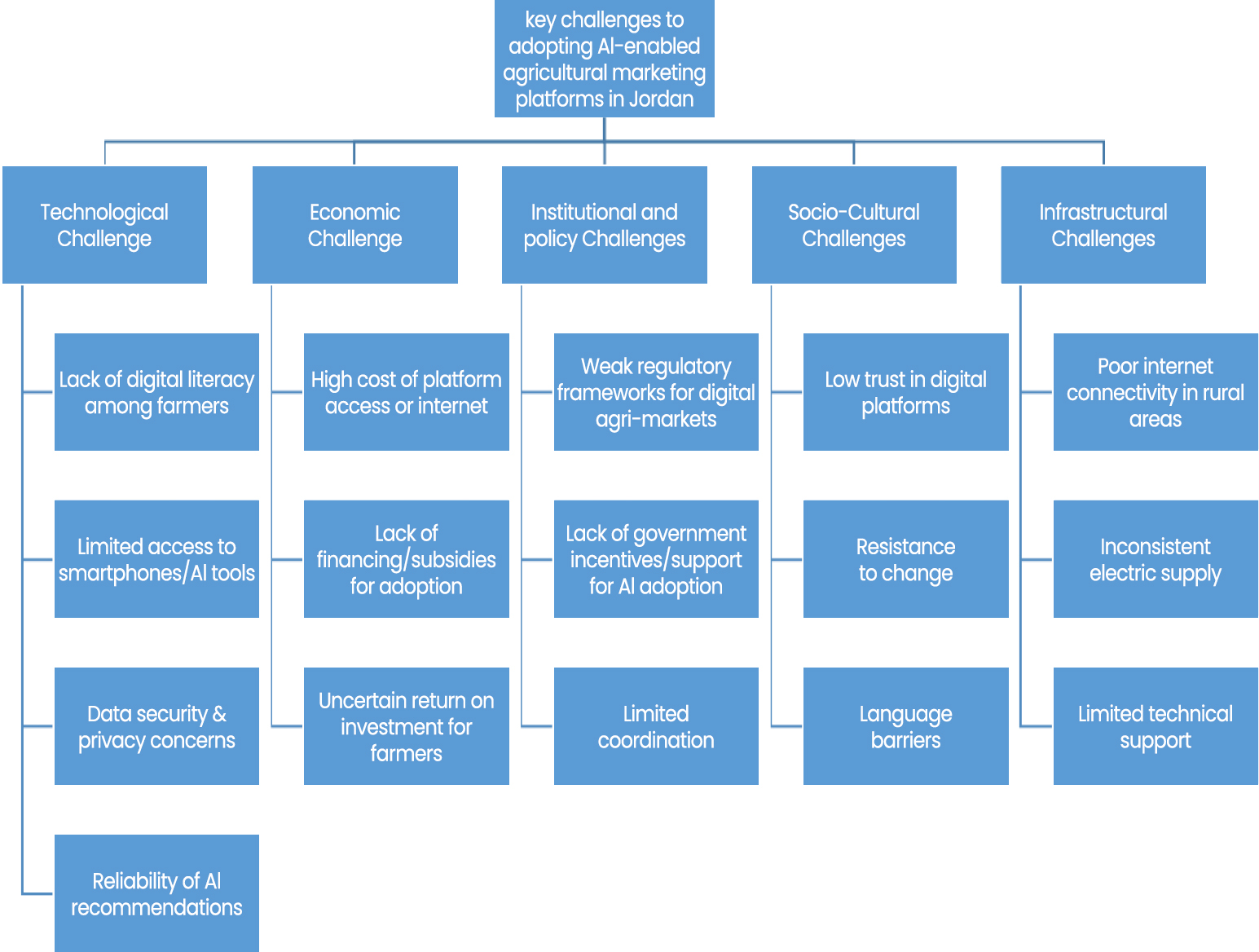
Fig. (1). Hierarchy of challenges.
4.2.2. Level 1 Analysis
Table 4 shows the criteria weights obtained from the AHP analysis for level 1 of the hierarchy, which included the key challenges such as technological challenges, economic challenges, institutional and policy challenges, socio-cultural challenges, and infrastructure challenges. As per the Table 4, technological challenge is the utmost priority and importance, with the criteria weights of 0.441. The second most important challenge is the infrastructural challenge with a criteria weight of 0.249, and the economic challenge is the third priority with a criteria weight of 0.164. However, the sociocultural and institutional challenges are the least important, with the criteria weights of 0.076 and 0.071, respectively. The consistency ratio is found to be 0.048, which is lower than 0.1 and hence shows consistency.
Table 4. Level 1: Challenges.
| Level 1: Challenges | |||
| ID | Criteria | Criteria Weights | Consistency Ratio |
| C1 | Technological challenge | 0.441 | 0.048 |
| C2 | Economic Challenge | 0.164 | |
| C3 | Institutional and policy challenge | 0.071 | |
| C4 | Sociocultural challenge | 0.076 | |
| C5 | Infrastructure challenge | 0.249 | |
4.2.3. Level 2 Analysis Technology Challenges
Table 5 shows the criteria weights from the AHP analysis for level 2 of the hierarchy. The sub-criteria challenges included lack of digital skills, limited access to smartphones/AI tools, data security and privacy concerns and reliability of AI recommendations. Table 5 Appendix shows a lack of digital skills as the top-most priority, with criteria weights of 0.476, and limited access as the second most priority, with criteria weights of 0.288. The reliability of AI recommendation is the third most important priority, with the criteria weight of 0.154, and data security and privacy concerns are the least important compared to others. The consistency ratio is 0.008 which indicates consistency.
Table 5. Level 2: Technological challenge.
| Level 2: Technological Challenge | |||
| ID | Sub-Criteria | Criteria Weights | Consistency Ratio |
| SC1.1 | Lack of digital skills | 0.476 | 0.008 |
| SC1.2 | Limited access to smartphone/AI tools | 0.288 | |
| SC1.3 | Data security & privacy concerns | 0.081 | |
| SC1.4 | Reliability of AI recommendations | 0.154 | |
4.2.4. Economic Challenges
Table 6 indicates that the high cost of platform/internet, with a weightage of 0.571, is the most significant economic challenge, followed by the lack of financing/subsidies, with a weightage of 0.286 and the uncertain ROI for farmers, with a weightage of 0.143. The consistency ratio of 0.000 reflects the consistency.
Table 6. Level 2: Economic challenge.
| Level 2: Economic Challenge | |||
| ID | Sub-Criteria | Criteria Weights | Consistency Ratio |
| SC2.1 | High cost of platform/internet | 0.571 | 0.000 |
| SC2.2 | Lack of financing/subsidies | 0.286 | |
| SC2.3 | Uncertain ROI for farmers | 0.143 | |
4.2.5. Institutional and Policy Challenges
Table 7 indicates that the weak regulatory framework, with a weightage of 0.648, is the most significant challenge. It is followed by the lack of government incentives, with a weightage of 0.230, and limited coordination, with a weightage of 0.122. The consistency ratio of 0.003 reflects consistency.
Table 7. Level 2: Institutional and policy challenge.
| Level 2: Institutional and Policy Challenges | |||
| ID | Sub-Criteria | Criteria Weights | Consistency Ratio |
| SC3.1 | Weak regulatory framework | 0.648 | 0.003 |
| SC3.2 | Lack of government incentives | 0.230 | |
| SC3.3 | Limited coordination | 0.122 | |
4.2.6. Socio-Cultural Challenges
Table 8 highlights low trust in digital platforms, with criteria weights of 0.557 being the utmost priority and resistance to change, with criteria weights of 0.320 being the second most important. The last important priority is language barriers, with a weightage of 0.123. The consistency ratio of 0.016 shows consistency.
Table 8. Level 2: Socio cultural challenge.
| Level 2: Socio Cultural Challenges | |||
| ID | Sub-Criteria | Criteria Weights | Consistency Ratio |
| SC4.1 | Low trust in digital platforms | 0.557 | 0.016 |
| SC4.2 | Resistance to change | 0.320 | |
| SC4.3 | Language barriers | 0.123 | |
4.2.7. Infrastructural Challenges
Table 9 shows that the poor internet connectivity has the weightage of 0.613 is the utmost challenge with inconsistent electric supply as the second most priority with weightage of 0.269 and limited technical support being least important with weightage of 0.118. The consistency ratio of 0.016 shows consistency.
Table 9. Level 2: Infrastructural challenge.
| Level 2: Infrastructural Challenges | |||
| ID | Sub-Criteria | Criteria Weights | Consistency Ratio |
| SC5.1 | Poor internet connectivity | 0.613 | 0.016 |
| SC5.2 | Limited technical support | 0.118 | |
| SC5.3 | Inconsistent electric supply | 0.269 | |
4.2.8. Regression Analysis
The demographic findings in Table 10 indicate that the majority of respondents aged between 26–30 (42.8%) and 31–35 (36.9%), reflecting the predominantly youthful workforce. Males accounted for 73.4% of the sample, reflecting gender skew. Designation-wise, agri-business managers (46.2%) were the majority, followed by agri-marketers (33.1%) and farmers (20.7%), reflecting managerial viewpoints.
Table 10. Demographics for quantitative analysis.
| Variable | Category | Frequency | Percent (%) |
| Age | 20–25 | 23 | 7.9 |
| 26–30 | 124 | 42.8 | |
| 31–35 | 107 | 36.9 | |
| 35+ | 36 | 12.4 | |
| Gender | Male | 213 | 73.4 |
| Female | 77 | 26.6 | |
| Designation | Agri-marketer | 96 | 33.1 |
| Agri-business Manager | 134 | 46.2 | |
| Farmer | 60 | 20.7 |
The regression analysis Table 11 illustrates that the predictors as a whole account for 19.5% of the variation in agricultural marketing performance, and the model is statistically significant (F = 23.046, p < 0.001). From among the predictors, Digital connectivity and market integration was the most significant determinant (β = 0.384, p < 0.001), implying that digital connectivity is the most important determinant of Agricultural Marketing Performance. BDA for price and demand prediction also had a strong positive influence (β = 0.155, p = 0.029), demonstrating their contribution to improving forecasting price and demand. Surprisingly, ML enabled market and trends forecast tools had insignificant negative affect (β = -0.104, p = 0.072), perhaps indicating adoption issues of complexity or scepticism about algorithmic forecasts.
Table 11. Regression analysis.
| – | Unstandardized Coefficients | Standardized Coefficients | |||
| – | B | Std. Error | Beta | t | Sig. |
| (Constant) | 2.275*** | 0.236 | – | 9.629 | 0.000 |
| ML enabled market and trend forecast tools | -0.104* | 0.058 | -0.124 | -1.804 | 0.072 |
| BDA for price and demand prediction | 0.155** | 0.070 | 0.130 | 2.198 | 0.029 |
| Digital Connectivity and market integration | 0.384*** | 0.058 | 0.447 | 6.622 | 0.000 |
| R-Squared | 0.195 | – | – | – | – |
| F-Statistics | 23.046*** | – | – | – | – |
Note: *** indicates significance at 1%, ** indicates significance at 5%, * indicates significance at 10%
5. DISCUSSION
This research was conducted on the impact of AI platform in developing agricultural marketing performance in Jordan. The qualitative evidence shows that there is an increasing yet reserved use of AI-based platforms in marketing of agriculture in Jordan. In line with TAM, farmers appreciated AI solutions as means of market access, price discovery and decision-enabling, especially predictive analytics. This coincides with (Dissanayake et al., 2022; and Adegbola, 2025) who state that perceived usefulness, in this case, on-time market information, facilitates adoption. Nevertheless, hybrid adoption was constantly re-occurring, where farmers consulted AI, but confirmed through word of mouth, having an intermediate phase in the process of digital transformation. The institutional enabler through training and subsidisation turned out to be a crucial requirement, which supports the literature in which (Mhlanga & Ndhlovu, 2023) report the differentiation in the role of ecosystem reinforcement in the diffusion of AI.
Problems identified during interviews, including digital illiteracy, infrastructural and trust problems, commuted with the results of (Dhillon & Moncur, 2023; and Alice & Ebuka, 2024). The distrust in AI products, financial considerations, and the small-scale localisation reported serious socio-cultural and infrastructural challenges that do not allow adopting technology in rural areas. Particularly, the belief in AI recommendations was found to be an emerging factor, which was grounded on conventional TAM determinants and emphasised the importance of situational credibility.
These barriers were ranked systematically in AHP ranking. The greatest rankings were technology issues (0.441) and the highest sub-factor was digital skills (0.476), which is consistent with qualitative data on the challenges by farmers to negotiate locations. Second in line was infrastructural problems in the path of unstable internet connectivity (0.613) which also helped to substantiate the fact that in the absence of stable digital infrastructure, adoption is superficial. (Mishra et al., 2023) are supported by economic barriers, especially the high cost of internet/platforms (0.571) when it comes to affordability gaps. Interestingly, institutional (0.071) and socio-cultural (0.076) had a lower weight implying that they are viewed as barriers but they may not be as urgent as more practical technology and infrastructural problems. These results offer hierarchical specificity, which may be lacking in qualitative research only and substantiate the (Araújo et al., 2021) argument about high-priority interventions.
The quantitative analysis also further substantiated these findings. Market integration and digital connectivity most heavily positively contributed to Agricultural Marketing Performance (β = 0.384, p < 0.001), affirming that ANT factors, such as real-time feedback and market integration, are crucial. It leads to the acceptance of H3. BDA for demand and price forecasting also contributed positively (β = 0.155, p = 0.029), consistent with (Giannakopoulos et al., 2024) concerning the role of data analytics in enhancing decision-making, accepting H2. Surprisingly, ML enabled market and trends forecast tools manifested a weak and negative affect (β = -0.104, p = 0.072), perhaps because of perceived technicality or insufficient trust in algorithmic accuracy, consistent with qualitative interviews’ concerns. It leads to rejection of H1. The negative value of the coefficient (-0.104) shows that the application of the ML-empowered market and trend forecasting instruments is marginally linked to the lower perceived marketing performance. Surprisingly, the ML-enabled forecasting tools generated a negative coefficient (-0.104), which was contrary to the expected positive correlation. This implies that the existing application of these tools might still be out of the realistic situations of agricultural markets in Jordan. Many farmers viewed the AI-made predictions as unrealistic or over insensitive to local seasonality, weather variations and market demand variations. They were not very confident about algorithm-based prediction in comparison to experience-based decision making. The negative and insignificant effect of ML-enabled forecasting tools contradicts earlier studies cited in the literature review. Although (Adegbola, 2025; and Alice & Ebuka, 2024) consider that ML can improve agricultural marketing by helping identify better trends and make preemptive decisions, the current result indicates that there is a discrepancy between the benefits of the theoretical concept and its practical implementation. On the same note, though (Dissanayake et al., 2022) give empirical evidence of better conversion and repeat purchase, their small-scale application prevents a generalization to complex agricultural systems such as Jordan. The negative coefficient is a sign that farmers might find these tools too technical or unsuitable to local realities and therefore less effective. This helps to fill the gap in the literature related to a lack of focus on contextual and behavioral factors. According to the Technology Acceptance Model, perceived usefulness and ease of use of the technology by farmers could be a barrier to its adoption. Altogether, the results highlight the importance of context-dependent adaptation and user-friendly implementation of ML tools.
The small R-squared (0.195) implies that although the model is found to be statistically significant, it still fails to explain a significant share of the variation in agricultural marketing performance, which is probably due to contextual, behavioural, and institutional factors, not measured within the model. This aligns with the previous studies that have indicated that technology-driven agricultural outcomes are affected by multi-faceted context-specific dynamics. In addition, the positive outcomes of digital connectivity and BDA are in line with the results of other studies, including (Adegbola, 2025; and Dissanayake et al., 2022) but the negative impact of ML tools conflicts with their findings, which illustrates the disconnect between theory and reality in the developing setting.
The combination of the three methods provides a consistent view: (1) qualitative data can reveal how and why farmers embrace or reject AI, (2) AHP can be used to determine the most significant barriers, and (3) quantitative regression can be used to define what technological enablers are statistically related to satisfaction. Collectively, they propose that although AI can radically transform the agricultural marketing, its adoption requires the solution to the underlying access issues, the creation of digital skills, and the establishment of trust in its suggestions. To transform the agricultural sector in Jordan into a digital one, policymakers must adopt a multi-dimensional approach that focuses on the infrastructure, capacity building, and context orientation.
There are a number of significant practical implications of the findings. To start with, the policymakers must focus on the establishment of rural digital infrastructure, especially the availability of a strong internet connection, so that the efficient implementation of AI-based agricultural technologies could become possible. Second, it is necessary to implement agricultural extension services and training programmes that would promote digital literacy of farmers and establish confidence in AI-based decision-support systems. Third, the cost barriers to the adoption of AI-enabled marketing and forecasting tools should be lowered by providing subsidies, grants, or low-interest financing by governments and financial institutions. Lastly, technology developers ought to aim at localising AI forecasting models through the use of regional climatic patterns, crop cycles, and market forces to enhance the accuracy of the prediction and the confidence of the farmer.
CONCLUSION AND RECOMMENDATION
This research concludes that although AI-informed platforms have immense potential in revolutionising the marketing of Jordanian produce via enhanced market reach, price transparency, and forecasting-based decision-making, there are a number of systemic impediments to their large-scale adoption. These are primarily technological challenges, specifically farmers’ lack of digital literacy, followed by infrastructural constraints such as substandard internet connectivity and lack of access to electricity. Financial hardships via prohibitive fees on platforms and absence of access to finance, coupled with low trust in AI technology and ambiguity regarding the rules of policy, also restrict digital tool integration in agriculture.
These issues being tackled, a number of practical proposals are offered. First, tailored digital literacy training needs to be introduced based on experience-focused, localised training methods to empower farmers’ confidence and capacity. Second, there needs to be investment in rural infrastructure that guarantees stable internet and electricity. Third, subsidised internet membership and low-interest credit for smartphones and digital hardware needs to be provided. Additionally, it must have a proper policy and regulatory framework of digital agriculture. Finally, the platforms must focus on transparency, applicability of context, and support of local language in order to make them instil confidence and be used regularly by farmers. The study has a theoretical contribution in that it combines the Technology Acceptance Model and Resource-Based View to understand the interactive effects of behavioural adoption factors and strategic digital capabilities on the AI-enabled agricultural marketing systems in the developing economy setting. It demonstrates the joint influence of behavioural technology acceptance and strategic resource capabilities on marketing performance that contributes to the body of literature on digital agriculture by bridging the gap between the stakeholder adoption behaviour and the competitive advantage at the sector level in the emerging economies.
POLICY IMPLICATIONS
This study has serious implications on the Jordanian agricultural policy. To start with, the omnipresence of trust in AI systems implies that the regulations must provide the transparency of algorithms, data protection, and the responsible use of AI in agriculture. This should be accompanied by policies that demand clear explanations of the way AI platforms generate predictions in order to make farmers less sceptical. Second, the national strategies should focus on investing in rural connectivity and digital infrastructure to close the gap in market access because of the beneficial effect of Advanced Networking Technologies. Third, the limited contribution of Big Data Analytics shows that when there is no proper absorptive capacity, the potential of the latter cannot be fully realised. Therefore, the policies should support the capacity-building initiatives, subsidies, and fiscal incentives to the small-scale farmers to embrace and effectively use AI tools.
LIMITATIONS AND FUTURE DIRECTION
There are several limitations that are face by this research. To begin with, quantitative analysis was founded on the cross-sectional design, which does not allow establishing causality. Secondly, despite the different approaches, the sample size might not have sufficient generalisability of the findings to the diverse agricultural sector in Jordan. Thirdly, qualitative results, though qualitative in nature, were anchored on self-reported perception, which may lead to bias. Future research should employ longitudinal designs to test the long-term effects of AI adoption, expand sample sizes to capture more diversified groups of farmers, and other variables such as cost of adoption and policy support procedures to further situate the knowledge.
LIST OF ABBREVIATIONS
| AI | = | Artificial Intelligence |
| ANT | = | Advanced Networking Technologies |
| BDA | = | Big Data Analytics |
| ML | = | Machine Learning |
| TAM | = | Technology Acceptance Model |
AUTHOR’S CONTRIBUTION
A.S.A. has contributed to conceptualization, idea generation, problem statement, methodology, results analysis, results interpretation.
ETHICAL STATEMENT & INFORMED CONSENT
The study was conducted in accordance with applicable ethical standards for professional survey research. Due to the anonymous nature of the study, ethical approval is not required. Informed consent was obtained from all participants prior to participation. The survey was anonymous, and no personally identifiable or sensitive personal information was collected. Formal ethical approval was not required in accordance with the applicable institutional and/or national guidelines.
AVAILABILITY OF DATA AND MATERIALS
The data will be made available on reasonable request by contacting the corresponding author [A.S.A.].
FUNDING
None.
CONFLICT OF INTEREST
The author declares no conflicts of interest, financial or otherwise.
ACKNOWLEDGEMENTS
Declared none.
DECLARATION OF AI
During the preparation of this manuscript, the author used ChatGPT for language polishing. After utilizing this tool, the author carefully reviewed and refined the content as necessary and accept full responsibility for the accuracy and integrity of the published work.
APPENDIX A: INTERVIEW QUESTIONNAIRE
- How are you currently using AI platforms (such as mobile apps, forecasting tools, or automation) in your agricultural marketing practices?
- What benefits have you observed from using AI, such as improved price prediction, market access, or demand forecasting?
- What challenges or barriers do you face when adopting AI technologies (e.g., cost, digital literacy, infrastructure, or trust in the system)?
- How important is transparency and trustworthiness of AI tools in influencing your decision to adopt them?
- In what ways do you think AI can improve competitiveness and profitability in Jordan’s agricultural sector?
- What kind of support (from government, agri-businesses, or technology providers) would help you adopt and benefit from AI tools more effectively?
APPENDIX B: AHP QUESTIONNAIRE
Instructions: Rate each of the KPI below using the rating scale as below:
| Level | Definition |
| 1 | Equal Importance |
| 3 | Moderate Importance |
| 5 | Strong Importance |
| 7 | Very Strong Importance |
| 9 | Extreme Importance |
| 2,4,6,8 | Intermediate values between 2 values |
| AHP Weighting Questionnaire LEVEL 1 | ||||||||||||||||||
| Level 1 | Level of Importance | Level 1 | ||||||||||||||||
| Technological challenge | 9 | 8 | 7 | 6 | 5 | 4 | 3 | 2 | 1 | 2 | 3 | 4 | 5 | 6 | 7 | 8 | 9 | Economic Challenge |
| Technological challenge | 9 | 8 | 7 | 6 | 5 | 4 | 3 | 2 | 1 | 2 | 3 | 4 | 5 | 6 | 7 | 8 | 9 | Institutional and Policy Challenges |
| Technological challenge | 9 | 8 | 7 | 6 | 5 | 4 | 3 | 2 | 1 | 2 | 3 | 4 | 5 | 6 | 7 | 8 | 9 | Socio-cultural Challenges |
| Technological challenge | 9 | 8 | 7 | 6 | 5 | 4 | 3 | 2 | 1 | 2 | 3 | 4 | 5 | 6 | 7 | 8 | 9 | Infrastructural challenges |
| Economic Challenge | 9 | 8 | 7 | 6 | 5 | 4 | 3 | 2 | 1 | 2 | 3 | 4 | 5 | 6 | 7 | 8 | 9 | Institutional and Policy Challenges |
| Economic Challenge | 9 | 8 | 7 | 6 | 5 | 4 | 3 | 2 | 1 | 2 | 3 | 4 | 5 | 6 | 7 | 8 | 9 | Socio-cultural Challenges |
| Economic Challenge | 9 | 8 | 7 | 6 | 5 | 4 | 3 | 2 | 1 | 2 | 3 | 4 | 5 | 6 | 7 | 8 | 9 | Infrastructural challenges |
| Institutional and Policy Challenges | 9 | 8 | 7 | 6 | 5 | 4 | 3 | 2 | 1 | 2 | 3 | 4 | 5 | 6 | 7 | 8 | 9 | Socio-cultural Challenges |
| Institutional and Policy Challenges | 9 | 8 | 7 | 6 | 5 | 4 | 3 | 2 | 1 | 2 | 3 | 4 | 5 | 6 | 7 | 8 | 9 | Infrastructural challenges |
| Socio-cultural Challenges | 9 | 8 | 7 | 6 | 5 | 4 | 3 | 2 | 1 | 2 | 3 | 4 | 5 | 6 | 7 | 8 | 9 | Infrastructural challenges |
| AHP Weighting Questionnaire LEVEL 2 | ||||||||||||||||||
| Technological challenge | ||||||||||||||||||
| Level 2 | Level of Importance | Level 2 | ||||||||||||||||
| Lack of digital skills | 9 | 8 | 7 | 6 | 5 | 4 | 3 | 2 | 1 | 2 | 3 | 4 | 5 | 6 | 7 | 8 | 9 | Limited access to smartphone/AI tools |
| Lack of digital skills | 9 | 8 | 7 | 6 | 5 | 4 | 3 | 2 | 1 | 2 | 3 | 4 | 5 | 6 | 7 | 8 | 9 | Data Security and Privacy Concerns |
| Lack of digital skills | 9 | 8 | 7 | 6 | 5 | 4 | 3 | 2 | 1 | 2 | 3 | 4 | 5 | 6 | 7 | 8 | 9 | Reliability of AI Recommendations |
| Limited access to smartphone/AI tools | 9 | 8 | 7 | 6 | 5 | 4 | 3 | 2 | 1 | 2 | 3 | 4 | 5 | 6 | 7 | 8 | 9 | Data Security and Privacy Concerns |
| Limited access to smartphone/AI tools | 9 | 8 | 7 | 6 | 5 | 4 | 3 | 2 | 1 | 2 | 3 | 4 | 5 | 6 | 7 | 8 | 9 | Reliability of AI Recommendations |
| Data Security and Privacy Concerns | 9 | 8 | 7 | 6 | 5 | 4 | 3 | 2 | 1 | 2 | 3 | 4 | 5 | 6 | 7 | 8 | 9 | Reliability of AI Recommendations |
| Economic Challenges | ||||||||||||||||||
| Level 2 | Level of Importance | Level 2 | ||||||||||||||||
| High Cost of platform access or internet | 9 | 8 | 7 | 6 | 5 | 4 | 3 | 2 | 1 | 2 | 3 | 4 | 5 | 6 | 7 | 8 | 9 | Lack of financing/subsidies for adoption |
| High Cost of platform access or internet | 9 | 8 | 7 | 6 | 5 | 4 | 3 | 2 | 1 | 2 | 3 | 4 | 5 | 6 | 7 | 8 | 9 | Uncertain return on investment for farmers |
| Lack of financing/subsidies for adoption | 9 | 8 | 7 | 6 | 5 | 4 | 3 | 2 | 1 | 2 | 3 | 4 | 5 | 6 | 7 | 8 | 9 | Uncertain return on investment for farmers |
| Institutional and Policy Challenges | ||||||||||||||||||
| Level 2 | Level of Importance | Level 2 | ||||||||||||||||
| Weak regulatory framework for digital agri-markets | 9 | 8 | 7 | 6 | 5 | 4 | 3 | 2 | 1 | 2 | 3 | 4 | 5 | 6 | 7 | 8 | 9 | Lack of government incentives/support for AI adoption |
| Weak regulatory framework for digital agri-markets | 9 | 8 | 7 | 6 | 5 | 4 | 3 | 2 | 1 | 2 | 3 | 4 | 5 | 6 | 7 | 8 | 9 | Limited Coordination |
| Lack of government incentives/support for AI adoption | 9 | 8 | 7 | 6 | 5 | 4 | 3 | 2 | 1 | 2 | 3 | 4 | 5 | 6 | 7 | 8 | 9 | Limited Coordination |
| Socio-Cultural Challenges | ||||||||||||||||||
| Level 2 | Level of Importance | Level 2 | ||||||||||||||||
| Low trust in digital platforms | 9 | 8 | 7 | 6 | 5 | 4 | 3 | 2 | 1 | 2 | 3 | 4 | 5 | 6 | 7 | 8 | 9 | Resistance to change |
| Low trust in digital platforms | 9 | 8 | 7 | 6 | 5 | 4 | 3 | 2 | 1 | 2 | 3 | 4 | 5 | 6 | 7 | 8 | 9 | Language Barriers |
| Resistance to change | 9 | 8 | 7 | 6 | 5 | 4 | 3 | 2 | 1 | 2 | 3 | 4 | 5 | 6 | 7 | 8 | 9 | Language Barriers |
| Infrastructural Challenges | ||||||||||||||||||
| Level 2 | Level of Importance | Level 2 | ||||||||||||||||
| Poor internet connectivity in rural areas | 9 | 8 | 7 | 6 | 5 | 4 | 3 | 2 | 1 | 2 | 3 | 4 | 5 | 6 | 7 | 8 | 9 | Limited Technical Support |
| Poor internet connectivity in rural areas | 9 | 8 | 7 | 6 | 5 | 4 | 3 | 2 | 1 | 2 | 3 | 4 | 5 | 6 | 7 | 8 | 9 | Inconsistent Electric supply |
| Limited Technical Support | 9 | 8 | 7 | 6 | 5 | 4 | 3 | 2 | 1 | 2 | 3 | 4 | 5 | 6 | 7 | 8 | 9 | Inconsistent Electric supply |
APPENDIX C: QUESTIONNAIRE
Part 1: Demographics
- a) Gender
- Male
- Female
- b) Age
- 20-25
- 26-30
- 31-35
- 35+
- c) Designation
- Agri-business manager
- Agri-marketer
- Farmers
- ML-enabled Market and trends Forecast
- Insights generated from machine learning forecasts help me make more timely and effective marketing decisions.
- Machine learning models provide valuable predictions that support strategic planning in agricultural markets.
- The use of ML-enabled trend analysis has improved my ability to respond to market fluctuations.
- BDA for Price and Demand Forecasting
- Big Data Analytics helps me process large volumes of market data for informed pricing decisions.
- Using BDA enhances my ability to forecast market demand trends effectively.
- BDA supports better strategic planning and reduces risk in agricultural marketing.
- Digital Connectivity and Market Integration
- Digital connectivity improves my access to real-time information on prices and market conditions.
- Connectivity tools strengthen collaboration with other actors in the agricultural value chain.
- Digital platforms have enhanced my ability to integrate with broader markets and reach new buyers.
- Agricultural Marketing Performance (Dependent Variable)
- I am satisfied with how AI tools have improved my marketing performance (g., sales, profitability).
- I am satisfied with the access AI platforms provide to broader and more competitive markets.
- I feel satisfied with the support AI applications offer in making timely and informed marketing decisions.
REFERENCES
Abaddi, S. (2025). Factors and moderators influencing artificial intelligence adoption by Jordanian MSMEs. Management & Sustainability: An Arab Review, 4(1), 47-73. https://doi.org/10.1108/MSAR-10-2023-0049.
Adegbola, I. (2025). Leveraging Machine Learning for Predictive Market Intelligence in Agricultural SMEs. Authorea Preprints. https://doi.org/10.22541/au.175217030.08204973/v1.
Ahmad, A., Liew, A. X., Venturini, F., Kalogeras, A., Candiani, A., Di Benedetto, G., … & Martos, V. (2024). AI can empower agriculture for global food security: challenges and prospects in developing nations. Frontiers in Artificial Intelligence, 7, 1328530. https://doi.org/10.3389/frai.2024.1328530.
Akintoye, A. (2023). AI-Driven Agriculture Marketplaces Digitalizing Farm to Retail Supply Chains in UK. AI-Driven Agriculture Marketplaces Digitalizing Farm to Retail Supply Chains in UK. Available from: https://www.researchgate.net/
Ali, H., & Salhab, H. A. (2025). The role of green marketing in addressing environmental and economic challenges in Jordan. Environmental Economics, 16(2), 15-25. http://dx.doi.org/10.21511/ee.16(2).2025.02.
Alice, S. I., & Ebuka, O. D. (2024). The Potential and Challenges of AI Adoption in Marketing Across Africa: Opportunities for Digital Transformation. Business and Investment Review, 2(6). Available from: https://lgdpublishing.org/index.php/birev/article/view/140.
Al-Taha’at, E., Harb, S. A., Abd Al-Slaibi, O., & Hamadneh, B. N. (2025). The Role of Artificial Intelligence in Enhancing the Agricultural Extension and Marketing. International Journal of Agriculture and Biosciences, 14(6), 1481-1491. https://doi.org/10.47278/journal.ijab/2025.062.
Anbar, A. H., Abu-Dalhoum, M., Maslamani, A., Al Antary, T. M., & Sawwan, J. (2020). Agricultural Patterns in Jordan: a new analytical approach. 29(12), 11006-11016. Available from: https://www.researchgate.net/publication/344769743.
Araújo, S. O., Peres, R. S., Barata, J., Lidon, F., & Ramalho, J. C. (2021). Characterising the agriculture 4.0 landscape—emerging trends, challenges and opportunities. Agronomy, 11(4), 667. https://doi.org/10.3390/agronomy11040667.
Beithou, N., Qandil, A., Khalid, M. B., Horvatinec, J., & Ondrasek, G. (2022). Review of agricultural-related water security in water-scarce countries: Jordan case study. Agronomy, 12(7), 1643. https://doi.org/10.3390/agronomy12071643.
Bhat, S. A., & Huang, N. F. (2021). Big data and AI revolution in precision agriculture: Survey and challenges. Ieee Access, 9, 110209-110222. https://doi.org/10.1109/ACCESS.2021.3102227.
Birner, R., Daum, T., & Pray, C. (2021). Who drives the digital revolution in agriculture? A review of supply‐side trends, players and challenges. Applied Economic Perspectives and Policy, 43(4), 1260-1285. https://doi.org/10.1002/aepp.13145.
Braun, V., & Clarke, V. (2021). To saturate or not to saturate? Questioning data saturation as a useful concept for thematic analysis and sample-size rationales. Qualitative Research in Sport, Exercise and Health, 13(2), 201-216. https://doi.org/10.1080/2159676X.2019.1704846.
Braun, V., & Clarke, V. (2023). Toward good practice in thematic analysis: Avoiding common problems and be (com) ing a knowing researcher. International journal of transgender health, 24(1), 1-6. https://doi.org/10.1080/26895269.2022.2129597.
Che, F. N., Strang, K. D., & Vajjhala, N. R. (2020). Voice of farmers in the agriculture crisis in North-East Nigeria: Focus group insights from extension workers. International Journal of Development Issues, 19(1), 43-61. https://doi.org/10.1108/IJDI-08-2019-0136.
Costa, F., Frecassetti, S., Rossini, M., & Portioli-Staudacher, A. (2023). Industry 4.0 digital technologies enhancing sustainability: Applications and barriers from the agricultural industry in an emerging economy. Journal of Cleaner Production, 408, 137208. https://doi.org/10.1016/j.jclepro.2023.137208.
Creswell, J. W., & Poth, C. N. (2016). Qualitative inquiry and research design: Choosing among five approaches. Sage publications, 552. Available From: https://uk.sagepub.com/en-gb/eur/qualitative-inquiry-and-research-design/book266033.
Devlet, A. (2021). Modern agriculture and challenges. Frontiers in Life Sciences and Related Technologies, 2(1), 21-29. https://doi.org/10.51753/flsrt.856349.
Dhillon, R., & Moncur, Q. (2023). Small-scale farming: A review of challenges and potential opportunities offered by technological advancements. Sustainability, 15(21), 15478. https://doi.org/10.3390/su152115478.
Dissanayake, C. A. K., Jayathilake, W., Wickramasuriya, H. V., Dissanayake, U., Kopiyawattage, K. P., & Wasala, W. M. C. B. (2022). Theories and models of technology adoption in agricultural sector. Human Behavior and Emerging Technologies, 15(1), 9258317. https://doi.org/10.1155/2022/9258317.
Eshbayev, O., Matkarimova, G., Kurolov, M., Mirzaliev, S., Mannapova, S., & Tojimova, K. (2024). Identifying Agricultural Market Structures and Digital Marketing Impact Using Advanced Networking Technologies. Proceedings of the 8th International Conference on Future Networks & Distributed Systems, 341-348. https://doi.org/10.1145/3726122.3726172.
Fitriyani, D. R., & Nasir, M. (2025). AI-Enabled Market Access: Farmers’ Perspectives on Digital Platforms and Their Impact on Agricultural Trade in Remote Areas. Digital Agriculture and Innovation Journal, 1(1), 28-36. https://doi.org/10.59261/journaldaij.v1i1.4.
Giannakopoulos, N. T., Terzi, M. C., Sakas, D. P., Kanellos, N., Toudas, K. S., & Migkos, S. P. (2024). Agroeconomic indexes and big data: digital marketing analytics implications for enhanced decision making with artificial intelligence-based modelling. Information, 15(2), 67. https://doi.org/10.3390/info15020067.
Jordan News Agency (2025). Jordan’s agricultural exports up by 6.9% to about JD1.5b last year-Hneifat, Petra. Available from: https://petra.gov.jo/Include/InnerPage.jsp?ID=71358&lang=en&name=en_news (Accessed: 16 September 2025).
Kannan, S. (2022). AI-Powered Agricultural Equipment: Enhancing Precision Farming Through Big Data and Cloud Computing. Kurdish Studies, 10(2), 891–905. https://doi.org/10.53555/ks.v10i2.3843.
Kendall, H., Clark, B., Li, W., Jin, S., Jones, G. D., Chen, J., … & Frewer, L. J. (2022). Precision agriculture technology adoption: A qualitative study of small-scale commercial “family farms” located in the North China Plain. Precision Agriculture, 23(1), 319-351. https://doi.org/10.1007/s11119-021-09839-2.
Khalili, H. (2024). Deep Learning Pricing of Processing Firms in Agricultural Markets. Agriculture, 14(5), 712. https://doi.org/10.3390/agriculture14050712.
Ma, H., & Zhang, X. (2022). Construction of Smart Marketing Model of Agricultural Products E‐Commerce in the Era of Big Data. Mobile Information Systems, 2022(1), 3016554. https://doi.org/10.1155/2022/3016554.
Mhlanga, D., & Ndhlovu, E. (2023). Digital technology adoption in the agriculture sector: Challenges and complexities in Africa. Human Behavior and Emerging Technologies, 2023(1), 6951879. https://doi.org/10.1155/2023/6951879.
Mishra, D., Muduli, K., Raut, R., Narkhede, B. E., Shee, H., & Jana, S. K. (2023). Challenges facing artificial intelligence adoption during COVID-19 pandemic: an investigation into the agriculture and agri-food supply chain in India. Sustainability, 15(8), 6377. https://doi.org/10.3390/su15086377.
Mohammad, A. A. S., Mohammad, S. I. S., Al‑Daoud, K. I., Al Oraini, B., Vasudevan, A., & Feng, Z. (2025). Optimizing the Value Chain for Perishable Agricultural Commodities: A Strategic Approach for Jordan. Research on World Agricultural Economy, 6(1), 465-478. https://doi.org/10.36956/rwae.v6i1.1571.
Mohr, S., & Kühl, R. (2021). Acceptance of artificial intelligence in German agriculture: an application of the technology acceptance model and the theory of planned behavior. Precision Agriculture, 22, 1816-1844. https://doi.org/10.1007/s11119-021-09814-x.
Permono, B., & Kurniati, A. (2024). Decision-making processes in resource management: Lessons from the agriculture sector. Journal of Resource Management and Decision Engineering, 3(2), 13-23. https://doi.org/10.61838/kman.jrmde.3.2.3.
Petcu, M. A., Sobolevschi-David, M. I., Curea, S. C., & Moise, D. F. (2024). Integrating artificial intelligence in the sustainable development of agriculture: Applications and challenges in the resource-based theory approach. Electronics, 13(23), 4580. https://doi.org/10.3390/electronics13234580.
Qazinform (2025). Jordan’s agricultural sector fuels 2024 Q4 growth, surpassing 8% GDP contribution (2025) Qazinform.com. ‘Inform’. Available from: https://qazinform.com/news/jordans-agricultural-sector-fuels-2024-q4-growth-surpassing-8-gdp-contribution-08422a#:~:text=Jordan’s%20agricultural%20sector%20fuels%202024%20Q4%20growth%2C%20surpassing%208%25%20GDP%20contribution,-19%3A15%2C%207&text=New%20data%20from%20the%20Department,nation’s%202024%20GDP%2C%20Petra%20reports (Accessed: 16 September 2025).
Soni, V. K., Verma, R., Verma, S., & Dewangan, V. (2025). AI-Powered Mobile Applications for Smallholder Farmers: Transforming Agricultural Productivity, Market Integration, and Resource Optimization. In International Conference on Advances and Applications in Artificial Intelligence, (ICAAAI 2025), Atlantis Press, 731-744. https://doi.org/10.2991/978-94-6463-738-0_58.
Sott, M.K., Furstenau, L.B., Kipper, L.M., Giraldo, F.D., López-robles, J.R., Cobo, M.J., Zahid, A., Abbasi, Q.H., & Imran, M.A. (2020). Precision Techniques and Agriculture 4.0 Technologies to Promote Sustainability in the Coffee Sector: State of the Art, Challenges and Future Trends. IEEE Access, 8, 149854-149867. https://doi.org/10.1109/ACCESS.2020.3016325.
Tiwari, R., Chand, K., Bhatt, A., Anjum, B., & Thirunavukkarasu, K. (2021). Agriculture 5.0 in India: opportunities and challenges of technology adoption. A Step Towards Society 5.0, 179-198. https://www.taylorfrancis.com/chapters/edit/10.1201/9781003138037-10/agriculture-5-0-india-rajesh-tiwari-khem-chand-arvind-bhatt-bimal-anjum-thirunavukkarasu?context=ubx&refId=ae489c15-cf55-409f-83ec-fb0ea13658ae.
Trade. Gov (2024). Jordan Country Commercial Guide Jordan – Agricultural Sectors, International Trade Administration | Trade.gov. Available from https://www.trade.gov/country-commercial-guides/jordan-agricultural-sectors (Accessed: 16 September 2025).