
- ABSTRACT
- 1. INTRODUCTION
- 2. LITERATURE REVIEW
- 3. METHODOLOGY
- 4. RESULTS
- 5. DISCUSSION
- CONCLUSION
- LIMITATIONS AND FUTURE DIRECTIONS
- POLICY IMPLICATIONS
- LIST OF ABBREVIATIONS
- AUTHOR'S CONTRIBUTION
- ETHICAL STATEMENT & INFORMED CONSENT
- AVAILABILITY OF DATA AND MATERIALS
- FUNDING
- CONFLICT OF INTEREST
- ACKNOWLEDGEMENTS
- DECLARATION OF AI
- REFERENCES
Evaluating Strategic Management Dimensions and Its Effect on Business Performance in The United Arab Emirates’ Hospitality and Food Service SMEs
 DOI:
DOI:
 PDF
PDF
⬇ Downloads: 14
1College of Business, Al Yamamah University, Riyadh, Saudi Arabia
Received: 29 December, 2025
Accepted: 19 June, 2026
Revised: 18 June, 2026
Published: 30 July, 2026
ABSTRACT
Introduction: This study investigates the effects of strategic management dimensions on the financial and non-financial performance of hospitality and food service SMEs in the United Arab Emirates (UAE). It further examines how organisational learning serves as a mediating factor in transforming strategic practices into actual financial and non-financial performance.
Methodology: The research design was a primary quantitative study, with a sample of 410 managers and leaders of UAE hospitality and food service SMEs, and data were gathered using a structured 5-point Likert scale questionnaire. Data analysis was conducted using PLS-SEM in SmartPLS.
Results: The study found that strategy formulation significantly enhanced financial and non-financial performance. The implementation of strategy was found to have insignificant direct effects. Significant indirect effects through organisational learning mediation on both financial and non-financial performance evidenced complete mediation. Environmental scanning showed insignificant direct effects, although it had an indirect impact on organisational learning, affecting both financial and non-financial performance. Strategy evaluation positively influenced non-financial performance, with a direct effect, and both financial and non-financial performance through the indirect effect of organisational learning.
Conclusion: The findings imply that including organisational learning within strategic processes is essential for UAE SMEs to enhance both financial and non-financial performance. However, the cross-sectional nature and reliance on self-reported data do not allow for causal inference; longitudinal studies and multi-source data may be necessary to enhance generalisability.
Keywords: Strategic management dimensions, organisational learning, business performance, smes, hospitality and food service sector, United Arab Emirates (UAE).
1. INTRODUCTION
The hospitality and food services sector in the United Arab Emirates (UAE) is one of the main pillars of the country’s economic diversification strategy, leveraging its strategic location, well-developed tourism infrastructure, and global connectivity to attract millions of visitors annually (AGDA, 2023). This atmosphere has led to a booming ecosystem of small and medium enterprises (SMEs) that run various businesses in hotels, restaurants, cafes, and other related service sectors, which have become a significant source of employment (King’s Business School, 2025). Nonetheless, the industry operates in a highly competitive, dynamic environment, and efficient strategic management practices are necessary to maintain organisational performance and sustainability, as stressed by (Alfalasi & Kaluvilla 2023; and Grassa et al., 2024).
Although the UAE foodservice market is estimated at nearly $12 billion, with more than 30,000 active outlets, hospitality and foodservice SMEs are feeling increasing pressure that negatively affects their performance (Arnold, 2024). The saturation of the market, intense competition between local and international brands, and increased compliance costs associated with licencing, labour, and food safety regulations continue to erode profitability and restrict strategic flexibility (Blitzindiamedia, 2024). In addition, the industry is experiencing a chronic human capital crunch, including labour shortages and employee turnover. (PwC Middle East, 2023) reported a labour shortage of almost 8.5% and a labour turnover rate of nearly 27%, both of which undermine service quality, employee development, and organisational stability. These difficulties highlight vital performance areas, especially dwindling market share growth and limited employee development, which are directly interconnected with shortcomings in strategic management aspects such as environmental scanning, strategy formulation, implementation, and assessment, as disclosed by (Bhambi, 2025; and Al Nuaimi et al., 2024).
In this background, strategic management dimensions have been consistently linked to better financial results, in terms of market share, and non-financial results, in terms of employee development and growth, as suggested by (ForouzeshNejad, 2024; and Imiru, 2024). Systematic environmental scanning allows organisations to foresee threats and opportunities, and, at the same time, with proper strategy formulation and implementation, they can align their resources with priorities in the competition, as argued by (Barragán-Hernández & Aguilar-Fernández, 2024; and Güner et al., 2024). Notably, as specified by (Andersson et al., 2022; and Alfalasi & Kaluvilla, 2023), the concept of organisational learning refers to how organisations continually acquire, understand, and institutionalise internal and external knowledge to systematically gain capability. It helps to adapt behaviour by turning strategic actions and feedback into better organisational practices and decision-making processes. It is not considered an outcome or process but a mediating capacity in the context of dynamic capability logic for strategic adjustment and performance improvement within the SME setting, as investigated in this study.
This study is placed in the context and configuration of its contribution. First, it builds on previous theory by exploring the strategic decision-making and learning processes of UAE hospitality and food service SMEs, which are distinct from those of large firms. Second, it explores how strategic decision-making and learning structures in these SMEs reflect and are shaped by local and regional contexts, such as legal, political, cultural, and social influences, as well as environmental challenges such as unemployment, tourism expansion, and the influx of foreign labour. Second, it contributes to the configurational view because it shows that the dimensions involved in strategic management environmental scanning, formulation, implementation, and evaluation have not constant effects on the financial and non-financial performance outcomes. Third, it provides interesting empirical evidence. In particular, Strategy Implementation has no direct impact on financial and non-financial performance, and environmental scanning has a highly positive relationship with Organisational Learning. In addition, the link between the formulation of strategy and its results does not occur through organisational learning. These findings enhance previous explanations supporting the theories, as they identify the boundary conditions in which the dimensions of strategic management affect the performance of UAE hospitality and food service SMEs. These findings, taken together, extend and complement the theory by specifying the boundary conditions under which Dynamic Capabilities Theory and the mechanisms of organisational learning can be used in the field of SME services.
2. LITERATURE REVIEW
2.1. Theoretical Framework
The research is based on the Dynamic Capabilities Theory and the Organisational Learning Theory, which provide the analytical approach for investigating improvements in strategic management dimensions and financial and non-financial performance in UAE hospitality and food service SMEs. Dynamic Capabilities Theory argues that firms sustain competitive advantage through their ability to sense opportunities, seize them strategically, and continuously transform organisational capabilities in dynamic environments (Rafiq et al., 2020). Environmental scanning, in this case, is defined as a dynamic sensing capability that helps firms detect both market opportunities and threats (Mai et al., 2022). In contrast, strategy formulation is a configurational capability that aligns tangible and intangible resources with strategic objectives (Tian et al., 2021). Strategy implementation is an operational capability that transforms strategic plans into operational routines (Alshukri et al., 2024). Strategy evaluation is a learning capability that enables feedback and adaptation to achieve better organisational outcomes, as suggested by (Chatterjee et al., 2024).
Organisational Learning Theory complements Dynamic Capabilities Theory by explaining how these capabilities are used through the mechanisms of knowledge acquisition, absorption, and dissemination (Soomro et al., 2021). The conceptualisation of organisational learning in this study assumes Dynamic Capabilities Theory, which constitutes a theory that sees the firms develop performance not by becoming encumbered with resources but by building up performance-based capabilities in three phases: sensing, seizing and transforming suggested in (Barragán-Hernández & Aguilar-Fernández, 2024) also. Environmental scanning becomes a sense-making ability, in which companies focus on the changes in their environments, and strategy formulation becomes a seizing ability in that companies allocate resources to strategic intent and opportunity capture to opportunity harvesting, as identified in (Phan et al., 2020). According to (Shabbir & Wisdom, 2020), the implementation and evaluation of strategies also transform the capabilities in which firms alter, develop, and formalise strategic activities through feedback loops. The embeddedness of organisational learning in the transforming dimension occurs through the processes of knowledge acquisition, interpretation, and institutionalisation, which promote adaptive change (Mousa et al., 2024; Kozcu & Özmen, 2023) propose that learning is set in motion through the creation of uncertainty and the need for a behavioural change in the process of strategic activities. This dynamic view highlights that the outcome of a performance is not solely a function of resources but also of how well the firm senses, seizes, and transforms knowledge into an adaptive strategic response.
This is not an author-derived classification but is based on dynamic capabilities theory and organisational learning theory to explain the distinction between strategic management dimensions. According to dynamic capabilities theory, strategic activities can be seen as being characterised based on the level of their involvement in sensing, interpreting, and reconfiguring organisational resources to adapt to environmental changes (Rafiq et al., 2020). Strategic intent, resource alignment, and opportunity selection are the focus of strategy formulation, and the effects of performance can be direct as a result of the quality of the managerial decisions. Environmental scanning, strategy implementation, and strategy evaluation, on the other hand, are repetitive activities, giving rise to feedback, uncertainty, and information interpretation, which in turn leads to organisational adaptation, as suggested by (Mai et al., 2022). Organisational learning theory argues that these dimensions are only beneficial when knowledge can be acquired, assimilated, and institutionalised in the firm’s knowledge assets. Consequently, learning emerged as a more viable mediator of these dimensions. This theoretical differentiation serves to ground a priori the selective mediation effects, as opposed to uniform ones.
The UAE context of hospitality and food service SME is a new territory for theoretical insights because of its specific structural and environmental features. In contrast to the western markets that are usually studied in strategic management literature, UAE SMEs are situated in highly dynamic markets driven by tourism, which have complex market conditions of intense competition, expatriate-dependent labour structures, and predominantly owner-centred decision-making. These conditions determine how the strategic management dimensions produce the desired performance outcomes, such as resource utilisation and knowledge processing. This context emphasises the boundaries of absorptive capacity and learning mechanisms at the informal level and in a fast-changing environment from a dynamic capability and organisational learning perspective. Therefore, the UAE SME setting allows for a more in-depth understanding of the boundary conditions under which strategic practices and learning mechanisms impact financial and non-financial performance.
2.2. Hypotheses Development
Although all dimensions are hypothesised to influence performance directly, the theoretical framework anticipates stronger mediation effects for action-based strategic dimensions. In this study, business performance is operationalised through financial and non-financial performance.
2.2.1. Environmental Scanning and Business Performance
This dimension of strategic management helps firms detect external opportunities, threats, and sustainability pressures that can affect their business performance. One of the most recurring issues in the literature is that a firm that is sensitive to environmental, social, and market signals is better positioned than its competitors because of its more substantial strategic alignment (Alshukri et al., 2024; Soomro et al., 2021; Ahmad et al., 2021) found that greater ESG involvement is associated with better financial performance, suggesting that environmental consciousness is a vital strategic resource. This aligns with the Dynamic Capabilities Theory, which posits that companies that can systematically monitor external demands are better positioned to convert information into competitive advantage.
The evidence available so far indicates that the impact of environmental scanning on performance is more related to the use and interpretation of knowledge acquired than to its acquisition. (Shabbir & Wisdom 2020) found that internally focused scanning is linked with profitability, but this does not automatically mean that it adds strategic value to the business unless it extends to include wider outside scanning. Similarly, (Phan et al., 2020) show that sustainability-related concepts have indirect financial impacts through employee satisfaction and customer loyalty, but not directly through operational impacts. Overall, these studies suggest that the strategic importance of environmental intelligence depends on the capacity of firms to coordinate knowledge, tie information to the firm’s goals, and integrate knowledge into decision-making. This viewpoint goes beyond collecting information and focuses on capability building in the organisation as a key prerequisite for improving performance, as mentioned by (Rafiq et al., 2020; and Tian et al., 2021).
Although rigorous in methodology, these studies are mostly confined to manufacturing industries and large companies, limiting their applicability to hospitality and food service SMEs in the Philippines. The synthesis of these understandings implies that environmental scanning can improve business performance only when companies learn, interpret, internalise, and act. These arguments emerging from the literature review led to the formulation of H1:
H1a: Environmental scanning has a significant positive effect on financial performance in the case of hospitality and food services SMEs in the UAE.
H1b: Environmental scanning has a significant positive effect on non-financial performance in the case of hospitality and food services SMEs in the UAE.
2.2.2. Strategy Formulation and Business Performance
Strategy formulation is one of the most critical dimensions of strategic management, determining financial and non-financial performance through resource allocation, prioritisation, and goal setting. According to the Dynamic Capabilities Theory (DCT), the strategy formulation process can help firms discover, assemble, and deploy valuable, rare, and inimitable resources and capabilities to create competitive advantages, as suggested by (Bhambi, 2025; and Imiru, 2024). According to (Barragan-Hernandez & Aguilar-Fernandez, 2024), the ability to distinguish oneself and achieve high results relies on strategic intent regarding the deployment of resources. The alignment of unique capabilities with market opportunities to gain profits and growth is also a significant issue, as (Andersson et al., 2022) argue. However, it has been argued that Dynamic Capabilities Theory is overly static because resources, in themselves, cannot be adequate unless managers interpret and leverage them, which requires adaptive processes (Mai et al., 2022).
(Chatterjee et al., 2024) note that organisational Learning Theory complements the Dynamic Capabilities Theory by explaining how knowledge creation, processing, and institutionalisation enhance strategy. In particular, double-loop learning enables companies to re-evaluate their assumptions and modify their strategies in response to environmental changes (Alshukri et al., 2024), which is particularly applicable to UAE hospitality and food service SMEs, as customer preferences and service expectations change quickly. (Güner et al., 2024) also state that strategy-based learning positively impacts innovation, employee engagement, and other non-financial outcomes.
Nevertheless, theoretical arguments indicate that strategy formulation can directly impact performance without being mediated by learning. The fact that formulation codifies strategic intent and resource fit, that is, it gives a structured plan of action that directly influences financial and other non-financial outcomes when compared with something like implementation or scanning, involves iterative revision and contextual adjustments. It was confirmed that the integration of Dynamic Capabilities Theory and learning perspectives was complete. It elucidates the benefits of leveraging resources in the formulation and the increased importance of learning mechanisms during the implementation and environmental scanning stages, which further supports the differentiating mediating role of organisational learning suggested by (ForouzeshNejad, 2024). In general, the combination of Dynamic Capabilities Theory and Organisational Learning Theory provides a more subtle explanation for why it was hypothesised that strategy formulation has a direct impact on financial and non-financial performance, whereas learning may mediate this effect. Based on these arguments, the following hypothesis is proposed:
H2a: Strategy formulation has a significant positive effect on financial performance in the case of hospitality and food services SMEs in the UAE.
H2b: There is a significant positive effect of strategy formulation on non-financial performance in the case of hospitality and food services SMEs in the UAE.
2.2.3. Strategy Implementation and Business Performance
The literature on the direct links between strategy implementation and improvements in non-financial and financial performance is mixed. Implementation is one of the areas that support performance if there is adherence between the resources and capabilities of the organisation with its strategic objectives, from the perspective of Dynamic Capabilities (Cui, 2025; Imiru, 2024). This is in line with (Mousa et al., 2024), who found positive financial and non-financial results related to strategic planning and participative management practices. However, implementation can have weak, if any, performance implications when firms do not possess the absorptive capacity to put strategic plans into practice, as shown by (Wang et al., 2025). The mismatch indicates that the degree of implementation effectiveness relies on how well the implementation is done, as well as on conditions within the organisation which facilitate adaptation.
This contradiction can be understood from the perspective of Organisational learning theory, which highlights how knowledge is acquired, internalised, and continually adjusted during the implementation process, leading to value creation (Arnold, 2024). To help substantiate this argument, (Kozcu & Özmen, 2023; and Nuwagaba et al., 2023) revealed that learning routines in institutions, shared understanding, and adaptive practices, rather than implementation activities alone, are better predictors of performance. Hence, the literature has been growing that implementation needs to be understood as a capability that has certain performance consequences which can be shaped by organisational learning and, therefore, are not necessarily positive. These studies are methodologically diverse in terms of sector, sample size, and context, manufacturing SME in Iraq, and public agencies in Uganda, thus limiting generalisation to hospitality SMEs in the UAE. Based on these arguments, H3 is formulated.
H3a: There is a significant positive effect of strategy implementation on financial performance in the case of hospitality and food services SMEs of the UAE
H3b: There is a significant positive effect of strategy implementation on non-financial performance in the case of hospitality and food services SMEs of the UAE
2.2.4. Strategy Evaluation on Business Performance
Strategic evaluation is an essential aspect of strategic management that enables companies to conduct a methodical evaluation of performance and operational goal orientation in relation to strategic plans. Strategy evaluation is a type of dynamic capability that, according to the Dynamic Capabilities Theory Dynamic Capabilities Theory, allows organisations to analyse performance-related information, change routines, and incorporate processes that are valuable, rare, and difficult to imitate to maintain the competitive advantage suggested by (Hieu & Nwachukwu, 2019). Similarly, (Okwemba & Njuguna, 2021) show that evaluation mechanisms enhance organisational effectiveness by offering directional clarity, accountability, and employee motivation, which is why they are considered actionable capabilities rather than procedural checklists. Although there is a tendency towards convergence in the evidence of positive effects, prior studies have contextual and methodological limitations. The majority of them are specific to individual industries or organisations, which limits generalisability and provides only a limited understanding of service-oriented SMEs, as (Sylvia, 2021) argues. Moreover, regulatory settings also show that institutional settings condition evaluation abilities; in the absence of favourable frameworks, evaluation in itself might not be translated into long-term financial or non-financial performance.
Organisational Learning Theory can supplement dynamic capabilities theory, as it follows an evaluation strategy as a mediating process that converts evaluative information into organisational knowledge, provides the means for adaptive response, and improves employee development, as suggested by (Imiru, 2024). Most importantly, this view explains the effect of evaluation on performance; it is not the practice for the assessment as such, but the combination of insights into decision-making and operational changes that produce concrete results that is important. Through the analytical synthesis of Dynamic Capabilities Theory and learning theory, the evaluation of strategy serves as a capability that comprises performance feedback and a learning-focused process that reinforces financial performance, such as market share growth, and non-financial performance, such as workforce development. This combined perspective highlights that the effectiveness of strategy evaluation depends on the firm’s capacity to operationalise insights, routinise practices, and encourage adaptive learning, providing a finer, capability-based justification for why this contributes to SME performance in dynamic service environments. Based on the literature, the following hypothesis (H4) was formulated:
H4a: There is a significant positive effect of strategy evaluation on financial performance in the case of hospitality and food services SMEs of the UAE
H4b: There is a significant positive effect of strategy evaluation on non-financial performance in the case of hospitality and food services SMEs of the UAE
2.2.5. Mediating Effect of Organisational Learning
While it is generally recognised that strategic management practices do not have the same effect on performance in all organisations, this has focused attention on organisational learning as an explanatory mechanism. Many recent studies have focused on the importance of learning as a vehicle for capturing, understanding, and storing knowledge from strategic activity, rather than learning as a transmission channel. For instance, (Ashal et al., 2021) show the conditions in which strategic orientation improves organisational outcomes (enquiry, dialogue, collaboration, and leadership support), and (Soomro et al., 2021) illustrate how learning capabilities enhance the performance outcomes of strategic management practices. The results of these studies imply that the impact of strategic activity becomes more or less significant based on the quality of strategic decision-making and the firm’s ability to incorporate knowledge into its organizational routines. This understanding is consistent with that of Organisational learning theory and dynamic capabilities theory, suggesting that the two processes of building adaptive ability and integrating knowledge are important building blocks of sustained performance, as posited by (Andersson et al., 2022).
On the other hand, Dynamic Capabilities Theory Dynamic Capabilities Theory proposes that the development of the strategy helps companies to recognise and assign valuable, rare, and inimitable resources and capabilities to gain competitive advantage (Bhambi, 2025; Imiru, 2024). Nonetheless, formulation, as opposed to implementation or scanning, primarily codifies strategic intention and aligns resources, and usually has a direct impact on performance rather than necessitating iterative learning capacities. Organisational Learning Theory is a supplement to Dynamic Capabilities Theory, stressing that adaptive learning, knowledge processing, and institutionalisation play an important role in translating strategic decisions into operational consequences, as (Alshukri et al., 2024) have shown. (Chatterjee et al., 2024) also. Empirical research, such as (ForouzeshNejad, 2024 and Güner et al., 2024), on service SMEs shows that even though strategy formulation can enhance financial performance, market share growth, and non-financial performance, including employee development. The role of organisational learning here is not as pronounced, as the strategic direction is already established. Therefore, H5b was developed to test whether the performance would change or stabilise depending on the formulated strategies.
Based on this, organisational learning is conceptualised as a mediator in this study. These findings from the literature derive the fifth hypothesis (H5) of the study.
H5a1: organisational learning statistically significantly and positively mediates the relationship between environmental scanning and financial performance in the case of hospitality and food services SMEs of the UAE
H5a2: organisational learning statistically significantly and positively mediates the relationship between environmental scanning and non-financial performance in the case of hospitality and food services SMEs of the UAE
H5b1: organisational learning statistically significantly and positively mediates the relationship between strategy formulation and financial performance in the case of hospitality and food services SMEs of the UAE
H5b2: organisational learning statistically significantly and positively mediates the relationship between strategy formulation and non-financial performance in the case of hospitality and food services SMEs of the UAE
H5c1: organisational learning statistically significantly and positively mediates the relationship between strategy implementation and financial performance in the case of hospitality and food services SMEs of the UAE
H5c2: organisational learning statistically significantly and positively mediates the relationship between strategy implementation and non-financial performance in the case of hospitality and food services SMEs of the UAE
H5d1: organisational learning statistically significantly and positively mediates the relationship between strategy evaluation and financial in the case of hospitality and food services SMEs of the UAE
H5d2: organisational learning statistically significantly and positively mediates the relationship between strategy evaluation and non-financial performance in the case of hospitality and food services SMEs of the UAE
2.3. Conceptual Framework
All hypothesised relationships are shown in Fig. (1).
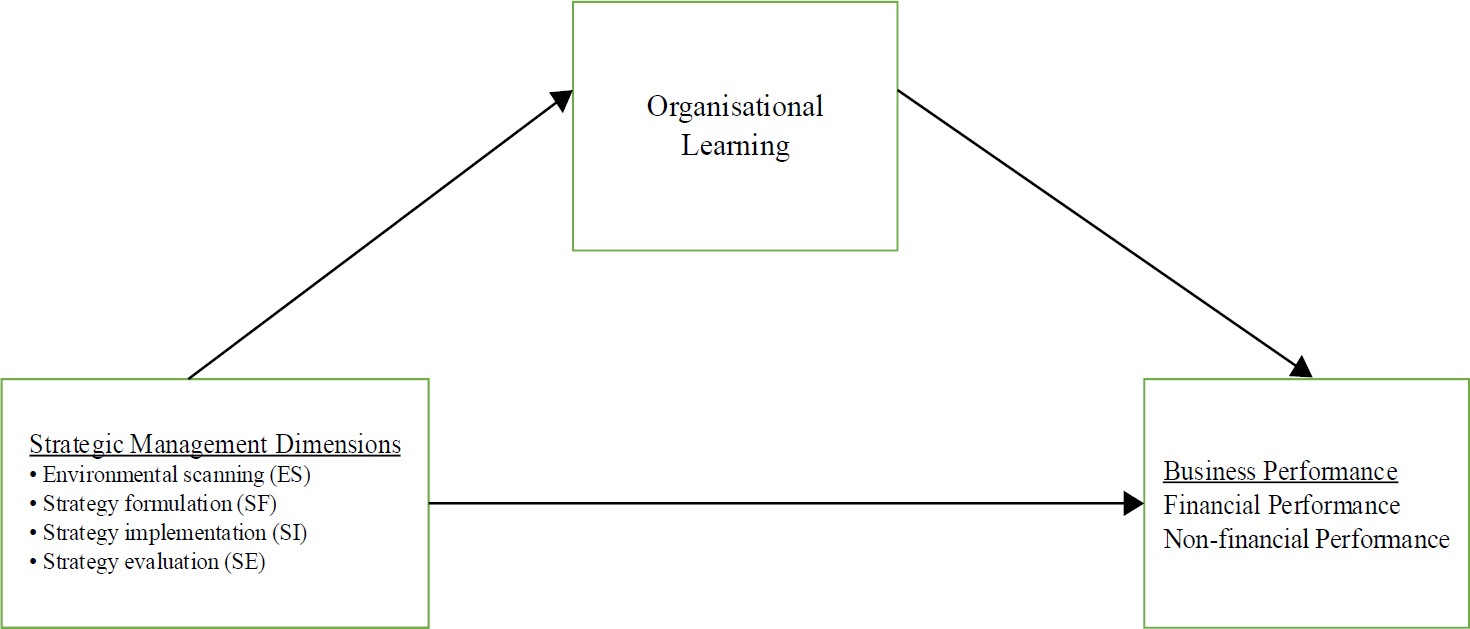
Fig. (1). Conceptual framework.
3. METHODOLOGY
This study employed primary quantitative research using a structured Likert-scale questionnaire (Appendix A) to gather information about hospitality and food service SMEs managers and leaders in the UAE. To reflect the perception of the strategic management dimensions and firm performance, all items were scaled using a five-point scale, 1 (strongly disagree) to 5 (strongly agree), to ensure that all items served the purpose of investigating this aspect suggested by (Kusmaryono et al., 2022). The constructs were Environmental Scanning (ES), Strategy Formulation (SF), Strategy Implementation (SI), Strategy Evaluation (SE), Financial Performance which was in the form of Market Share Growth, Non-Financial Performance which was in the form of Employee Growth, and the mediating variable of Organisational Learning. Hospitality SMEs are highly sensitive to market-share fluctuations due to heavy sector saturation, and employee growth captures human capital health amid high industry turnover; therefore, limited performance dimensions have been considered.
The UAE hospitality and food services SMEs were selected based on three sources: public business listings, official company websites, and verified company profiles on LinkedIn. The recruitment frame consisted only of registered active SMEs. Respondents were distinguished at the initial stage of the questionnaire through a qualification filter necessitating them to authorise their managerial or leadership designation, comprising roles such as operations manager, department head, or owner-manager.
Two main indicators, market share growth and employee growth, were used for the operationalisation of business performance. Several dimensions were chosen as they address external competitiveness and internal capability building issues which are important in the SME-based food service or hospitality industry. However, (Soomro et al., 2021) noted that SMEs are unable to use reliable financial information for reporting purposes because of the lack of financial data and high volatility in financial reporting, resulting in non-financial and hybrid performance indicators being used. For the UAE hospitality industry, market share growth is related to the competitive position in a tourism-based economy, and employee growth is related to employment stability and service enhancement. However, it is recognised that whilst profitability and ROI indicators are not included in financial methods of performance measurement, this may result in a less comprehensive assessment of performance, as stated as a methodological constraint.
A purposive sample of managers and leaders was used to gather data because this group should have the necessary strategic management experience to participate in the study. Since the UAE hospitality and food service sector does not have an extensive and readily available SME database, it was deemed impractical to use probability sampling; thus, purposive sampling was used. Using this method helps to obtain relevant managerial and strategic experience. However, it has several potential limitations, including selection bias and lack of generalisability, as stated in the study limitations.
To determine a suitable sample size, G*Power analysis was performed using an alpha of 0.05, power of 0.95, and medium effect size (f² = 0.15), which recommended a minimum of 200 participants. In practice, 750 individuals from UAE hospitality and food service SMEs were approached through professional platforms and official company social media pages. Of these, 450 responded to the questionnaire, which is equivalent to a 60% response rate. After excluding a further 40 responses because of missing values and outliers, the final sample consisted of 410 valid responses. To avoid multiple responses, every survey link was limited to a single response per IP address, and the respondents were asked to provide an email for the organisation, which was different for each survey respondent. Furthermore, the firms’ names were captured to avoid intra-firm duplication and prevent more than one response from being captured during data screening.
The participants representing SME businesses in the UAE were contacted through professional platforms such as LinkedIn and official social media pages of well-established SMEs in the hospitality and food service industry in the UAE to reduce selection bias. The non-response bias was evaluated by comparing early respondents (n1 = 30) to those who reported late (n2 = 30); no significant differences were found, which shows that there was little bias, as recommended by (Hashim et al., 2021). To overcome common method bias (CMB), a single-factor test by Harman was applied, which showed that a single factor explained less than 40% of the total variance, suggesting that common method bias is unlikely to be a significant issue. In addition, full collinearity VIF was also tested for CMB, where (Hair et al., 2025) suggested that the threshold value of CMB should be 3.3. Hence, for all the constructs in the model, the VIF was below 3.3 which ensured that CMB was not an issue in the model.
Although common method bias was checked statistically, statistical techniques cannot completely rule out the possibility of common method bias in the data collected through surveys. Several procedural remedies were implemented to minimise this in the design of the questionnaire and the data collection process. These were the anonymity of the respondents, the reduction of evaluation apprehension, the separation of the predictor variables from the outcome on the questionnaire design, and the minimisation of the use of ambiguous language. All these ex-ante measures enhanced the validity of the collected data.
As suggested by (Hair et al., 2025), the analysis was performed using Partial Least Squares Structural Equation Modelling (PLS-SEM) with the assistance of SmartPLS software. The measurement model assessment was performed for reliability and validity using Cronbach’s alpha, composite reliability, and convergent validity with the help of Average Variance Extracted (AVE). Then, the hypothesis causal relationships between strategic management dimensions, organisational learning, and financial and non-financial performance were tested with PLS-SEM path analysis.
4. RESULTS
4.1. Demographics Profile Analysis
The results in Table 1 specify the demographic profile of the study population (n = 410). The results indicate that among the total sample population, 64.63% were males and 35.37% were females. Among these participants, 17.80% were 20-29 years of age, 32.93% were 30-39 years, 28.29% were 40-49 years, and 20.98% were 50-59 years. In addition, 30.49% of the total participants served as managers, 36.59% served as Senior Managers, and 32.93% served as department heads. Lastly, in terms of departments of the population, 19.02% served the operations department, 32.93% worked in HR, 23.66% in marketing and sales, and 24.39% served finance departments of the companies.
Table 1. Demographics analysis.
| Demographic Category | Frequency (n) | Percentage (%) | |
| Gender | Male | 265 | 64.63% |
| Female | 145 | 35.37% | |
| Age Range | 20-29 | 73 | 17.80% |
| 30-39 | 135 | 32.93% | |
| 40-49 | 116 | 28.29% | |
| 50-59 | 86 | 20.98% | |
| Job Title/Position | Manager | 125 | 30.49% |
| Senior Manager | 150 | 36.59% | |
| Department Head | 135 | 32.93% | |
| Department | Operations | 78 | 19.02% |
| Human Resources | 135 | 32.93% | |
| Marketing & Sales | 97 | 23.66% | |
| Finance | 100 | 24.39% | |
4.2. Measurement Model Assessment
The validity and reliability of the measurement model were verified using approaches which included Cronbach’s alpha, composite reliability, and Average Variance Extracted (AVE), as suggested by (Hair et al., 2025). The results provided in Table 2 indicates that all constructs in the measurement model shows high factor loadings between (0.714-0.937). On the other hand, the results also show strong internal consistency and reliability since the value of Cronbach’s Alpha and Composite Reliability for all the constructs is found to be (α>0.7). Moreover, all the constructs in the study showed strong convergent validity through AVE above the threshold of 0.5.
Table 2. Measurement model.
| Latent variables | Indicators | Factor oadings | Cronbach’s alpha | Composite reliability (Rho_C) | Average Variance Extracted (AVE) |
| Environmental Scanning | ES1 | 0.879 | 0.852 | 0.910 | 0.771 |
| ES2 | 0.904 | ||||
| ES3 | 0.851 | ||||
| Financial Performance | FP1 | 0.859 | 0.859 | 0.914 | 0.780 |
| FP2 | 0.908 | ||||
| FP3 | 0.881 | ||||
| Non-financial Performance | NFP1 | 0.714 | 0.782 | 0.824 | 0.610 |
| NFP2 | 0.830 | ||||
| NFP3 | 0.794 | ||||
| Organisational Learning | OL1 | 0.900 | 0.891 | 0.932 | 0.821 |
| OL2 | 0.937 | ||||
| OL3 | 0.881 | ||||
| Strategy Evaluation | SE1 | 0.908 | 0.898 | 0.936 | 0.831 |
| SE2 | 0.930 | ||||
| SE3 | 0.895 | ||||
| Strategy Formulation (SF) | SF1 | 0.828 | 0.814 | 0.889 | 0.729 |
| SF2 | 0.903 | ||||
| SF3 | 0.828 | ||||
| Strategy Implementation | SI1 | 0.890 | 0.882 | 0.927 | 0.809 |
| SI2 | 0.920 | ||||
| SI3 | 0.887 |
4.3. Discriminant Validity
Discriminant validity was measured using the HTMT ratio against the threshold value of 0.85, as suggested by (Gorai et al., 2024). This allows for the measurement of distinctiveness and conceptual overlap among the study constructs, the results of which are specified in Table 3.
Table 3. Discriminant validity.
| – | Environmental Scanning | Financial Performance | Non-Financial Performance | Organisational Learning | Strategy Evaluation | Strategy Formulation |
| Financial Performance | 0.324 | – | – | – | – | – |
| Non-Financial Performance | 0.368 | 0.718 | – | – | – | – |
| Organisational Learning | 0.282 | 0.659 | 0.665 | – | – | – |
| Strategy Evaluation | 0.619 | 0.523 | 0.523 | 0.482 | – | |
| Strategy Formulation | 0.634 | 0.423 | 0.577 | 0.353 | 0.478 | – |
| Strategy Implementation | 0.719 | 0.513 | 0.506 | 0.495 | 0.737 | 0.566 |
The results in Table 3 show that the value of HTMT among all constructs is evidently below the threshold value of (0.85). This shows that the issue of conceptual overlap does not exist in the model and that all the constructs in the model are separated and distinctive from each other.
4.4. Path Coefficient Analysis
According to Table 4, the direct effects suggest that the dimensions of strategic management have different impacts on performance. Environmental scanning does not significantly influence financial performance (β = -0.018; p = 0.675) or non-financial performance (β = -0.062; = 0.354). There are positive and direct impacts of strategy formulation on financial performance (β = 0.185; p = 0.019) but a high impact on non-financial performance (β = 0.274; p = 0.000). Financial (β = 0.028; p = 0.559) and non-financial performance do not directly impact strategy implementation. Strategy evaluation has a weak significant direct impact on financial performance (β = 0.092; p = 0.053) at the 10% significance level, and a significant impact on non-financial performance (β = 0.149; p = 0.014). Lastly, organisational learning robustly affects financial performance (β = 0.749; p = 0.000) and non-financial performance (β = 0.371; p = 0.000).
Table 4. Path analysis.
| – | Path coefficients | T statistics | P values | f-square |
| Environmental Scanning -> Financial Performance | -0.018 | 0.419 | 0.675 | 0.001 |
| Environmental Scanning -> Non-Financial Performance | -0.062 | 0.926 | 0.354 | 0.003 |
| Environmental Scanning -> Organisational Learning | 0.155** | 2.150 | 0.032 | 0.017 |
| Organisational Learning -> Financial Performance | 0.749*** | 23.918 | 0.000 | 1.392 |
| Organisational Learning -> Non-Financial Performance | 0.371*** | 6.850 | 0.000 | 0.166 |
| Strategy Evaluation -> Financial Performance | 0.092* | 1.936 | 0.053 | 0.014 |
| Strategy Evaluation -> Non-Financial Performance | 0.149** | 2.458 | 0.014 | 0.018 |
| Strategy Evaluation -> Organisational Learning | 0.267*** | 3.133 | 0.002 | 0.051 |
| Strategy Formulation -> Financial Performance | 0.185** | 2.355 | 0.019 | 0.016 |
| Strategy Formulation -> Non-Financial Performance | 0.274*** | 4.834 | 0.000 | 0.081 |
| Strategy Formulation -> Organisational Learning | 0.133* | 1.875 | 0.061 | 0.016 |
| Strategy Implementation -> Financial Performance | 0.028 | 0.585 | 0.559 | 0.001 |
| Strategy Implementation -> Non-Financial Performance | 0.045 | 0.643 | 0.520 | 0.001 |
| Strategy Implementation -> Organisational Learning | 0.299*** | 3.801 | 0.000 | 0.054 |
| Specific Indirect Effects | ||||
| Strategy Evaluation -> Organisational Learning -> Financial Performance | 0.211*** | 3.127 | 0.002 | – |
| Strategy Evaluation -> Organisational Learning -> Non-Financial Performance | 0.099*** | 2.998 | 0.003 | – |
| Strategy Formulation -> Organisational Learning -> Financial Performance | 0.099* | 1.877 | 0.061 | – |
| Strategy Formulation -> Organisational Learning -> Non-Financial Performance | 0.049* | 1.703 | 0.089 | – |
| Strategy Implementation -> Organisational Learning -> Financial Performance | 0.224*** | 3.715 | 0.000 | – |
| Strategy Implementation -> Organisational Learning -> Non-Financial Performance | 0.111*** | 3.102 | 0.002 | – |
| Environmental Scanning -> Organisational Learning -> Financial Performance | 0.116** | 2.141 | 0.032 | – |
| Environmental Scanning -> Organisational Learning -> Non-Financial Performance | 0.058** | 1.971 | 0.049 | – |
Additionally, the direct effect of environmental scanning on financial performance (β = −0.018, p = 0.675) and non-financial performance (β = −0.062, p = 0.354) is insignificant, indicating that environmental scanning has a significant positive direct effect on organisational learning (β = 0.155, t = 2.150, p = 0.032). The indirect impact on financial performance (β = 0.116, t = 2.141, p = 0.032) and non-financial performance (β = 0.058, t = 1.971, p = 0.049) is, however, quite significant. This refers to full mediation, where environmental scanning affects performance only through organisational learning.
Second, strategy formulation is not significantly related to organisational learning (β = 0.133; p = 0.061). Therefore, the indirect effects on financial performance (β = 0.099, p = 0.061) and non-financial performance (β = 0.049, p = 0.089) are also insignificant in this study. Organisational learning does not mediate this relationship, as there is no mediation effect (direct-only relationship), although it has significant direct effects on financial performance (β = 0.185, p = 0.019) and on non-financial performance (β = 0.274, p = 0.000).
Furthermore, the direct effect of strategy implementation on the financial performance (β = 0.028, p = 0.559) and non-financial performance (β = 0.045, p = 0.520) of the organisation is not significant. In addition, the direct impact of strategy implementation on an organisation’s financial (β = 0.028, p = 0.559) and non-financial performance (β = 0.045, p = 0.520) is insignificant. The indirect effects are significant for financial performance (β = 0.224, t = 3.715, p = 0.000) and non-financial performance (β = 0.111, t = 3.102, p = 0.002), respectively. This confirms full mediation, suggesting that implementation only indirectly affects performance through organizational learning.
Finally, strategy evaluation significantly affected organisational learning (β = 0.267, t = 3.133, p = 0.002). It also has a significant direct effect on non-financial performance (β = 0.149, p = 0.014), whereas its direct impact on financial performance is small (β = 0.092, p = 0.053). The indirect effect of strategy evaluation on financial performance through organisational learning is statistically significant (β = 0.211, p = 0.002), while the direct effect is not (β = 0.092, p = 0.053) at 10%. Hence, the relationship between strategy evaluation and financial performance was fully mediated by organisational learning, suggesting that financial performance benefits come mainly through the learning pathway and not directly from the evaluation.
Furthermore, Cohen’s guidelines consider f² values of 0.02, 0.15, and 0.35 as small, medium, and large effect sizes, respectively. The findings show that the effects of environmental scanning on financial performance (f² = 0.001) and non-financial performance (f² = 0.003) are small, suggesting that environmental scanning activities alone have little explanatory power. Likewise, the direct impact of strategy implementation on financial and non-financial performance (f² = 0.001) is negligible, indicating that, without the necessary organisational mechanisms supporting it, strategy implementation would not have a significant impact.
When evaluating the strategy, small effects on both financial (f² = 0.014) and non-financial performance (f² = 0.018) were recorded, meaning that the strategy’s contribution is limited and slightly low. In contrast, organisational learning has a very large effect on financial performance (f² = 1.392) and a medium effect on non-financial performance (f² = 0.166). The results confirm that organisational learning is the key that determines the outcome of the model, while the majority of strategic management dimensions have a weak influence on performance when used individually.
4.5. Model Explanatory Power
The explanatory power of the study’s measurement model is measured through R-squared and adjusted R-squared which allows us to determine the percentage of variance in the dependent variables that can be predicted by the independent variables. The results are presented in Table 5.
Table 5. Explanatory power.
| – | R-square | R-square adjusted |
| Financial Performance | 0.697 | 0.693 |
| Non-Financial Performance | 0.376 | 0.369 |
| Organisational Learning | 0.249 | 0.242 |
The results show that the strategic management dimensions tend to predict 69.7% variation in financial performance, 37.6% variation in non-financial performance, and 24.9% variation in organisational learning in the UAE’s hospitality and food services sector (Table 6).
Table 6. Predictive relevance.
| – | Q²predict | RMSE | MAE |
| OL | 0.220 | 0.890 | 0.664 |
| FP | 0.250 | 0.875 | 0.642 |
| NFP | 0.246 | 0.875 | 0.643 |
4.6. Q-square for predictive relevance.
In all the main groups (OL, FP, NFP), the Q²predict values exceeded the zero limit and were, 0.220, 0.250 and 0.246, respectively, which are analysed as being in a suitable range of predictive relevance of the model. The smaller values of the RMSE and MAE for both FP and NFP also indicate good out-of-sample prediction accuracy, whereas the comparatively smaller values of the RMSE and MAE for the OL further confirm the good predictive performance.
4.7. Model Fitness
Overall, there was a good model fit from the model fit indices. Table 7 also shows that the SRMR values are below 0.08, demonstrating a good model fit, and the difference between the saturated and estimated model(d_ULS) and the differences between the saturated and measured(d_G) are small, which shows the stability of the model. The NFI values (0.817-0.819) were close to the recommended level of 0.90, with a moderate but acceptable fit of the model.
Table 7. Model fitness.
| – | Saturated model | Estimated model |
| SRMR | 0.059 | 0.060 |
| d_ULS | 0.815 | 0.836 |
| d_G | 0.420 | 0.426 |
| Chi-square | 1060.354 | 1068.804 |
| NFI | 0.819 | 0.817 |
5. DISCUSSION
The results indicate that environmental scanning has no major direct impact on the financial and non-financial performance of hospitality and food service SMEs in the UAE; thus, H1 is not accepted at the direct level. The lack of a direct effect of environmental scanning on financial and non-financial outcomes can be understood using the theory of dynamic capabilities and absorptive capacity logic. Sensing is not a measure of performance; it is a capability of the system, but unless transformed through learning and capability reconfiguration, the financial or non-financial benefit of environmental scanning does not occur. In the RBV context, external information is not a strategic resource unless it is ‘transcended’ and integrated into organisational processes. Scanning is better suited to stable and predictable environments where information can be readily converted into market advantages, as (Ahmad et al., 2021; and Kozcu & Özmen, 2023) suggest. However, is lacking in direct link between scanning and outcomes of performance, as noted by (Tian et al., 2021) that UAE tourism is a seasonal industry and hospitality small and medium enterprises (SMEs) in this sector face a high level of volatility. Thus, the effects of performance only occur when environmental scanning is accompanied by organisational learning processes that can be interpreted at the time of knowledge absorption (Rafiq et al., 2020).
The findings affirm that strategy formulation positively influences both financial and non-financial performance, and H2 is accepted. From a financial perspective, the ability to develop a clear strategy improves market share growth, as it allows SMEs to fit well within a competitive market, namely, the hospitality industry. This observation favours the Dynamic Capabilities Theory, which focuses on strategic planning as a process of maximising valuable and scarce resources, as reflected by (Arnold, 2024; and Cui, 2025) in their findings. Regarding non-financial performance, clear strategies promote employee development by defining their roles, expectations, and career progression. Strategic clarity, as (Bhambi, 2025) hints, improves workforce alignment and motivation, which is essential in service-focused sectors. The mediation value of organisational learning is low, indicating that strategy formulation directly impacts market performance and employee growth and is a core organisational strength.
The study also indicated no direct impact on strategy implementation, market share growth, or employee development which led H3 to the rejected at the direct effect level. The absence of a significant direct effect of strategy implementation on market share growth and employee development can be theoretically explained through Dynamic Capabilities Theory and RBV logic. Strategy implementation represents a seizing capability; however, its impact on financial and non-financial performance is contingent on how effectively it is transformed into organisational routines through learning mechanisms. Without this transformation, execution alone does not guarantee the desired measurable outcomes. While (Mousa et al., 2024; and Nuwagaba et al., 2023) report positive effects of implementation in more stable manufacturing and institutional contexts, their findings assume a relatively structured workforce and operational environments. In contrast, UAE hospitality SMEs operate under highly dynamic labour conditions characterised by high employee turnover and expatriate workforce dependency, which weakens the direct implementation effects. Therefore, the significant indirect effects indicate full mediation, suggesting that strategy implementation enhances performance only when it strengthens organisational learning processes, including skill transfer, knowledge sharing, and capability development, as suggested by (Cui, 2025).
The results partially confirm H4, meaning that strategy evaluation has a strong direct impact on non-financial performance but only a weak impact on financial performance. This is consistent with (Hieu & Nwachukwu, 2019), who discovered that systematic evaluation enhances strategic performance through the ability to take corrective measures. Evaluation practices in the UAE hospitality setting seem to be especially relevant for increasing employee development through feedback, performance monitoring, and alignment with service standards. Better financial returns, such as market shares, might take a longer assessment period to be realised, particularly in fluctuating tourism markets. The significant direct impact implies that evaluation enhances financial and non-financial performance by strengthening reflective learning and sustained improvement. This two-way avenue justifies Dynamic Capabilities Theory because it emphasises evaluation as a tool to narrow strategic resources and emphasises learning theory, focusing on adaptation as a response to feedback.
The results partly support H5, which states that H5 holds in UAE hospitality and food service SMEs, where the performance of strategic management dimensions has a partial but significant relationship with financial and non-financial performance mediated by organisational learning. In particular, organisational learning plays a key role in mediating the impacts of environmental scanning, strategy implementation, and strategy evaluation on market share and employee growth. These findings are congruent with those of (Ashal et al., 2021), who revealed that a learning culture converts strategic orientations into better organisational results by enabling knowledge acquisition and behavioural transformation. Similarly, (Soomro et al., 2021) concluded that organisational learning increases employees’ capacity, which consequently improves their innovativeness and performance results.
The non-significant mediating role of organisational learning in the relationship between strategy formulation and both financial and non-financial performance suggests that learning mechanisms are not uniformly embedded across all the strategic dimensions. From a Dynamic Capabilities perspective, strategy formulation is primarily a cognition-driven process focused on strategic intent, resource orchestration, and goal setting, which can directly influence outcomes without requiring iterative knowledge transformation. As (Andersson et al., 2022 and Barragán-Hernández & Aguilar-Fernández, 2024) argue, formulation effectiveness is largely determined by the alignment between managerial judgement and resource deployment rather than organisational learning processes. In contrast, organisational learning is more relevant in adaptive, feedback-intensive activities, where experience accumulation reshapes actions. In UAE hospitality SMEs, where decision-making is highly centralised and experience-based, strategy formulation tends to rely on managerial intuition rather than on structured knowledge creation. (Alshukri et al., 2024) support this by arguing that it reduces the explanatory role of organisational learning as a mediating mechanism in this specific strategic context.
Consequently, the financial and non-financial performance results are more directly a product of strategic intent and resource commitment, and organisational-level learning mechanisms do not need to intervene in such cases. The reason behind discovery of insignificant mediating effect of organisational learning on the relationship between strategy formulation and business performance is based on the contextual factors of UAE hospitality and food service SMEs. The development of strategy is often highly centralised and subject to short-term market pressures, leaving little room for participatory learning or institutionalisation of knowledge. Strategic decisions in these contexts can be directly converted into financial and non-financial results with quick implementation, instead of being learned, which is still informal and loosely integrated at the organisational level. This implies that strategy formulation in the UAE hospitality context’s financial and non-financial performance is not through learning-driven processes but through direct processes.
Theoretically, this result narrows the scope of the Organisational Learning Theory, as it suggests that there are boundary conditions under which learning is not a requisite channel between strategy and results. In Dynamic Capabilities Theory, the ability to formulate a strategy can serve as an effective organisational resource, which would directly improve financial competitiveness and workforce alignment without mediation. This subtle result highlights the fact that although organisational learning is essential to transform action-focused strategies into performance, its mediation depends on the dimension of the strategy being discussed, specifically the operation of hospitality SMEs in the UAE that are structured and professionally managed.
CONCLUSION
The findings of this study offer a critical examination of the effects of strategic management dimensions on the financial and non-financial performance of UAE hospitality and food service SMEs, with the subtle role of organisational learning. The findings dismiss the supposition that all strategic practices inherently translate into performance improvements, with the effects of environmental scanning and strategy implementation only available through learning mechanisms, as opposed to a direct effect of strategy formulation. The importance of strategy evaluation is two-fold in terms of employee assessment and positioning in the financial portfolio, as it proves to have an indirect impact. In practice, UAE SMEs should incorporate learning-based systems selectively, coupled with strategic aspects aligned with their organisational environments, to maximise their financial and non-financial performance.
Furthermore, this study refines existing theoretical knowledge by demonstrating that the effects of strategic management dimensions on financial and non-financial performance are contingent rather than uniform. Contrary to common assumptions, environmental scanning was positively associated with organisational learning, strategy implementation showed no direct performance effects, and organisational learning did not mediate the strategy formulation performance relationship. These findings indicate that learning mechanisms are not universally activated in all strategic activities. Consequently, this study refines the RBV, Dynamic Capabilities Theory, and Organisational Learning Theory by identifying important boundary conditions that determine when strategic capabilities and learning processes contribute to performance outcomes in SME service contexts.
LIMITATIONS AND FUTURE DIRECTIONS
This study has certain limitations because of its cross-sectional design, which does not allow for the determination of causal relationships over time. In addition, there was a risk of introducing response and social desirability biases into the survey data self-reported by managers. Additionally, the focus on UAE hospitality and food service SMEs limits the generalisability to other fields or regions where cultural and operational dynamics differ. Longitudinal research studies are suggested to be adopted in the future to study the temporal impacts of strategic management dimensions on performance. It is suggested that comparative research across sectors or nations can examine contextual differences, and incorporating qualitative knowledge can enhance knowledge about the organisational learning process and how it impacts financial and non-financial performance by industry.
POLICY IMPLICATIONS
The results of this study provide practical policy implications for stakeholders in the UAE hospitality and food service sectors. To improve workforce development and market competitiveness, government regulators and industry associations should promote the use of structured strategy assessment frameworks and organisational learning models. This calls on hospitality SMEs to combine learning-oriented practices with environmental scanning and strategy implementation to ensure that financial and non-financial outcomes are optimised. Continuous development of skills and knowledge-sharing mechanisms should be a priority for training bodies and HR policymakers to decrease turnover and improve the quality of services. In addition, strategic planning guidelines and performance monitoring standards should be formalised to assist hospitality and food service SMEs in improving their operational practices and outcomes while guaranteeing enhanced growth in the market. However, for UAE hospitality and food service industry SMEs, managers should also consider organisational learning systems a priority during uncertainties of strategic activities, continuous feedback, and adaptations in operational processes, including environmental scanning, implementation, and evaluation stages. For these dimensions, systematic knowledge sharing, employee training, and feedback loops are needed to enhance financial and non-financial results. However, strategy formulation does not require extensive learning to implement, as it can result in an immediate effect on performance, particularly in SMEs, where strategic decisions are made in a centralised way and are quickly and rapidly implemented by the owner. This distinction allows managers to make better use of the resources they invest in learning.
LIST OF ABBREVIATIONS
AVE | = | Average Variance Extracted |
CMB | = | Job Characteristics Theory |
DCT | = | Dynamic Capabilities Theory |
ES | = | Environmental Scanning |
PLS SEM | = | Partial Least Squares Structural Equation Modelling |
SE | = | Strategy Evaluation |
SF | = | Strategy Formulation |
SI | = | Strategy Implementation |
SMEs | = | Small and Medium Enterprises |
UAE | = | United Arab Emirates |
AUTHOR’S CONTRIBUTION
S.A. has contributed to conceptualization of the study, development of idea, methodology, analysis of result and interpretation of result.
ETHICAL STATEMENT & INFORMED CONSENT
Participation in this study was voluntary, and informed consent was obtained from all participants before data collection. Respondents were informed of the study’s purpose and assured that their responses would remain anonymous and confidential and would be used solely for research purposes. The study was conducted in accordance with established ethical guidelines for research involving human participants.
AVAILABILITY OF DATA AND MATERIALS
The data supporting the findings of this study are available from the corresponding author upon reasonable request.
FUNDING
None.
CONFLICT OF INTEREST
The author declares that there are no conflicts of interest related to the publication of this article.
ACKNOWLEDGEMENTS
Declared none.
DECLARATION OF AI
The author used ChatGPT to improve the language and readability of this manuscript. All AI-assisted content was carefully reviewed and verified by the author, who took full responsibility for the final manuscript.
APPENDIX A
Demographics
| Demographic variable | Response options |
| Gender | ☐ Male ☐ Female |
| Age | ☐ 20–29 ☐ 30–39 ☐ 40–49 ☐ 50–59 |
| Job Title/ Position | ☐ Manager ☐ Senior Manager ☐ Department Head |
| Department | ☐ Operations ☐ Human Resources ☐ Marketing & Sales ☐ Finance |
Survey questionnaire
| Construct | Item No. | Questionnaire Item | Likert Scale (1–5) |
| Environmental Scanning (ES) | ES1 | Our organisation regularly monitors changes in market trends and customer preferences. | 1 2 3 4 5 |
| ES2 | We actively gather information about competitors and industry developments. | 1 2 3 4 5 | |
| ES3 | External environmental factors are systematically considered in our strategic decisions. | 1 2 3 4 5 | |
| Strategy Formulation (SF) | SF1 | Our organisation develops clear strategic objectives aligned with long-term goals. | 1 2 3 4 5 |
| SF2 | Alternative strategies are evaluated before finalising decisions. | 1 2 3 4 5 | |
| SF3 | Strategy formulation involves top management and key stakeholders effectively. | 1 2 3 4 5 | |
| Strategy Implementation (SI) | SI1 | Strategic plans are translated into actionable initiatives efficiently. | 1 2 3 4 5 |
| SI2 | Resources are adequately allocated to support the execution of strategic plans. | 1 2 3 4 5 | |
| SI3 | Employees are well-informed and engaged during the implementation of strategies. | 1 2 3 4 5 | |
| Strategy Evaluation (SE) | SE1 | Performance indicators are regularly monitored to assess strategy effectiveness. | 1 2 3 4 5 |
| SE2 | Feedback from strategy evaluation is used to revise and improve future plans. | 1 2 3 4 5 | |
| SE3 | We systematically review strategic outcomes against initial objectives. | 1 2 3 4 5 | |
| Organisational Learning (OL) | OL1 | Our organisation encourages continuous learning and knowledge sharing. | 1 2 3 4 5 |
| OL2 | Lessons learned from past projects are incorporated into future strategies. | 1 2 3 4 5 | |
| OL3 | Employees are empowered to experiment and learn from failures. | 1 2 3 4 5 | |
| Financial Performance (Market Share Growth) | FP1 | Our organisation has increased its market share over the past three years. | 1 2 3 4 5 |
| FP2 | Revenue growth is consistent with industry benchmarks. | 1 2 3 4 5 | |
| FP3 | Our competitive position in the market has strengthened due to strategic initiatives. | 1 2 3 4 5 | |
| Non-Financial Performance (Employee Growth) | NFP1 | Employee skills and capabilities have improved due to strategic initiatives. | 1 2 3 4 5 |
| NFP2 | Employee engagement and satisfaction have increased in our organisation. | 1 2 3 4 5 | |
| NFP3 | Training and development programs are effectively implemented to enhance workforce growth. | 1 2 3 4 5 |
REFERENCES
AGDA. (2023). UAE economic diplomacy report 2023: An AGDA flagship report. Available From: https://www.agda.ac.ae/docs/default-source/2023/uae-economic-diplomacy-report-2023/full-doc—website-version.pdf
Ahmad, N., Mobarek, A., & Roni, N. N. (2021). Revisiting the impact of ESG on financial performance of FTSE350 UK firms: Static and dynamic panel data analysis. Cogent Business & Management, 8(1), 1900500.
https://doi.org/10.1080/23311975.2021.1900500
Al Nuaimi, F. M. S., Singh, S. K., & Ahmad, S. Z. (2024). Open innovation in SMEs: A dynamic capabilities perspective. Journal of Knowledge Management, 28(2), 484–504.
https://doi.org/10.1108/JKM-11-2022-0906
Alfalasi, A., & Kaluvilla, B. B. (2023). Comparison of the longevity of food and beverage outlets: Comparison between Dubai and New York. Journal of Business Strategy Finance and Management, 5(2).
http://dx.doi.org/10.12944/JBSFM.05.02.07
Alshukri, T., Seun Ojekemi, O., Öz, T., & Alzubi, A. (2024). The interplay of corporate social responsibility, innovation capability, organisational learning, and sustainable value creation: Does stakeholder engagement matter? Sustainability, 16(13), 5511.
https://doi.org/10.3390/su16135511
Andersson, S., Svensson, G., Molina-Castillo, F. J., Otero-Neira, C., Lindgren, J., Karlsson, N. P., & Laurell, H. (2022). Sustainable development—Direct and indirect effects between economic, social, and environmental dimensions in business practices. Corporate Social Responsibility and Environmental Management, 29(5), 1158–1172.
https://doi.org/10.1002/csr.2261
Arnold, P. (2024). UAE SME sector is buoyant, despite global challenges. ME News 247. Available From: https://menews247.com/uae-sme-sector-is-buoyant-despite-global-challenges/
Ashal, N., Alshurideh, M., Obeidat, B., & Masa’deh, R. (2021). The impact of strategic orientation on organisational performance: Examining the mediating role of learning culture in Jordanian telecommunication companies. Academy of Strategic Management Journal, 21(6), 1–29. Available From: https://www.abacademies.org/articles/the-impact-of-strategic-orientation-on-organizational-performance-examining-the-mediating-role-of-learning-culture-in-jordanian-te-13765.html
Barragán-Hernández, A. D., & Aguilar-Fernández, M. (2024). Strategic dimensions of eco-innovation adoption in manufacturing SMEs in the context of Mexico City. Systems, 12(7), 246.
https://doi.org/10.3390/systems12070246
Bhambi, D. (2025). Restaurant industry challenges in UAE: Key Problems & How to Overcome Them. Available From: https://www.restauranttimes.com/blogs/operations/restaurant-industry-challenges-in-uae/
Blitz India Media. (2024). Challenges before SMEs in the UAE. Strategy evaluation process and strategic performance nexus. Available From: https://bm.uni-svishtov.bg/title.asp?title=1343
Imiru, G. A. (2024). The mediating role of marketing capability and innovation capability in the link between strategic orientation dimensions and business performance: In the case of selected manufacturing companies operating in Ethiopia. European Journal of Management and Marketing Studies, 9(1).
https://doi.org/10.46827/ejmms.v9i1.1704
King’s Business School. (2025). The future of tourism and hospitality in UAE’s growing economy. Available From: https://kingsedu.ac/the-future-of-tourism-and-hospitality-in-uaes-growing-economy/
Chatterjee, S., Rana, N. P., & Dwivedi, Y. K. (2024). How does business analytics contribute to organisational performance and business value? A resourced-based view. Information Technology & People, 37(2), 874–894.
https://doi.org/10.1108/ITP-08-2020-0603
Cui, J. (2025). The explore of knowledge management dynamic capabilities, AI-driven knowledge sharing, knowledge-based organisational support, and organisational learning on job performance: Evidence from Chinese technological companies. arXiv.
https://doi.org/10.48550/arXiv.2501.02468
ForouzeshNejad, A. (2024). A hybrid data-driven model for project portfolio selection problem based on sustainability and strategic dimensions: A case study of the telecommunication industry. Soft Computing, 28(3), 2409–2429.
https://doi.org/10.1007/s00500-023-08445-w
Gorai, J., Kumar, A., & Angadi, G. R. (2024). Smart PLS-SEM modeling: Developing an administrators’ perception and attitude scale for apprenticeship programme. Multidisciplinary Science Journal, 6(12), e2024260. https://doi.org/10.31893/multiscience.2024260
Grassa, R., Bocanet, A., Adulla, A., Ben Abdullah, H., & Ben Ayed, N. (2024). Does COVID-19 reduce food waste in the hospitality sector in Dubai? International Journal of Tourism Cities, 10(3), 757–768.
https://doi.org/10.1108/IJTC-07-2022-0183
Güner, Ş., Köse, İ., Topaylı, E., & Yıldız, A. E. (2024). Strategic dimensions affecting to innovation performance in the healthcare sector: A systematic literature analysis. Süleyman Demirel University Visionary Journal, 15(42), 515–532. https://doi.org/10.21076/vizyoner.1299495
Hair, J. F., Babin, B. J., Ringle, C. M., Sarstedt, M., & Becker, J. M. (2025). Covariance-based structural equation modeling (CB-SEM): A SmartPLS 4 software tutorial. Journal of Marketing Analytics, 13, 709-724.
https://doi.org/10.1057/s41270-025-00414-6
Hashim, H., Salam, S., Mohamad, S. N. M., Abdullah, M. M., & Rusdi, J. F. (2021). Proposed effective learning design model on language skills using partial least squares structural equation modeling (PLS-SEM). Journal of Theoretical and Applied Information Technology, 99(17), 4284–4294. Available From: https://www.jatit.org/volumes/Vol99No17/6Vol99No17.pdf
Hieu, V. M., & Nwachukwu, C. (2019). Strategy evaluation process and strategic performance nexus. Available From: https://bm.uni-svishtov.bg/title.asp?title=1343
Kozcu, G. Y., & Özmen, Ö. (2023). Organisational learning capability, organisational resilience, organisational performance, and market turbulence: A moderated mediation model. Journal of Management Sciences, 21(49), 482–503.
https://doi.org/10.35408/comuybd.1252398
Kusmaryono, I., Wijayanti, D., & Maharani, H. R. (2022). Number of response options, reliability, validity, and potential bias in the use of the Likert scale in education and social science research: A literature review. International Journal of Educational Methodology, 8(4), 625–637.
https://doi.org/10.12973/ijem.8.4.625
Mai, N. K., Do, T. T., & Ho Nguyen, D. T. (2022). The impact of leadership competences, organisational learning, and organisational innovation on business performance. Business Process Management Journal, 28(5–6), 1391–1411.
https://doi.org/10.1108/BPMJ-10-2021-0659
Mousa, K. M., Ali, K. A. A., & Gurler, S. (2024). Strategic planning and organisational performance: An empirical study on the manufacturing sector. Sustainability, 16(15), 6690.
https://doi.org/10.3390/su16156690
Nuwagaba, A., Angima, C., Namateefu, L. K., & Mugizi, T. (2023). The impact of strategy implementation on the performance of Ugandan state agencies: A quantitative study. Journal of Economics and Behavioral Studies, 15(4), 69–86.
https://doi.org/10.22610/jebs.v15i4(J).3653
Okwemba, J. A., & Njuguna, N. (2021). Effect of strategy evaluation on performance of Chemelil Sugar Company in Kisumu County, Kenya. Journal of Strategic Management, 5(4), 70–82.
https://doi.org/10.53819/81018102t5038
Phan, T. T. H., Tran, H. X., Le, T. T., Nguyen, N., Pervan, S., & Tran, M. D. (2020). The relationship between sustainable development practices and financial performance: A case study of textile firms in Vietnam. Sustainability, 12(15), 5930.
https://doi.org/10.3390/su12155930
PwC Middle East. (2023). Workforce Hopes and fears survey 2023. Available From: https://www.pwc.com/m1/en/issues/upskilling/hopes-and-fears-2023.html
Rafiq, M., Zhang, X., Yuan, J., Naz, S., & Maqbool, S. (2020). Impact of a balanced scorecard as a strategic management system tool to improve sustainable development: Measuring the mediation of organisational performance through PLS-SEM. Sustainability, 12(4), 1365.
https://doi.org/10.3390/su12041365
Shabbir, M. S., & Wisdom, O. (2020). The relationship between corporate social responsibility, environmental investments, and financial performance: Evidence from manufacturing companies. Environmental Science and Pollution Research, 27(32), 39946–39957.
https://doi.org/10.1007/s11356-020-10217-0
Soomro, B. A., Mangi, S., & Shah, N. (2021). Strategic factors and significance of organisational innovation and organisational learning in organisational performance. European Journal of Innovation Management, 24(2), 481–506.
https://doi.org/10.1108/EJIM-05-2019-0114
Sylvia, S. C. (2021). Effect of strategic evaluation and control on financial performance of small and medium enterprises in Juba, South Sudan. Quest Journals Journal of Research in Business and Management, 9(12), 13–18. https://d1wqtxts1xzle7.cloudfront.net/77272300/C09121318-libre.pdf
Tian, H., Dogbe, C. S. K., Pomegbe, W. W. K., Sarsah, S. A., & Otoo, C. O. A. (2021). Organisational learning ambidexterity and openness as determinants of SMEs’ innovation performance. European Journal of Innovation Management, 24(2), 414–438.
https://doi.org/10.1108/EJIM-05-2019-0140
Wang, J., Adouko, K. A. R. P., & Teye, J. (2025). Effect of strategic management practices on financial and non-financial performance of SMEs in Abidjan, Ivory Coast. Future Business Journal, 11(1), 248.
https://doi.org/10.1186/s43093-025-00641-4