
- ABSTRACT:
- 1. INTRODUCTION
- 2. LITERATURE REVIEW
- 3. RESEARCH METHODOLOGY
- 4. RESULTS AND DISCUSSION
- 5. DISCUSSION
- CONCLUSION AND RECOMMENDATION
- POLICY RECOMMENDATION
- LIMITATIONS AND FUTURE RESEARCH DIRECTION
- ETHICAL APPROVAL & INFORMED CONSENT
- AVAILABILITY OF DATA AND MATERIALS
- FUNDING
- CONFLICT OF INTEREST
- ACKNOWLEDGEMENTS
- DECLARATION OF AI
- REFERENCES
Impact of Green Technology on Fintech Development: Moderating Role of Regulations
PDF
1College of Business, Al-Yamamah University, Riyadh, Saudi Arabia
Received: 10 September, 2025
Accepted: 11 February, 2026
Revised: 11 February, 2026
Published: 30 April, 2026
ABSTRACT:
Introduction: This research evaluated the effect of green technology on Fintech growth, with regulation as a moderator.
Methodology: The research used a quantitative research design. Data were collected from 25 Asian developing countries from 2010 to 2024 to cover the period of the development of financial technologies and the shift in focus to sustainability. Generalised Least Squares (GLS) regression was used to analyse the data due to heteroscedasticity and autocorrelation.
Results: The findings illustrated that green technology positively and significantly influenced Fintech development, validating the hypothesis that environmentally driven innovation promotes digital financial growth. Regulation also had a significant, positive direct influence on Fintech development, contrary to earlier research findings that indicated a negative or insignificant contribution. In addition, the moderating role of regulation on the relationship between green technology and Fintech was positive and significant, suggesting that regulatory systems enhance the efficiency of green innovations in driving Fintech.
Conclusion: These results imply that policymakers should combine green technology programs with complementary regulations to drive sustainable Fintech innovation. It highlights the importance of integrating green technology initiatives with supportive regulatory measures for fostering sustainable Fintech innovation.
Keywords: Green technology, fintech development, regulation, south asia, developing countries, GLS.
1. INTRODUCTION
Green environmental technologies are innovations designed to reduce environmental impact and promote sustainability across industries. They include energy-efficient systems, pollution-control techniques, and renewable energy solutions that reduce resource consumption and emissions. These technologies are recognised widely as established drivers of sustainable economic and financial development. Their adoption in the financial sector has supported Fintech growth (Sharif et al., 2024). However, the lack of financial and digital infrastructure is the fundamental problem which has impacted Fintech development in developing Asian countries. Rural communities in these nations lack reliable internet access, an unreliable power supply, and limited smartphone coverage, which deters the adoption of digital financial services (Adjasi et al., 2023; Ediagbonya & Tioluwani, 2023; Xu et al., 2024). Further, a major proportion of the population is unbanked due to limited financial literacy and a lack of trust in formal banking institutions. Another challenge is the regulatory environment, as governments fail to keep pace with technological innovation. This sometimes leads to scattered or contradictory policies, which discourage innovation and deter investment. Cybersecurity threats and data privacy also deter service providers and users (Shi & Wang, 2025; Chen et al., 2023). These issues, combined, hinder the evolution and accessibility of Fintech, which might otherwise enhance financial inclusion, economic participation, and poverty alleviation within the region. Green technology can help address Fintech concerns in Asian developing countries by enhancing infrastructure and promoting environmentally friendly innovation.
The research by (Udeagha & Muchapondwa, 2023) suggested that in BRICS nations, solar-powered internet cafes and mobile charging points could provide digital connectivity to rural areas with limited electricity supply, offering access to Fintech services. Renewable energy-based green data centres can reduce operational costs and carbon emissions, making Fintech services scalable and sustainable. (Tchidi & Zhang, 2025) found that in Mali, Orange’s solar-powered mobile towers and Senegal’s rural connectivity projects are enhancing the internet penetration for digital financial services. Such green technologies ramp up infrastructure in off-grid regions, enabling wider FinTech adoption and financial inclusion, particularly in underdeveloped areas with little or no electricity and high-speed internet connectivity.
Further, green technology can advance trust and transparency by supporting blockchain-based systems for secure, environmentally friendly transactions. Incorporating green solutions into Fintech also creates opportunities for climate-oriented financial products, such as microloans for green energy projects or carbon credit trading platforms, that spur both economic and environmental development (Guo et al., 2023; Ojukwu et al., 2024; Udeagha & Ngepah, 2023). Together with financial technology, countries can enhance financial inclusion to address energy and environmental issues and build a more resilient, inclusive economy.
While the existing literature identifies the cross-impacting relationship between Fintech and green innovation (Li et al., 2024; Xue et al., 2022), few studies have examined how green technology stimulates Fintech development, particularly in Asian developing nations. Existing studies, such as those by (Chien et al., 2024; and Zhe et al., 2024), focus mostly on environmental impacts or on developed economies. Thus, it remains unclear which specific infrastructural and regulatory issues affect developing areas. In addition, the role of regulation as a moderator for this association remains under-researched. Institutional theory holds that institutional quality strongly influences the diffusion of innovation, yet empirical support for this claim in the green fintech context remains limited. Several established theories explain how regulations can moderate the relationship between green technology and FinTech. Institutional theory suggests that the regulatory environment creates pressures and constraints shaping the adoption of innovation, either enabling or hindering technological progress (Mertzanis, 2023). Similarly, dynamic capabilities theory focuses on the firm’s ability to adapt to changing regulatory frameworks, influencing its success in implementing green and digital innovation (He et al., 2024). Therefore, regulations should not be viewed as an external context but as a moderating factor. In this regard, this research fills these gaps by examining how green technology drives Fintech development and the role of regulation in moderating this impact. It adds new findings to sustainability-driven Fintech research and policy guidance on how to encourage innovation in environmentally and institutionally limited contexts.
This research is critical for investigating the neglected link between green technology and Fintech innovation in Asian developing nations, where sustainable innovation is both a necessity and a challenge. Although Western nations rely heavily on these aspects (Tchidi & Zhang, 2025), Asian nations lag, and thus, research is needed to develop more robust policy implications. By synthesising Innovation Diffusion Theory and Institutional Theory, this framework provides an inclusive framework for understanding how environmental requirements and regulatory landscapes co-determine digital finance ecosystems. The results can inform policymakers in framing regulatory guidelines that enable sustainable Fintech solutions and advise businesses on how to utilise green technology to gain a competitive edge. Finally, the research underpins wider objectives of financial inclusion, climate resilience, and sustainable economic growth among emerging markets. This research specifically focuses on Asian developing countries, with the research question: “What is the impact of green technology on Fintech development in Asian developing countries and the moderating role of regulations?” The specific research objectives are
- To evaluate the impact of green technology on Fintech development in Asian developing countries
- To evaluate the moderating role of regulation on the relationship between green technology and Fintech Development.
2. LITERATURE REVIEW
2.1. Green Technology and Fintech Development
Green technology is the application of science and innovation to create products, services, and processes that reduce environmental impact and contribute to sustainability (Xue et al., 2022). Green technology encompasses a range of solutions, from renewable energy sources (solar, wind, hydro) to energy-saving systems, sustainable farming, waste reduction, and carbon-cutting technologies (Shahzad et al., 2022). The main aim of green technology is to minimise carbon emissions, conserve natural resources, and counter the negative impacts of industrialisation and climate change. In the financial world, green technology plays a revolutionary role by promoting the creation of sustainable financial products such as green bonds, carbon credit mechanisms, and ESG investment platforms (Xu et al., 2023). It also encourages digital solutions that maximise transparency and traceability in sustainability practice, such as blockchain (Lin & Ma, 2022). Green technology innovation is known to reduce environmental pollution, improve energy efficiency and attain the “win-win” goals of ecological environmental protection and corporate performance (Alvarez-Herránz et al., 2017). With increasing global environmental challenges, green technology is being viewed not just as a means to protect the environment but also as a strategic facilitator of economic resilience and innovation.
Fintech development is the growth of technology-enabled financial services that enhance the delivery, availability, and effectiveness of financial products. Fintech encompasses a wide range of innovations, including digital banking, mobile payments, peer-to-peer lending, robo-advisory, blockchain, and cryptocurrency platforms (Gao, 2022; Tao et al., 2022). Its evolution involves embedding new-age technologies such as artificial intelligence, big data, and cloud computing into financial systems to improve user experience, reduce transaction costs, and promote financial inclusion (Dong & Yu, 2023; Tan et al., 2023). In emerging economies, Fintech is important in filling gaps in the conventional banking infrastructure by providing low-cost, easy-to-use financial services to the underserved. Fintech growth depends on several drivers, including technological preparedness, regulatory climate, investor sentiment, and consumer culture. As digital environments expand, Fintech plays a more critical role in modernising economies and enhancing innovation across sectors such as microfinance, mobile money, and green finance (Chen et al., 2022; Nguyen, 2022). Finally, Fintech growth facilitates inclusive growth, financial democratisation, and overall digital economy transformation.
The role of green technology in Fintech growth can be understood through Everett Rogers’s Innovation Diffusion Theory (IDT). According to IDT, innovations diffuse across a social system over time based on perceived benefits, compatibility, and social needs (Hussain et al., 2025). Green technology, being an innovation, generates a need for sustainable, efficient, and transparent financial products (Ambreen & Awan, 2024). This drives the development of Fintech solutions customised to finance green actions, including carbon trading platforms, ESG investment apps, and blockchain traceability systems (Aboalsamh et al., 2023; Hussain et al., 2025).
As companies and customers embrace green technology, the financial markets follow by innovating in product development, risk management, and information handling, which are Fintech’s main pillars. Further, the use of green tech puts pressure on regulatory agencies to develop facilitative frameworks, which, in turn, encourage Fintech services for environmental compliance and sustainability funding (Musleh Alsartawi, 2024). Green technology, therefore, becomes a driver and facilitator of Fintech innovation by changing market perceptions and accelerating the spread of green financial services.
A number of empirical studies offer indirect evidence in support of green innovation in Fintech development. (Cen & He, 2018) have indicated that green technology and Fintech development have a significant relationship, with the Fintech climate well developed and growing significantly with the integration of green technology. (Xue et al., 2022) provided evidence from Chinese listed firms and Fintech in prefecture-level cities from 2011 to 2018. Their findings showed that Fintech advancement promotes corporate green innovation by mechanisms such as enhanced regulation and access to funds. Such mechanisms can operate in the opposite direction as well, and mass adoption of green technology can compel regulatory agencies and financial institutions to develop, creating market space for Fintech instruments such as carbon trading platforms and green investment websites.
(Li et al., 2024) utilised panel data on 4,195 A-share-listed companies (2011–2022) and concluded that Fintech alleviates financing constraints, thereby improving innovation output. Their mediation model suggests that green, innovation-oriented firms might indirectly stimulate demand for Fintech to meet their changing financial and environmental needs. (Chien et al., 2024) examined large Asian economies during the COVID-19 era using MMQR and documented that green innovation enhances climate performance. (Zhe et al., 2024), using panel data from G7 and G11 nations and a Panel Smooth Transition Regression (PSTR) model, show that green innovation has a significant impact on environmental sustainability. According to their evidence, with green innovation, clean digital infrastructure and green financial platforms are likely to grow in demand, making conditions conducive to Fintech expansion, especially in environmentally leading economies.
In the pre-COVID-19 context, previous research already indicated an increasing interplay between green technology and FinTech. (Navaretti et al., 2018) even stated that digital innovation and disintermediation by FinTech were transforming the banking industry into new avenues of sustainable and technology-driven finance long before COVID-19. (Alvarez-Herránz et al., 2017) have presented preliminary empirical results indicating that green technological innovation enhances energy efficiency and corporate performance, which form the basis for green financial products. (Cen & He, 2018) demonstrated that areas with greater green technology capabilities had more developed FinTech, suggesting that sustainability issues were already affecting financial innovation. On the same note, (Dorfleitner & Braun, 2019) highlighted how blockchain and FinTech can be used to mobilise green finance in Europe by enhancing transparency and reducing costs. (Shin & Choi, 2019) also revealed that FinTech acted as a platform industry that could facilitate sustainable economic growth. All of these pre-COVID research papers demonstrate that the nexus between green technology and FinTech was well established before the pandemic.
Although Fintech demonstrated poor environmental performance throughout the pandemic, the authors highlight that greater green innovation is essential to guide Fintech towards sustainable, low-carbon growth. Hence, it is hypothesised that;
H1: Green technology has a positive and significant impact on the Fintech development.
2.2. Moderating Role of Regulation
The moderating role of regulation in the relationship between green innovation and Fintech development can be better explained through Institutional Theory. This theory holds that organisational conduct and innovation are influenced by the institutional context, such as formal rules, norms, and regulations (Mertzanis, 2023). Within green innovation and Fintech development, regulation is a central institutional mechanism that shapes whether and how Fintech solutions are developed to meet green technology demands. When regulatory systems back environmental objectives through green finance policies, carbon disclosure requirements, or promotion of sustainable investment, it underwrites and encourages Fintech innovation to serve green purposes (Almaqtari et al., 2025; Bagh & Iftikhar, 2024; Zhou et al., 2025). These purposes involve carbon credit trading platforms, green bond issuance, and ESG data management.
Institutional theory further posits that in conditions of poor, inconsistent, or underdeveloped regulations, the link between green innovation and Fintech development can be disrupted by uncertainty, investors’ lack of confidence, or misplaced incentives (Hussain et al., 2024; Tsai & Ahn, 2024). Thus, regulation, as an institutional force, moderates this relationship by either facilitating or limiting the diffusion of Fintech solutions to green innovation. When congruent, regulation reinforces institutional legitimacy, minimises risk, and creates a favourable ecosystem for Fintech to compete with environmental technological advancement. Hence, it can be hypothesised that;
H2: Regulation moderates the relationship between green technology and Fintech development.
2.3. Conceptual Model
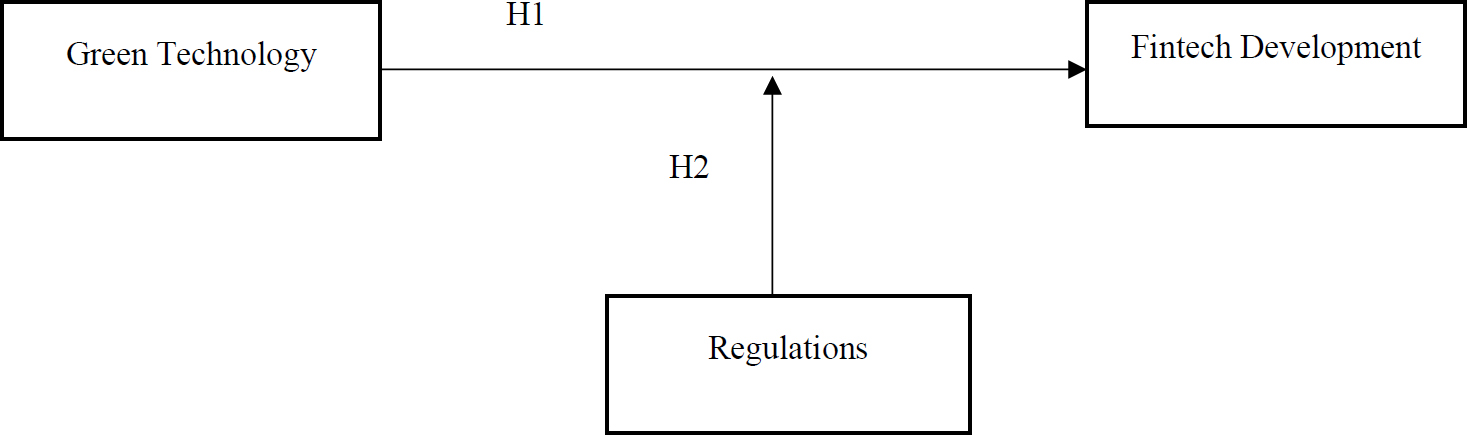
Fig. (1) presents the conceptual framework for this research, grounded in two pillars: Innovation Diffusion Theory (IDT) and Institutional Theory. It asserts that green technology as an innovation fuels Fintech growth by generating demand for transparent, sustainable, and efficient financial products (Shahzad et al., 2022). Regulatory quality, according to Institutional Theory, moderates this association and influences the environment under which Fintech innovations are implemented. An effective regulatory framework reinforces the diffusion of green Fintech innovations such as carbon trading platforms and ESG investment products (Mertzanis, 2023). The framework, therefore, records the dynamic interplay among technological innovation, the institutional environment, and financial system change in emerging economies.
Fig. (1). Conceptual framework.
3. RESEARCH METHODOLOGY
3.1. Sample and Data Collection
This research explores the effect of green technology on fintech development, with an emphasis on the moderating role of regulations in developing Asian nations, using a quantitative approach. The quantitative technique was utilised consistently with previous studies, such as (Li et al., 2024; Xue et al., 2022; and Zhe et al., 2024), to verify the hypothesis using scientific methods. The sample consists of 25 countries categorised by the Australian Government’s Department of Foreign Affairs and Trade (DFAT) as developing in the Asian region. The data is collected from 2010 to 2024 to cover more than a decade of Fintech and green technology development. The period is reasonable, as it covers major global and regional milestones, such as the emergence of mobile financial services, increased awareness of climate change, and the enactment of significant green technology policies and the Sustainable Development Goals (SDGs). The post-2010 period also signifies the wave of digitalisation and rule-making innovations in developing economies (Abbas & Najam, 2024). Data were drawn from the World Bank’s World Development Indicators (WDI) and the IEA Energy Technology Patents Data Explorer, which provide a sound, unidimensional dataset.
3.2. Variable Measurement
3.2.1. Dependent Variable: Fintech Development
Fintech Development in this research is quantified using a composite Fintech Index (FI) constructed via a two-stage Principal Component Analysis (PCA) approach, as described by (Zheng et al., 2024). The index reflects three essential dimensions: Access, Usage, and Digital Infrastructure as shown in Table 1. The Access dimension captures people’s ability to access digital financial services; Usage captures how intensively they use such services; and Digital Infrastructure captures the technological landscape that facilitates Fintech adoption. All indicators are normalised on a 0–1 scale to avoid scale differences between countries and over time. PCA is subsequently used within each dimension and then across dimensions to provide objective weights based on variance explained (Tram et al., 2023). This method avoids the subjectivity inherent in indiscriminate weighting and provides a balanced, data-driven measure of Fintech progress. The dimensions considered in this study followed those of (Zheng et al., 2024), and the PCA analysis yielded three dimensions with eigenvalues greater than 1; hence, three dimensions have been used to develop the index.
Table 1. Financial development index dimensions.
| Dimension | Indicators | Reference | Source |
| Access | Mobile Money Account | (Tram et al., 2023; and Zheng et al., 2024) | World Bank Findex |
| Own a Mobile Money Account | |||
| Internet Access | |||
| Usage | Saving from mobile money | ||
| Borrowed Money from Mobile Money | |||
| Made Digital Payment | |||
| Received digital payment | |||
| Made digital payment for instore purchase | |||
| Digital Infrastructure | Use of Internet for purchases | ||
| Internet use for accessing account |
3.2.2. Other Variables
Table 2 below provides descriptions of the key variables. Green Technology is quantified by the total number of patents awarded for energy technologies, reflecting innovation in green energy solutions. The variable adopts the methodology of (Li et al., 2024) and is derived from the IEA Energy Technology Patents Data Explorer. Energy Consumption is a measure of renewable energy consumption as a proportion of GDP, indicating the extent to which green energy contributes to the economy. This is adopted from (Hou et al., 2024) and sourced from the World Development Indicators. Economic Growth is measured by annual GDP growth (%) to capture macroeconomic performance. The moderating variable, regulation, was measured using the CPIA policy and institutional rating for environmental sustainability, as adopted from (Xia & Liu, 2024). The data for this is obtained from the World Development Indicators.
Table 2. Variable description.
| Variable | Description | Reference | Source |
| Green Technology | Number of Patents for Energy Technology | (Li et al., 2024) | IEA Energy Technology Patents Data Explorer |
| Energy Consumption | Energy use (kg of oil equivalent per capita) | (Hou et al., 2024) | World Development Indicators |
| Economic growth | GDP Growth (%) | (Hou et al., 2024) | |
| Regulation | CPIA policy and institutions for environmental sustainability rating (1 = low to 6 = high) | (Xia & Liu, 2024) |
3.2.3. Data Analysis
The data for this study were analysed using panel data regression. The study first conducted random and fixed-effect models. The model’s suitability was assessed using the Hausman test. Furthermore, the chosen model was evaluated for potential issues, including heteroscedasticity and autocorrelation. Given these issues, the final robust model considered was Generalised Least Squares (GLS), which addresses them by providing robust standard errors. The following are the equations: the first is the equation without any interaction effect, and the second contains the interaction effect.
(1)
(2)
In these equations;
FD = Fintech Development, GT = Green Technology, EC = Energy Consumption, GDP = GDP growth, R= Regulation, ‘u’ = error term, ‘i’ indicates cross section, β,0,1,2,3,4,5 are the coefficients and ‘t’ indicates time series
4. RESULTS AND DISCUSSION
4.1. Descriptive Statistics
Table 3 shows that green technology (number of patents) has a high mean of 733.24 and a very large standard deviation of 9,932.52, reflecting wide variations in patent levels across countries, with some showing very high levels of innovation while others account for very little. Regulation has a mean score of 3.166 and a relatively low standard deviation of 0.424, indicating moderate regulatory quality and very low variation across countries. GDP Growth has a mean of 3.171%, indicating modest average economic growth during the period, but a large standard deviation of 5.174%, indicating significant fluctuations, including both economic contractions and expansions. Energy Consumption has a mean of 2,358.4 kg and a high standard deviation of 2,412.34 kg, indicating substantial variation in renewable energy consumption across nations. Lastly, Fintech development has a mean score of 0.135 and a small standard deviation of 0.0219, suggesting relatively low but fairly consistent Fintech development across the sample.
Table 3. Descriptive statistics.
| Variable | Obs | Mean | Std. Dev. | Min | Max |
| Green Technology (number of patents) | 375 | 733.240 | 9932.524 | 0.11 | 189952 |
| Regulation (CPIA score) | 375 | 3.166 | 0.424 | 1.5 | 4 |
| GDP Growth (%) | 375 | 3.171 | 5.174 | -32.9 | 37.5 |
| Energy Consumption (kg) | 375 | 2358.4 | 2412.34 | 0 | 10832.9 |
| Fintech Development (score) | 375 | 0.135 | 0.0219 | 0.067 | 0.313 |
4.2. Correlation Analysis
Table 4 shows the correlation analysis of the variables. Green Technology shows extremely weak correlations with other variables, such as Fintech development (0.007), suggesting a minimal direct relationship between green innovation and Fintech development. Regulation also shows little correlation with Fintech development (r = 0.008), suggesting that regulatory quality may not have a significant independent effect on Fintech. GDP Growth is weakly positively related to Fintech development (0.047), and there is some indication that stronger economic performance is slightly linked to better Fintech performance. Energy Consumption is weakly negatively related to both Regulation (-0.116) and GDP Growth (-0.125), both of which are statistically significant, indicating that greater use of renewable energy is linked to reduced regulatory quality and slower economic growth in certain situations.
Table 4. Correlation analysis.
| – | Green Technology | Regulation | GDP Growth | Energy Consumption | Fintech Development |
| Green Technology | 1 | – | – | – | – |
| Regulation | -0.012 | 1 | – | – | – |
| GDP Growth | 0.014 | -0.067 | 1 | – | – |
| Energy Consumption | -0.045 | -0.116** | -0.125** | 1 | – |
| Fintech Development | 0.007 | 0.008 | 0.047 | -0.002 | 1 |
Note: ** indicates significance at 5% level
4.3. Panel Regression
Table 5 presents a panel data regression to evaluate the impact of green technology on Fintech development, with regulation as a moderating variable. Green Technology has a positive (B = 0.002) and significant (p = 0.000) impact on Fintech development, suggesting that green technology innovation is positively associated with higher Fintech development. It indicates a complementary relationship in which eco-innovation promotes digital financial advancement. Energy Consumption also has a positive, statistically significant impact (B = 0.008, p = 0.000), suggesting that increased energy consumption, possibly driven by digital infrastructure and industry activities, is associated with greater Fintech development.
Table 5. Panel regression.
| – | Random Effect Model | Fixed Effect Model | GLS | |||
| Fintech Development | Coefficient | P-Value | Coefficient | P-Value | Coefficient | P-Value |
| Green Technology | 0.001*** | 0.006 | 0.001*** | 0.003 | 0.002*** | 0.000 |
| Energy Consumption | 0.000 | 0.625 | 0.000 | 0.575 | 0.008*** | 0.000 |
| Regulation | -0.044*** | 0.000 | -0.043*** | 0.000 | 0.017*** | 0.001 |
| GDP Growth | 0.010 | 0.509 | 0.008 | 0.603 | 0.061*** | 0.001 |
| Reg X Fintech | 0.196*** | 0.000 | 0.190*** | 0.000 | 0.191*** | 0.000 |
| R-Squared | 0.7731 | – | 0.769 | – | – | – |
| Hausman | 3.03 | – | – | – | – | – |
| Heteroscedasticity | 109437.4 | – | – | – | – | – |
| Autocorrelation | 30.007 | – | – | – | – | – |
Note: *** indicates significance at 1%, ** indicates significance at 5%, * indicates significance at 10%
Regulation, interestingly, has a positive impact (B= 0.017, p = 0.001) in GLS, contrary to its negative influence in Random and Fixed Effects models. This implies that in controlling heteroscedasticity and autocorrelation, regulatory frameworks facilitate the growth of Fintech by instilling clarity and minimising market uncertainty. GDP Growth shows a positive and significant correlation (B = 0.061, p = 0.001), suggesting that economic growth underpins Fintech development. The interaction term RegXFintech is also positive (B = 0.191) and significant (p = 0.000), indicating that regulation complements the effect of Fintech development, perhaps by fostering a more stable and innovative financial environment.
5. DISCUSSION
The purpose of this study is to evaluate the impact of green technology on Fintech development, with regulations as a moderating factor. The findings of this study corroborate and extend earlier studies on the nexus between green technology and Fintech development. In line with the findings by (Li et al., 2024; and Xue et al., 2022), green technology illustrates a positive and significant relationship with Fintech development B = 0.002, p = 0.000), corroborating the hypothesis that eco-innovation drives digital financial progress. This connection is especially apt for Asian developing nations, where environmental concerns and digital transformation initiatives intersect with increasing calls for sustainable financial solutions. The complementary dynamics between green technology and Fintech indicate that environmentally motivated innovation can foster the development of new financial instruments, including carbon trading platforms and green investment tools.
In contrast to earlier research, which found either a direct negative effect or that regulation was not of prime importance (Hussain et al., 2024), the current study finds that regulation significantly and positively influences Fintech development (B = 0.017, p = 0.001). This result confirms Institutional Theory, which holds that regulatory clarity and institutional quality can foster innovation (Mertzanis, 2023). In Asian developing economies, efficient regulation can reduce investor uncertainty and promote innovation to advance Fintech solutions that are aligned with environmental protection. Additionally, the significant and positive interaction term (RegXFintech, B = 0.191, p = 0.000) supports the proposition that regulation enhances the impact of green technology on Fintech growth. This complementarity likely arises from growing government interest in spearheading sustainable finance as part of domestic digital and green agendas. Lastly, the substantial role of GDP growth and energy consumption demonstrates that overall economic growth and infrastructural development also favour Fintech growth, a trend found in fast-industrialising Asian economies.
Asian developing country policymakers should incentivise the adoption of green technology as a driver of Fintech growth, incorporating eco-innovation into national digital finance plans. Transparent and accommodating regulatory environments will be needed to lessen investor uncertainty and promote financially sustainable innovation. Governments ought to harmonise regulations with environmental and technological targets, promoting developments such as carbon trading exchanges and green financial instruments. Digital infrastructure investment and pro-GDP growth policies will further solidify Fintech expansion. By harmonising financial technology with environmental sustainability, policymakers can fuel inclusive, innovative, and sustainable economic development aligned with international sustainability goals.
CONCLUSION AND RECOMMENDATION
Building on the established influence of green technology on financial innovation, this study highlighted that regulatory frameworks significantly increase its effect on Fintech development, emphasising the importance of integrating supportive policies with sustainable technological initiatives. This research finds that green technology contributes substantively to Fintech development, particularly when supported by efficient regulations in Asia’s developing economies. Regulations not only directly contribute to Fintech development but also reinforce the role of green innovation towards digital finance.
POLICY RECOMMENDATION
Based on the empirical evidence, there are several significant policy implications for governments, regulators, and development agencies. Enhancing regulatory frameworks is the priority, with a focus on clear, transparent, and uniform policies that facilitate the innovation of Fintech and the adoption of green technologies. Regulatory consistency will minimise regulatory uncertainty, increase investor confidence, and provide an enabling environment of sustainable digital finance, and regulatory sandboxes can promote innovation without jeopardising financial stability. Governments, too, ought to proactively encourage eco-innovation in the financial sector by providing specific incentives, including tax incentives, subsidies, and special financing for Fintech companies that incorporate environmentally sustainable technologies, and by encouraging cooperation between providers of green technologies and financial innovators. Moreover, increased investment in digital infrastructure, such as broadband networks, data centres, cybersecurity, and renewable energy and energy-efficient technologies, is required to facilitate scalable and environmentally friendly Fintech ecosystems. Policy effectiveness can also be reinforced by strengthening institutional capacity, including regulatory expertise, inter-agency coordination, and regional cooperation among Asian economies. Lastly, it is important to promote sustainable financial behaviour and speed up the implementation of green Fintech solutions through public awareness and financial literacy campaigns.
LIMITATIONS AND FUTURE RESEARCH DIRECTION
This research is limited by its sample of Asian developing economies, which may limit the generalisability of its findings to other geographies with varying regulatory and technological landscapes. Moreover, reliance on quantitative data might miss subtle socio-political considerations affecting Fintech and green technology uptake. Qualitative research needs to be integrated in the future to yield deeper insights and examine the influence of institutional culture and stakeholder conduct. Regional and income comparisons may provide a wider insight into the green technology–Fintech intersection. Longitudinal analysis is also suggested to evaluate the dynamic influence of regulations and environmental innovations over time.
ETHICAL APPROVAL & INFORMED CONSENT
Not applicable.
AVAILABILITY OF DATA AND MATERIALS
The data will be made available on reasonable request by contacting the corresponding author.
FUNDING
None.
CONFLICT OF INTEREST
The author declares no conflicts of interest.
ACKNOWLEDGEMENTS
Declared none.
DECLARATION OF AI
During the preparation of this work, the author utilized ChatGPT to enhance the readability and improve grammar. Following the use of this tool the author carefully reviewed and revised the content as necessary and takes full responsibility for the final version of the publication.

REFERENCES
Abbas, J., & Najam, H. (2024). Role of environmental decentralisation, green human capital, and digital finance in firm green technological innovation for a sustainable society. Environment, Development and Sustainability, 1-15. https://doi.org/10.1007/s10668-024-04783-3.
Aboalsamh, H. M., Khrais, L. T., &Albahussain, S. A. (2023). Pioneering perception of green fintech in promoting sustainable digital services application within smart cities. Sustainability, 15(14), 11440. https://doi.org/10.3390/su151411440.
Adjasi, C., Hamilton, C., & Lensink, R. (2023). Fintech and financial inclusion in developing countries. In The Fintech Disruption: How Financial Innovation Is Transforming the banking industry, (pp. 297-328). Cham: Springer International Publishing. https://doi.org/10.1007/978-3-031-23069-1_12.
Almaqtari, F. A., Yahya, A. T., Al-Maskari, N., Farhan, N. H., & Al-Aamri, A. M. Y. Y. (2025). Assessing the Integrated Role of IT Governance, Fintech, and Blockchain in Enhancing Sustainability Performance and Mitigating Organizational Risk. Risks, 13(6), 105. https://doi.org/10.1108/K-05-2023-0918.
Alvarez-Herránz, A., Balsalobre, D., Cantos, J. M., & Shahbaz, M. (2017). ´ Energy innovations-GHG emissions nexus: Fresh empirical evidence from OECD countries. Energy Policy, 101, 90–100. https://doi.org/10.1016/J.ENPOL.2016.11.030.
Ambreen, S., & Awan, T. (2024). Dual Impact of Green Financing and Financial Technology on Energy Efficiency. Journal of Innovative Research in Management Sciences, 5(3), 60-76. https://doi.org/10.62270/jirms.v5i3.83.
Bagh, T., & Iftikhar, K. (2024). Understanding the Theoretical Context of Green Finance. In The Palgrave Handbook of Green Finance for Sustainable Development (pp. 49-87). Cham: Springer International Publishing. https://doi.org/10.1007/978-3-031-65756-6_3.
Cen, T., & He, R. (2018). Fintech, green finance and sustainable development. In 2018 international conference on management, economics, education, arts and humanities (MEEAH 2018), (pp. 222-225). Atlantis Press. https://doi.org/10.2991/meeah-18.2018.40.
Chen, W., Wu, W., & Zhang, T. (2023). Fintech development, firm digitalization, and bank loan pricing. Journal of Behavioral and Experimental Finance, 39, 100838. https://doi.org/10.1016/j.jbef.2023.100838.
Chen, X., Yan, D., & Chen, W. (2022). Can the digital economy promote FinTech development? Growth and Change, 53(1), 221-247. https://doi.org/10.1111/grow.12582.
Chien, F., Zhang, Y., Lin, Z., Lin, Y., & Sadiq, M. (2024). An integrated perspective on fintech, green innovation and natural resource rent: Evidence from Asia. Resources Policy, 92, 104945. https://doi.org/10.1016/j.resourpol.2024.104945.
Dong, X., & Yu, M. (2023). Does FinTech development facilitate firms’ innovation? Evidence from China. International Review of Financial Analysis, 89, 102805. https://doi.org/10.1016/j.irfa.2023.102805.
Dorfleitner, G., & Braun, D. (2019). Fintech, digitalization and blockchain: possible applications for green finance. In The rise of green finance in Europe: opportunities and challenges for issuers, investors and marketplaces (pp. 207-237). Cham: Springer International Publishing. https://doi.org/10.1007/978-3-030-22510-0_9.
Ediagbonya, V., & Tioluwani, C. (2023). The role of fintech in driving financial inclusion in developing and emerging markets: issues, challenges and prospects. Technological Sustainability, 2(1), 100-119. https://doi.org/10.1108/TECHS-10-2021-0017.
Gao, J. (2022). Comparison of fintech development between China and the United States. International Journal of Innovative Science and Research Technology (IJISRT), www. ijisrt. com. ISSN-2456-2165, pp:1150-1155. https://doi.org/10.5281/zenodo.6563524.1272-6.
Guo, L., Tang, L., Cheng, X., & Li, H. (2023). Exploring the role of fintech development in reducing firm pollution discharges: Evidence from Chinese industrial firms. Journal of Cleaner Production, 425, 138833. https://doi.org/10.1016/j.jclepro.2023.138833.
He, B., Jie, W., He, H., Alsubih, M., Arnone, G., & Makhmudov, S. (2024). From resources to resilience: How green innovation, fintech and natural resources shape sustainability in OECD countries. Resources Policy, 91, 104856. https://doi.org/10.1016/j.resourpol.2024.104856.
Hou, Y., Li, X., Wang, H., & Yunusova, R. (2024). Focusing on energy efficiency: The convergence of green financing, FinTech, financial inclusion, and natural resource rents for a greener Asia. Resources Policy, 93, 105052. https://doi.org/10.1016/j.resourpol.2024.105052.
Hussain, A., Malik, A.H., ur Rehman, A., Rehan, M. & Aboya, Y., (2025). Financial Technology and Sustainable Performance of Islamic Banks: A Conceptual Approach Using Diffusion of Innovation Theory. In Digital Technologies for Sustainability and Quality Control (pp. 53-66). IGI Global Scientific Publishing. https://doi.org/10.4018/979-8-3693-4373-9.ch003.
Hussain, S., Rasheed, A., & Rehman, S. U. (2024). Driving sustainable growth: exploring the link between financial innovation, green finance and sustainability performance: banking evidence. Kybernetes, 53(11), 4678-4696. https://doi.org/10.1108/K-05-2023-0918.
Li, Y., Chu, E., Nie, S., Peng, X., & Yi, Y. (2024). Fintech, financing constraints and corporate green innovation. International Review of Financial Analysis, 96, 103650. https://doi.org/10.1016/j.irfa.2024.103650.
Lin, B., & Ma, R. (2022). How does digital finance influence green technology innovation in China? Evidence from the financing constraints perspective. Journal of Environmental Management, 320, 115833. https://doi.org/10.1016/j.jenvman.2022.115833.
Mertzanis, C. (2023). The Global Environmental Effects of FinTech Market Growth. Available at SSRN 4562439. http://dx.doi.org/10.2139/ssrn.4562439.
Musleh Alsartawi, A. (2024). The diffusion of financial technology-enabled innovation in GCC-listed banks and its relationship with profitability and market value. Journal of Financial Reporting and Accounting. https://doi.org/10.1108/JFRA-01-2024-0010.
Navaretti, G. B., Calzolari, G., Mansilla-Fernandez, J. M., & Pozzolo, A. F. (2018). Fintech and banking. Friends or foes? Friends or Foes. http://dx.doi.org/10.2139/ssrn.3099337.
Nguyen, Q. K. (2022). The effect of FinTech development on financial stability in an emerging market: The role of market discipline. Research in Globalization, 5, 100105. https://doi.org/10.1016/j.resglo.2022.100105.
Ojukwu, P. U., Cadet, E., Osundare, O. S., Fakeyede, O. G., Ige, A. B., &Uzoka, A. (2024). Advancing green bonds through FinTech innovations: A conceptual insight into opportunities and challenges. International Journal of Engineering Research and Development, 20, 565-576. Available from: https://www.researchgate.net/profile/Abel-Uzoka/publication/386453889_Advancing_Green_Bonds_through_FinTech_Innovations_A_Conceptual_Insight_into_Opportunities_and_Challenges/links/6751b46770fb742879dc34e3/Advancing-Green-Bonds-through-FinTech-Innovations-A-Conceptual-Insight-into-Opportunities-and-Challenges.pdf.
Shahzad, M., Qu, Y., Rehman, S. U., & Zafar, A. U. (2022). Adoption of green innovation technology to accelerate sustainable development among manufacturing industry. Journal of Innovation & Knowledge, 7(4), 100231. https://doi.org/10.1016/j.jik.2022.100231.
Sharif, A., Bashir, U., Mehmood, S., Cheong, C. W., & Bashir, M. F. (2024). Exploring the impact of green technology, renewable energy and globalization towards environmental sustainability in the top ecological impacted countries. Geoscience Frontiers, 15(6), 101895. https://doi.org/10.1016/j.gsf.2024.101895.
Shi, J., & Wang, Y. (2025). Opportunities and Challenges of Fintech in Southeast Asia. Fintech and the Emerging Ecosystems, 375-389. https://doi.org/10.1007/978-3-031-83402-8_16.
Shin, Y. J., & Choi, Y. (2019). Feasibility of the FinTech industry as an innovation platform for sustainable economic growth in Korea. Sustainability, 11(19), 5351. https://doi.org/10.3390/su11195351.
Tan, Q., Yasmeen, H., Ali, S., Ismail, H., & Zameer, H. (2023). Fintech development, renewable energy consumption, government effectiveness and management of natural resources along the belt and road countries. Resources Policy, 80, 103251. https://doi.org/10.1016/j.resourpol.2022.103251.
Tao, R., Su, C. W., Naqvi, B., & Rizvi, S. K. A. (2022). Can Fintech development pave the way for a transition towards low-carbon economy: A global perspective. Technological Forecasting and Social Change, 174, 121278. https://doi.org/10.1016/j.techfore.2021.121278.
Tchidi, G. E., & Zhang, W. (2025). Mediating effect of financial inclusion on FinTech innovations and economic development in West Africa: Evidence from the Benin Republic. International Journal of Finance & Economics, 30(2), 1032-1048. https://doi.org/10.1002/ijfe.2954.
Tram, T. X. H., Lai, T. D., & Nguyen, T. T. H. (2023). Constructing a composite financial inclusion index for developing economies. The Quarterly Review of Economics and Finance, 87, 257-265.https://doi.org/10.1016/j.qref.2021.01.003.
Tsai, C. L., & Ahn, J. M. (2024). How do institutional effects shape open innovation adoption? Technology Analysis & Strategic Management, 36(10), 2761-2773. https://doi.org/10.1080/09537325.2022.2163383.
Udeagha, M. C., &Muchapondwa, E. (2023). Green finance, fintech, and environmental sustainability: fresh policy insights from the BRICS nations. International Journal of Sustainable Development & World Ecology, 30(6), 633-649. https://doi.org/10.1080/13504509.2023.2183526.
Udeagha, M. C., & Ngepah, N. (2023). The drivers of environmental sustainability in BRICS economies: do green finance and fintech matter? World Development Sustainability, 3, 100096. https://doi.org/10.1016/j.wds.2023.100096.
Xia, A., & Liu, Q. (2024). Modelling the asymmetric impact of fintech, natural resources, and environmental regulations on ecological footprint in G7 countries. Resources Policy, 89, 104552. https://doi.org/10.1016/j.resourpol.2023.104552.
Xu, A., Zhu, Y., & Wang, W. (2023). Micro green technology innovation effects of green finance pilot policy—from the perspectives of action points and green value. Journal of Business Research, 159, 113724. https://doi.org/10.1016/j.jbusres.2023.113724.
Xu, F., Sun, Y., Zhou, Y., & Yu, D. (2024). The impact of fintech development on the entrepreneurial behavior of farmers: evidence from the China Household Finance Survey. Scientific Reports, 14(1), 17505. https://doi.org/10.1038/s41598-024-68737-5.
Xue, Q., Bai, C., & Xiao, W. (2022). Fintech and corporate green technology innovation: Impacts and mechanisms. Managerial and Decision Economics, 43(8), 3898-3914. https://doi.org/10.1002/mde.3636.
Zhe, D., Su, N., Zhu, X., Mahmoud, H.A. and Akhtar, T., (2024). Non-linear relationship between FinTech, natural resources, green innovation and environmental sustainability: Evidence from panel smooth transition regression model. Resources Policy, 91, p.104902. https://doi.org/10.1016/j.resourpol.2024.104902.
Zheng, C., Rahman, M. A., Hossain, S., & Alam Siddik, M. N. (2024). Construction of a composite fintech index to measure financial inclusion for developing countries. Applied Economics, 56(52), 6498-6515. https://doi.org/10.1080/00036846.2024.2313600.
Zhou, J., Yang, X., Zhu, Y., & Li, W. (2025). The impact of local green finance policies on corporate green innovation from the perspective of policy embeddedness: evidence from Chinese A-listed companies. Digital Economy and Sustainable Development, 3(1), 7. https://doi.org/10.1007/s44265-025-00058-5.


Latest Articles
Author Ishaq Kalanther1 ,* 1Jubail Industrial College, Jubail Industrial City, Jubail, Kingdom of Saudi Arabia Article History: Received: 09 February,...
Author Abu-Shariq1 ,* 1Jubail Industrial College, Jubail, Kingdom of Saudi Arabia Article History: Received: 09 February, 2026 Accepted: 08 April,...