
- ABSTRACT
- 1. INTRODUCTION
- 2. LITERATURE REVIEW
- 3. Methodology
- 4. RESULTS
- 5. DISCUSSION
- CONCLUSION
- THEORETICAL CONTRIBUTION
- IMPLICATIONS FOR INDIAN RETAIL PRACTITIONERS
- LIMITATIONS AND FUTURE DIRECTIONS
- LIST OF ABBREVIATIONS
- AUTHOR'S CONTRIBUTION
- ETHICAL STATEMENT & INFORMED CONSENT
- AVAILABILITY OF DATA AND MATERIALS
- FUNDING
- CONFLICT OF INTEREST
- ACKNOWLEDGEMENTS
- DECLARATION OF AI
- REFERENCES
Sustainable Business Model Innovation and Digital Transformation Capability: Testing the Organisational Agility as Mediator and Green Innovation Orientation as Moderator in the Indian Retail Sector
 DOI:
DOI:
 PDF
PDF
⬇ Downloads: 29
1Independent Researcher, Computer Science and Applied Economics, United States.
Received: 29 April, 2026
Accepted: 07 September, 2026
Revised: 04 September, 2026
Published: 26 September, 2026
ABSTRACT
Introduction: Digital transformation has become a critical capability for retailers seeking to develop sustainable business models; however, limited understanding exists regarding how digital capabilities translate into sustainability-oriented innovation, particularly in emerging market contexts. The aim of this study was to examine Digital Transformation (DT) Capability and Sustainable Business Model Innovation (SBMI) association in the Indian retail sector. The study also investigated Organisational Agility (OA) as mediator and Green Innovation Orientation (GIO) as moderator.
Methodology: On the basis of Dynamic Capabilities Theory and the Natural Resource-Based View, this study developed and empirically tested an integrated framework using survey data from Indian retail organisations and analysed it through PLS-SEM.
Results: The findings revealed that DT Capability significantly enhances SBMI and OA, while OA partially mediates the DT Capability–SBMI relationship. Although GIO positively influences SBMI, its moderating effect on the DT Capability–SBMI relationship is negative, indicating that GIO contributes positively to SBMI directly but slightly weakens the positive relationship between DT Capability and SBMI at higher levels of GIO.
Conclusion: This study made contribution to digital transformation and sustainability literature as it highlighted the importance of capability alignment rather than isolated technological or environmental investments.
Keywords: Sustainable business model innovation, digital transformation capability, green innovation orientation, organisational agility, retail, India.
1. INTRODUCTION
Sustainable Business Model Innovation (SBMI) has become a strategic imperative for organisations to achieve long-term competitive sustainability and meet growing environmental and societal demands (Geissdoerfer et al., 2018). In parallel, digital transformation capability has become increasingly important as firms redefine their value creation, delivery, and capture. Recent research has shown that Digital Transformation (DT) is no longer regarded as merely the adoption of digital technology but rather as an organisational ability that entails connecting digital technologies, digital data resources, processes, and strategic routines (Verhoef et al., 2021; Vial, 2019; Warner & Wäger, 2019). The strategic importance of DT is not only about the investments in technology but also about firms’ capacity to dynamically reconfigure resources, build adaptive capabilities, and redesign business models in response to environmental change (Teece, 2023; Yu et al., 2022). Existing literature also support that digital transformation can change value creation mechanisms through data-based decisions, cooperation with ecosystems, customer focus and operational flexibility (Hanelt et al., 2021). However, emerging research debates that digital transformation does not necessarily provide better results and that its success requires additional organisational capabilities, alignment, and integration with broader organisational goals (Chen et al., 2024; Warner & Wäger, 2019).
This debate is especially relevant to the Indian retail industry, which over the past decades, has significantly transformed, particularly with the advent of e-commerce, mobile technology, digital payment systems, AI, and changing consumer habits (Seshadri & Verghese, 2026). As Indian retailers navigate the evolving retail landscape, they are embracing digital transformation and data-driven decision-making to deliver superior customer experiences, streamline operations, and remain competitive (Jena & Meena, 2025; Khaled et al., 2025). The Indian retail segment offers a prime example for studying these relationships, as it involves high-speed digital transformation and significant structural variation. The sector continues to be highly fragmented, with Small and Medium Enterprises (SMEs) playing a significant role in retail and sitting alongside large organised retail and digital-first platforms. With the extensive adoption of digital payment systems, especially the Unified Payments Interface (UPI), digital transactions have been enhanced, and customers’ expectations for seamless omnichannel experiences have grown. (Padma & Vedala, 2025). However, there are significant differences in technological infrastructure, digital capabilities, and financial resources among retailers of different sizes (Buteau, 2021; Raji et al., 2023). Simultaneously, the rising trend of sustainable consumption by consumers and the increasing regulatory focus on environmental sustainability have put pressure on retailers to incorporate sustainability into their business models (Ganjikunta & Jonna, 2026; Kumar et al., 2021). These unique structural circumstances provide a suitable context for understanding how sustainable business model innovation is related to digital transformation capabilities in the Indian retail industry.
Although digital technologies offer immense potential for improving efficiency and innovation, retailers still face challenges such as capability development, cybersecurity concerns, green authenticity claims, consumer scepticism, integration complexity, and the conversion of digital investments into lasting strategic value (Eltayeb, 2025; Joshi et al., 2025; Khan et al., 2025; Ul Haq & Khalil, 2026). Hence, the Indian retail environment serves as a key focus area for exploring how organisations can drive sustainable business model innovation through digital capabilities.
Although the subject has been of growing interest in the scholarly world, there are a number of theoretical and empirical gaps that remain unresolved. The existing literature has shown that digital transformation can enable business model innovation through the integration of resources, organisational learning, and value creation (Hajiheydari et al., 2023; Wang et al., 2023; Vares et al., 2023). But many of these studies come from developed economies or from large samples of industries and are not necessarily relevant to emerging-market retail. Additionally, recent research has highlighted that the success of digital transformation is not just about technology but also about the capabilities within an organisation. While agility has been identified as a crucial organisational capability to respond to uncertainty and reconfigure resources effectively (Mangalaraj et al., 2023), only a limited number of studies have investigated how organisational agility can serve as an explanatory chain linking DT Capability to sustainable business model innovation. In addition, the moderating effect of Green Innovation Orientation (GIO) on how digital capabilities lead to better sustainability outcomes is under-researched.
To fill these gaps, current study proposes an integrated approach to understand how DT Capability affects Sustainable Business Model Innovation (SBMI), by employing Organisational Agility (OA) as a chain linking mechanism and Green Innovation Orientation (GIO) as a boundary condition in the Indian retail industry. A quantitative research design was used and through an online survey questionnaire, data were collected from Indian retail professionals. Moreover, Partial Least Squares Structural Equation Modelling (PLS-SEM) was used to analyse 300 responses and test the proposed direct, mediation, and moderation relationships.
This study is significant because it embeds Dynamic Capabilities Theory and Natural Resource-Based View to elucidate the process of how digital capabilities can be translated into sustainability orientated innovation outcomes. It also contributes to empirical knowledge by analysing an under-researched retail context in an emerging market and identifying the organisational and strategic preconditions that enable digital transformation to lead to sustainable business model innovation. The rest of the manuscript includes literature review and the theory background and hypotheses, methodology, findings, discussion, implications, limitations, and future research directions.
2. LITERATURE REVIEW
2.1. Key Constructs
Digital Transformation (DT) capability refers to an organisation’s ability to integrate, deploy, and leverage digital technologies, data-driven resources, and digital competencies to produce strategic value (Yu et al., 2022). In this study, DT Capability is framed as a strategic organisational capability that helps Indian retail businesses leverage digital technologies for operational efficiency, value creation for customers, and business transformation. From the dynamic capabilities perspective, DT Capability is not simply seen as technology adoption but as an organisational capacity for the continuous exploitation of digital resources.
Organisational Agility (OA) is defined as a company’s ability to detect shifts in its environment, act quickly to opportunities and/or threats, and adapt resources and processes as needed (Cohard & Messeghem, 2022). For this study, OA is considered as a mediation capability through which part of the influence of digital transformation capabilities may be translated into sustainable business model innovation. In particular, agile retail companies are likely to leverage digital capabilities better, allowing them to make quicker decisions, operate more flexibly and adapt to customer and market changes.
The literature has studied the impact of Green or sustainability orientation and suggested that companies that are highly sustainability-oriented have their stakeholder needs, environmental conservation, and business objectives aligned (Al Qussair et al., 2026). Building on this, Green Innovation Orientation (GIO) is a strategic orientation that expresses an organisation’s tendency to include environmental sustainability in decisions and practices related to innovation (Jiang et al., 2026). This study treats GIO as a boundary condition that influences the translation of DT capability into sustainable business model innovation.
Sustainable Business Model Innovation (SBMI) is the redesign and transformation of value proposition, creation, and capture mechanism of an organisation for economic, environmental, and social sustainability (Ferlito & Faraci, 2022). This multidimensional perspective is in line with the business model innovation literature, which views innovation as coordinated changes in value creation, value proposition, and value capture, rather than isolated changes in organisational processes (Clauss, 2017). In line with this, SBMI is a comprehensive strategic renewal in which environmental, social, and economic objectives are integrated within the business model, rather than as separate sustainability projects. In this study, SBMI is defined as major shifts in a firm’s value proposition, value generation mechanisms, operating processes, stakeholder interactions, and revenue models to attain long-term sustainability. This is suggested to be the result of digital and organisational transformation in the Indian retail environment.
2.2. Theoretical Framework
This study is mainly based on the Dynamic Capabilities Theory (DCT) developed by David J. Teece, Pisano, and Shuen (1997) focused on how firms maintain their competitiveness through ongoing sensing, seizing, and reconfiguring resources and capabilities in their market environment (Teece, 2023). Unlike the Resource-Based View, which emphasises obtaining valuable and hard-to-imitate resources, the DCT focuses on the processes that organisations use to renew and transform their capabilities over time (Xiao et al., 2023). This is especially important for the digital transformation of markets, as markets cannot be transformed by technological resources alone. In this study, DT Capability is defined as the ability of the firm to combine digital technologies, digital resources, and digital competencies; OA is defined as the adaptive mechanism that enables these capabilities to translate into strategic changes, such as SBMI. Moreover, focusing on sustainability-oriented innovation adds to the theoretical underpinning. Sustainability-oriented innovation goes beyond conventional innovation as it requires firms to focus not only on economic competitiveness but also on environmental and social challenges through systemic organisational change (Adams et al., 2016). This perspective suggests that, in addition to technical capabilities, firms must align their resources, strategic intent, and sustainability objectives to achieve innovation. Thus, investigating the relationship between DT Capability, OA, and GIO provides a more inclusive explanation of how firms use DT and convert it into SBMI.
However, although DCT accounts for the development and deployment of transformation capabilities, it has little to say about the motives for organisations to focus on sustainability. Thus, this study adopts the Natural Resource-Based View (NRBV) suggested by (Hart, 1995) which is an extension of the resource-based perspective, where he argued that environmental issues may be turned into a source of competitive advantage if firms develop capabilities in the field of pollution prevention, sustainable resource management, and environmentally responsible innovation. Significantly, NRBV is not simply about meeting compliance standards; it is about embedding sustainability as a strategic asset that can drive sustainable value creation within organisations.
However, NRBV does not automatically imply that environmental and other organisational abilities are always complementary resources. Instead, it focuses on how environmental capabilities can be strategically important and how companies can arrange their resources to strive for environmentally responsible innovations. Therefore, GIO was theorised in this study as a sustainability-oriented capability that could condition the value generated from DT Capability. Traditional NRBV logic offers a foundation for complementarity (whereby a stronger GIO can support the role of DT Capability in SBMI), but complementarity may also imply resource allocation tensions. According to the Attention-Based View (ABV), organisational outcomes are not only a function of the number of strategic priorities but also of the distribution of organisational attention between multiple strategic priorities (Joseph et al., 2024; Ocasio, 1997). Therefore, if a company is working on both digital and green transformations, focusing on environmental issues could limit managerial focus, resources, and capacity for a more comprehensive digital transformation in business models. Thus, the interaction between DT Capability and GIO is not assumed to be complementary but rather an empirical issue. This framing provides a way to articulate the possibility of reinforcement and substitution between digital and green capabilities in the Indian retail industry.
2.3. Hypothesis Development
Dynamic Capabilities Theory proposes that firms can continuously reconfigure resources and capabilities in light of environmental changes, rather than necessarily owning the technology, to achieve strategic renewal (Teece, 2023). In this regard, DT Capability has the potential to bolster SBMI.
In the literature, digital capabilities are linked to increased organisational learning, resource reconfiguration, digital integration, and value creation, all of which contribute to the economic, environmental, and social redesign of business models (Hajiheydari et al., 2023; Wang et al., 2023; Vares et al., 2023). These studies all make the point that digitalisation is not just a technological project but is strategically important when integrated into organisational processes that enable ongoing business model renewal. Moreover, business model innovation is the deliberate and intentional adjustment of the ways in which an organisation creates, delivers, and captures value in the face of changes in the environment and competition (Foss & Saebi, 2017). Business model innovation differs from incremental process innovation because it involves the strategic reconfiguration of organisational activities and relationships between stakeholders. In this sense, DT Capability is a set of digital tools and information-processing capabilities that allow companies to experiment with novel value propositions, customer interaction methods, and digitally enabled services.
However, with this convergence comes the increasing question of whether DT leads to sustainable innovation in business models. The potential benefits of digital capabilities are largely dependent on other factors that facilitate their adoption of digital capabilities within organisations, such as leadership capability, organisational readiness, and the capacity to embed them into organisations’ wider goals and objectives (Chen et al., 2024). Likewise, research on the retail sector suggests that DT can create implementation problems, such as capability gaps, regulatory pressures, cybersecurity vulnerabilities, and growing digital performance gaps between digitally mature and less mature retailers (Joshi et al., 2025; Khan et al., 2025). Such results suggests that for SBMI, DT should be seen as an important but not sufficient prerequisite, and that organisations need to be equipped with complementary capabilities to leverage DT’s the strategic potential in adequate manner.
While the literature offers considerable support for the DT Capability and SBMI positive relationship, empirical studies still focus on cross-industry environments or conceptual models, with little attention to the development-economy retail environment. Therefore, it is unclear whether the findings of the positive relationship between the aforementioned variables in prior studies can be transferred to the Indian retail industry, given the varying maturity levels of digital transformation, resource scarcity, and sustainability issues. Based on this contextual gap, H1 was formulated.
H1: Digital Transformation Capability is positively associated with Sustainable Business Model Innovation.
Theoretically, DCT also offers a foundation for understanding how DT Capability can facilitate organisational agility in the sense that businesses can constantly reconfigure and adapt their organisational resources in light of the market context. DT Capability is always included in the literature as a fundamental element of an agile organisation. (Mangalaraj et al., 2023) showed that organisations with higher digital capabilities were better prepared to face the consequences of the pandemic, quickly remapping supply chains, incorporating digital distribution, and using analytics to make rapid decisions. Their results add to dynamic capability research by providing an example of how agility can be achieved through strategic digital resource deployment and not just through technology adoption. Empirically, (Zhang et al., 2025) demonstrated that digitalisation can increase organisational agility by improving resource allocation and reducing transaction costs; however, this impact differs across sectors and competitive settings. Combined, these studies indicate that DT Capability can be used to make an organisation more agile in that it can sense, coordinate, and respond to changing surroundings, as well as that the relationship between DT Capability and agility is shaped by contextual factors.
However, there is growing literature that questions technology explanations and states that digital capabilities alone do not produce agility in an organisation. (Troise et al., 2022) added that innovative cultures and relational capabilities are complementary aspects of digital transformation, stating that digital technologies alone cannot make organisations agile. Likewise, a systematic literature review by (Danielsen & Sæbø, 2026) concluded that it is the strategic alignment of digital initiatives with organisational processes and organisational learning mechanisms that makes the difference, meaning that digital is not an agility in itself. Together, these findings move the discussion from the significance of digital transformation to the organisational conditions that make digital transformation possible.
While there is some evidence that agility can be achieved with digital capability, the reverse argument that organisational agility can foster the development of digital capability is less prominent, as (Zhang et al., 2024) suggest. This does not contradict the literature; rather, it points to a more complex dynamic than is generally believed and can vary in an organisational context. Overall, the evidence suggests that DT Capability positively impacts organisational agility; however, differences in organisational context, management skills, and digitalisation level suggest that additional empirical findings are needed. Hence, H2 suggests that there is a link between DT Capability and OA.
H2: Digital Transformation Capability is positively associated with Organisational agility.
From the DCT perspective, investments in technology alone are likely insufficient to induce SBMI; organisations need to consistently reconfigure their resources and strategic routines in response to market changes. In this logic, organisational agility is the adaptive capability used to convert digital transformation into SBMI, thereby providing the theoretical rationale for both direct and mediating relationships between organisational agility and both DT Capability and SBMI (H3 and H4).
There is a growing consensus in the recent literature that OA can support business model innovation by helping companies adjust their value creation processes to the evolving needs of stakeholders and the market. Analysing companies in an emerging economy, (Bouguerra et al., 2024) show that there is a need for being strategically agile, as this helps build successful collaborative environmental innovations. However, agility does not only speed up internal decision-making; it also improves cross-organisational coordination and stakeholder participation. Similarly, (Mihardjo et al., 2019) demonstrate that organisational agility is the primary driver of stimulating sustainable transformation through business model innovation, rather than through operational efficiency. These findings indicate that agility is about the potential to redesign the creation, delivery, and capture of value, rather than incremental process changes.
However, this relationship is not universal or necessarily achieved, but appears in the literature. According to a systematic review conducted by (Syarkani, 2025), agility consistently enhances innovation outcomes; however, this influence is often mediated through other capabilities rather than being a stand-alone factor influencing the performance of organisations. Furthermore, (Mueller-Saegebrecht & Walter, 2025) argue that agility is dependent on contextual factors such as managerial cognition, resource fluidity, digital capabilities, market dynamism and leadership unity. Their conceptual model contests the deterministic reading, indicating that agility offers capacity for business model renewal, but if it is actually transformed into sustainable innovation, it is dependent on the organisational and environmental context. Consequently, the literature has moved beyond exploring the question of whether agility is an enabler of business model innovation to how agility impacts it.
(Abuseta et al., 2025) revealed that the link between digital technologies and business model innovation is partially mediated by firm agility, and that the indirect path increases during market turbulence, suggesting that investments in digital technologies require adaptive organisational capabilities to create strategic value. Likewise, (Xu et al., 2024) show that OA has a significant mediating role between DT and innovation performance, but they also recognised that the empirical evidence of the impact of DT on innovation has been mixed. They found that such inconsistencies are less attributable to technologies than to the adaptive strategic actions that organisations can take from digital resources. This is especially relevant for the Indian retail industry, which is quickly digitising, highly competitive, and seeing evolving customer expectations, which means that retailers must constantly reconfigure their business models instead of merely digitising them. Thus, OA is hypothesised to directly improve SBMI (H3) and act as mediator between DT Capability and SBMI (H4).
H3: Organisational Agility is positively associated with Sustainable Business Model Innovation.
H4: Organisational Agility Mediates the Relationship Between Digital Transformation Capability and Sustainable Business Model Innovation.
The NRBV provides theoretical explaining about why the DT Capability’s strategic value is dependent on an organisation’s commitment to environmental sustainability. In this view, GIO is an organisational capability that helps companies integrate digital capabilities with sustainability goals, implying that the impact of digital capabilities may vary if sustainability concerns are integrated into the decision-making process.
While the significance of environmental commitment is becoming more recognised, empirical research has rarely investigated GIO as a moderator of the relationship between DT Capability and SBMI. However, existing studies use conceptually related constructs to explain when innovation capabilities result in sustainable outcomes. As (Zhang & Walton, 2017) show, environmental orientation is an important enabler of the positive impact of eco-innovation on performance, indicating that innovation capability is more effective in the presence of an environmental orientation. Similarly, (Ardito et al., 2021) claim that environmental and digital orientations work as complementary strategic capabilities, but that their interplay differs depending on the context of innovation, indicating that digital transformation alone is not sufficient to guarantee sustainable innovation.
The following research expands this view by highlighting that the effects of sustainability-oriented strategic orientations do not directly lead to innovation but strengthen organisational capabilities. (Shehzad et al., 2026) found that green entrepreneurial orientation positively influences green business model innovation, which helps firms effectively utilise their resources to tackle sustainability issues. They observed that such relationships are conditioned by organisational resilience. These results suggest that sustainability-related abilities serve as contextual enablers that rely on other organisational resources. However, this is not yet a unanimous conclusion. (Qing & Jin, 2023) concluded that while digital transformation positively impacts the sustainability of companies, green innovation’s moderating role is not statistically significant, indicating that its influence on digital transformation within different organisational contexts is inconsistent.
Overall, the literature offers a theoretical foundation for the expectation of complementarity between environmental orientation and digital capability which does not necessarily apply uniformly. GIO can play a key role in augmenting DT Capability when environmental and digital transformation priorities are aligned. However, if there are limited resources, competing strategic priorities, or limited managerial attention, a stronger GIO can lead to substitution or trade-off effects as resources and attention are directed toward specific environmental objectives. According to the ABV, attention is not infinite for organisations and is influenced by strategic issues that are given priority. Thus, the relationship between GIO and DT Capability can be either reinforcing or constraining, depending on how these capabilities are set up. Therefore, the current study examines positive moderation, as suggested by conventional complementarity logic, aware that the empirical results may deviate from this.
H5: Green Innovation Orientation Positively Moderates the Relationship Between Digital Transformation Capability and Sustainable Business Model Innovation, such that the relationship is stronger when Green Innovation Orientation is high.
2.4. Literature Gap
While there is increasing awareness about the catalysing effect of DT for SBMI, gaps still remain. First, there is a contextual gap, as most studies explore the relationship between DT and business model innovation in developed economies or at a general industry level, which may not be applicable to the resource-constrained and highly fragmented Indian retail sector. Second, a mechanism gap exists, as few empirical studies have focused on how OA accounts for the process of translating DT Capability to SBMI. Third, another gap is in the boundary conditions, as the moderating role of GIO has received limited theoretical and empirical attention and has yet to be clearly understood when digital transformation capabilities have a stronger sustainability-oriented innovation outcome. Moreover, many publications implicitly presume that digital and sustainable capabilities are complementary strategic resources. Therefore, limited research has examined how sustainability-focused strategic capabilities can change, restrict, or even restructure the effectiveness of digital transformation in bringing about SBMI. It is important because this theoretical uncertainty is especially prevailing in emerging retail markets where companies experience a set of circumstances, including resource scarcity, fast-paced technological shifts, and heightened sustainability requirements. To fill these identified gaps, current research proposed an integrated framework in which DT Capability affects SBMI via OA, and GIO is strategically considered as a contingency factor.
2.5. Conceptual Framework
This study’s conceptual framework is shown in Fig. (1), wherein the direct and indirect paths and moderating effects are presented. The hypothesised direct effects of H1, H2, and H3 and indirect mediating effects are presented with lines and arrows, whereas the moderating effect (H5) is presented with dotted lines.
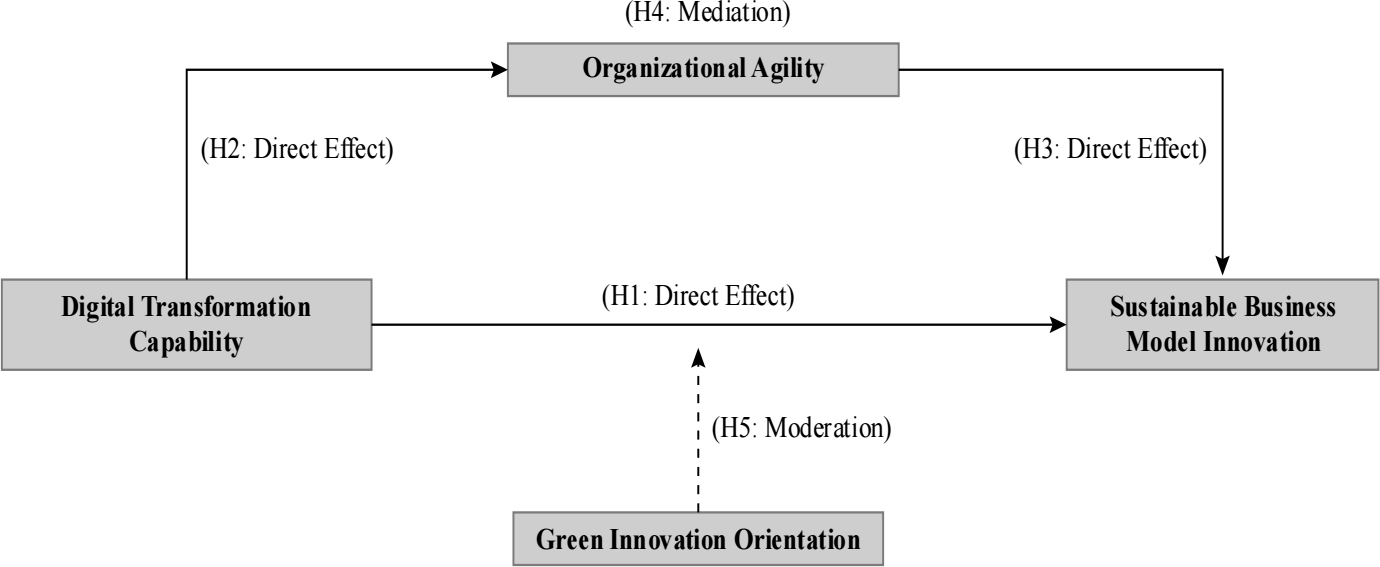
Fig. (1). Conceptual framework.
3. Methodology
3.1. Research Design
This study uses a quantitative and cross-sectional research design, as defined by (Thomas & Zubkov, 2023) which is a systematic collection and statistical analysis of numerical data at a single point in time to investigate the relationships between variables and test a theoretically derived hypothesis. The present study requires a quantitative approach, as the aim is to empirically analyse the relationship between DT Capability, OA, GIO, and SBMI in the Indian retail sector. In particular, this allows latent constructs to be measured objectively and structural relationships to be assessed, as well as the direct, mediation, and moderation effects to be tested with statistical modelling. As this study aims to validate a theoretically developed framework based on DCT and NRBV, a quantitative study design is suitable for hypothesis testing and requires methodological rigor.
3.2. Data Collection Instrument
For data gathering, a structured, online, closed-ended questionnaire was created using Google Forms. Online data collection was chosen because it offers improved accessibility and geographical reach, as well as lower cost and greater respondent convenience over traditional, face-to-face survey methods, especially for professionals in geographically spread retail organisations. Furthermore, online questionnaires reduced the administrative burden and enabled data collection through standardised questionnaires with minimal interviewer-related biases.
Two sections were made to divide the questionnaire (Appendix A). The demographic section was Section A, including details like age, gender, education, organisational position, work experience, and organisational characteristics, were collected. The main research constructs were in Section B: DT Capability, OA, GIO, and SBMI. Five items were adapted from previous studies to measure each construct, focusing on theoretical consistency and validity. A five-point Likert scale ranging from 1 (strongly disagree) to 5 (strongly agree) was used
3.3. Construct Measurement and Adaptation
The instruments for the four constructs were adapted from concepts supported by well-established literature. DT Capability items were adopted from (Chen, 2023; Yu & Moon, 2021; Vial, 2019; Verhoef et al., 2021; and Warner & Wäger, 2019) and included digital integration, digital infrastructure, data-driven capabilities, and digital process transformation. OA items were adopted from previous agility frameworks, such as (Tallon et al., 2022; Cohard & Messeghem, 2022; Overby et al., 2006; Roberts & Grover, 2012; and Nafei, 2016), which focused on sensing capability, responsiveness, flexibility, and adaptation. The GIO items were developed based on the environmental orientation and green innovation studies by (Chen, 2008; Song & Yu, 2018; and Wang, 2020). Finally, the SBMI items were adapted from the sustainable business model frameworks presented by (Geissdoerfer et al., 2018; Bocken et al., 2014; and Schaltegger et al., 2012) and the scale validated by (Bashir et al., 2022). To enhance the applicability of the constructs to the Indian retail context, all items were adapted while maintaining original conceptual meanings in the literature to suit the Indian retail environment. The construct dimensions, literature foundations, and adaptation rationale are listed in Table 1.
Table 1. Mapping measurement items adaptation sources.
| Construct | Key Dimensions/Indicators | Supporting Literature | Adaptation for Current Study (Indian Retail Context) |
| Digital Transformation Capability (DTC) | Digital technology integration, digital infrastructure capability, data-driven decision-making, digital process transformation, and digital innovation capability. | (Vial, 2019; Warner & Wäger, 2019; Chen, 2023; Verhoef et al., 2021; Yu & Moon, 2021) | The items were modified to measure the integration of digital technologies, data analytics use, retail processes, customer journeys, and employee digital capabilities of Indian retail businesses. |
| Organisational Agility (OA) | Environmental sensing; response speed; decision-making flexibility; resource adaptability; operational flexibility; continuous adaptation | (Cohard & Messeghem, 2022; Nafei, 2016; Overby et al., 2006; Roberts & Grover, 2012; Tallon et al., 2022; Warner & Wäger, 2019) | The items were localised to reflect how well Indian retail organisations can react rapidly to variations in consumer tastes and preferences, competition, supply chain challenges, and market uncertainty. |
| Green Innovation Orientation (GIO) | Strategic environmental commitment; support for green innovation; environmental decision-making; investment in green initiatives; sustainability-oriented innovation culture | (Chen, 2008; Song & Yu, 2018; Xie et al., 2019; Wang, 2020) | The items were modified to assess the level of environmental sustainability in Indian retailers’ innovation, resource use, and business improvement efforts. |
| Sustainable Business Model Innovation (SBMI) | Sustainable value proposition; sustainable value creation; sustainable value delivery; sustainable value capture; stakeholder-oriented innovation; business model transformation | (Schaltegger et al., 2012; Bocken et al., 2014; Geissdoerfer et al., 2018; Bashir et al., 2022) | The items were adapted to explore how Indian retail companies enhance their products/services, operational systems, stakeholder partnerships, and revenue streams to create sustainable economic, environmental, and social impacts. |
3.4. Population and Recruitment
The study population included managers and professionals from Indian retail organisations with knowledge of digital transformation initiatives, innovation practices, and business model development. Purposive sampling was used because respondents with experience in an organisation were necessary. Participants were recruited using professional networks, industry contacts, and online business communities of Indian retail professionals. Specifically, invitations were sent to managers, department heads, and senior staff members from retail organisations across various functions, including those related to digital operations, information technology, supply chain management, sustainability, innovation, and strategic planning. Respondent suitability was based on direct involvement or familiarity with organisational digital initiatives, technology adoption practices, innovation activities or sustainability-related decision-making. Responses were collected from people who could assess the strategic impact of digital transformation and its impact on SBMI.
A total of 420 questionnaire invitations were sent out online, and 360 questionnaires were returned (85.7% return rate). Following data screening, the retained responses were 300, as incomplete responses and those that failed the quality check were discarded. To calculate the minimum required sample, G*Power analysis was used. The calculation provided that for statistical power of 0.80, significance level of 0.05, and at a medium effect size (f² = 0.15) with five predictors, 119 minimum sample size was required. This was less than the final sample size, which showed the adequacy of the sample size for reliable testing of hypothesises and estimating the structural model.
3.5. Data Analysis
Partial Least Squares Structural Equation Modelling (PLS-SEM) was used to test the hypotheses. PLS-SEM is a variance-based structural equation modelling technique used to estimate complex models involving multiple constructs, direct effects, mediation relationships, and moderation effects (Subhaktiyasa, 2024). This was thought to be appropriate because this study aimed to analyse a theoretically integrated model of latent variables and predictive relations and explain the variance in SBMI. Furthermore, other studies that examined the impact of digital transformation on sustainability performance through mediation mechanisms and moderating effects have mostly adopted the PLS-SEM (Asif et al., 2024; Ma et al., 2023). Data analysis was performed in a two-stage process as follows. Reliability, convergent validity, and discriminant validity were assessed for the measurement model. Second, the structural model was tested by considering the path coefficients, significance of the path coefficients by bootstrapping, coefficient of determination (R2), effect size (f2), and predictive relevance.
3.6. Common Method Bias, Non-response Bias, and VIF
A measurement error known as Common Method Bias (CMB) can occur in cases when same sources is used for measuring both the dependent and independent variables and can lead to an overestimation of the relationship (Podsakoff et al., 2024). A preliminary assessment, Harman’s single-factor test was used, as per which, CMB is unlikely to be a serious concern when a single factor accounting for not more than half of the total variance (Aguirre-Urreta & Hu, 2019). In this study, the test showed 34.2% variance for the direct factor (<50%), suggesting that CMB was not an issue. In addition, the researcher also performed a full collinearity assessment by comparing the Variance Inflation Factor (VIF) values. According to (Kock, 2015), CMB issue or severe multicollinearity is unlikely if the VIF values is under 3.3. As shown in Table 2, all constructs’ VIF values were below the recommended limit, indicating that there was no collinearity problem. Lastly, non-response bias was evaluated through independent samples t-tests, wherein early and late responses were compared across all the constructs, following the method of Armstrong and Overton (Polas, 2026). Between these two groups, no significant differences (p > 0.05) was found.
Table 2. Collinearity statistics (VIF).
| – | VIF |
| Digital Transformation Capability -> Organisational Agility | 1.000 |
| Digital Transformation Capability -> Sustainable Business Model Innovation | 2.490 |
| Green Innovation Orientation -> Sustainable Business Model Innovation | 2.533 |
| Green Innovation Orientation x Digital Transformation Capability -> Sustainable Business Model Innovation | 1.319 |
| Organisational Agility -> Sustainable Business Model Innovation | 2.119 |
| Digital Transformation Capability -> Organisational Agility -> Sustainable Business Model Innovation | 3.200 |
3.7. Ethical Consideration
Ethical principles were followed throughout the process of research. Voluntary participation was ensured, and informed consent was obtained prior to the participation from all of the respondents, which included study aims and their right to withdraw at any moment without any penalty. No information that can identify a respondent was collected, and assurance of confidentiality was communicated to the participants. It was also communicated that their responses would only be used for academic research purposes.
4. RESULTS
4.1. Descriptive Analysis
Table 3 provides results for 300 respondents’ demographics. In the sample, male was high in number (59.3%), and 25-34 years was the largest age group (32.7%) followed by 35-44 years (28.0%). A large percentage of the respondents had bachelor’s (36.3%) and master’s (40.3%) degrees, and the largest occupational group was senior/general managers (25.3%). Respondents were from a variety of retail business types, with the largest group being grocery/supermarket retailers (22.3% of respondents). 30.3% of the respondents had 6–10 years of organisational experience and worked in medium-sized companies (50–249 employees) (30.7%), showing a good balance in managerial positions and retail segments.
Table 3. 300 respondents’ demographic profile.
| Variable | Category | Frequency (n) | Percentage (%) |
| Gender | Male | 178 | 59.3 |
| Female | 115 | 38.3 | |
| Prefer not to disclose | 7 | 2.4 | |
| Age | 18–24 years | 42 | 14.0 |
| 25–34 years | 98 | 32.7 | |
| 35–44 years | 84 | 28.0 | |
| 45–54 years | 53 | 17.7 | |
| 55 years and above | 23 | 7.6 | |
| Educational Qualification | Bachelor’s Degree | 109 | 36.3 |
| Master’s Degree | 121 | 40.3 | |
| Doctoral Degree (PhD) | 24 | 8.0 | |
| Professional Qualification (MBA, CA, CFA, etc.) | 46 | 15.4 | |
| Current Job Role / Position | Owner / Founder | 31 | 10.3 |
| CEO / Managing Director | 28 | 9.4 | |
| Senior Manager / General Manager | 76 | 25.3 | |
| Department Head / Functional Manager | 58 | 19.3 | |
| Digital Transformation / IT Manager | 44 | 14.7 | |
| Sustainability / CSR Manager | 21 | 7.0 | |
| Operations / Supply Chain Manager | 42 | 14.0 | |
| Retail Sector | Grocery & Supermarket Retail | 67 | 22.3 |
| Fashion & Apparel Retail | 59 | 19.7 | |
| Electronics & Consumer Goods Retail | 48 | 16.0 | |
| Pharmaceutical & Healthcare Retail | 37 | 12.3 | |
| E-commerce / Online Retail | 54 | 18.0 | |
| Home & Lifestyle Retail | 35 | 11.7 | |
| Experience in Current Organisation | Less than 3 years | 38 | 12.7 |
| 3–5 years | 72 | 24.0 | |
| 6–10 years | 91 | 30.3 | |
| 11–15 years | 56 | 18.7 | |
| More than 15 years | 43 | 14.3 | |
| Organisation Size | Less than 10 employees | 29 | 9.7 |
| 10–49 employees | 61 | 20.3 | |
| 50–249 employees | 92 | 30.7 | |
| 250–499 employees | 54 | 18.0 | |
| 500 employees and above | 64 | 21.3 |
4.2. Measurement Model
Measurement model assessment results are presented in Table 4. The indicator loadings were all above the recommended factor loadings of 0.70, ranging from 0.707 to 0.914, which indicates good indicator reliability. Composite Reliability (CR) values were between 0.904 and 0.950 and Cronbach’s alpha values were between 0.867 and 0.934, which shows high internal consistency for all the constructs. Additionally, the values of Average Variance Extracted (AVE) ranged between 0.655 and 0.792 (>0.50), suggestion convergent validity. The measurement model results support good validity as well as reliability, and the constructs are fit for analysing the structural model.
Table 4. Measurement model.
| Constructs | Indicators | Factor Loading | Cronbach’s Alpha | Composite Reliability | Average Variance Extracted (AVE) |
| Digital Transformation Capability | DTC1 | 0.853 | 0.928 | 0.945 | 0.776 |
| DTC2 | 0.893 | ||||
| DTC3 | 0.911 | ||||
| DTC4 | 0.893 | ||||
| DTC5 | 0.854 | ||||
| Green Innovation Orientation | GIO1 | 0.859 | 0.934 | 0.950 | 0.792 |
| GIO2 | 0.903 | ||||
| GIO3 | 0.914 | ||||
| GIO4 | 0.897 | ||||
| GIO5 | 0.875 | ||||
| Organisational Agility | OA1 | 0.892 | 0.913 | 0.935 | 0.742 |
| OA2 | 0.857 | ||||
| OA3 | 0.891 | ||||
| OA4 | 0.832 | ||||
| OA5 | 0.834 | ||||
| Sustainable Business Model Innovation | SBMI1 | 0.816 | 0.867 | 0.904 | 0.655 |
| SBMI2 | 0.826 | ||||
| SBMI3 | 0.707 | ||||
| SBMI4 | 0.833 | ||||
| SBMI5 | 0.856 |
Note: Factor Loadings ≥ 0.70; Cronbach’s alpha ≥ 0.70; CR ≥ 0.70; AVE ≥ 0.50 (Haji-Othman & Yusuff, 2022).
4.3. Discriminant Validity
The discriminant validity (HTMT criterion) is shown in Table 5. The HTMT values were below the recommended threshold of 0.85, indicating good discriminant validity between the study constructs. The association between SBMI and OA (0.791) was the highest, followed by that between SBMI and GIO (0.789) and that between SBMI and DT Capability (0.792). This high association is conceptually understandable because OA is posited to directly enable SBMI, leading to significant conceptual overlap while maintaining the separation of latent constructs. Therefore, discriminant validity was established in this study.
Table 5. Discriminant Validity
| – | Digital Transformation Capability | Green Innovation Orientation | Organisational Agility | Sustainable Business Model Innovation |
| Green Innovation Orientation | 0.786 | – | – | – |
| Organisational Agility | 0.722 | 0.706 | – | – |
| Sustainable Business Model Innovation | 0.792 | 0.789 | 0.791 | – |
| Green Innovation Orientation x Digital Transformation Capability | 0.361 | 0.459 | 0.467 | 0.497 |
Note: Threshold <0.85
4.4. Model Fit
The model fit statistics for the saturated and estimated models are presented in Table 6. The SRMR value for the saturated model was 0.088, indicating an acceptable model fit (SRMR < 0.10). The SRMR for the estimated model was 0.089 (upper acceptable limit threshold reported in the PLS-SEM literature), and d_ULS for the saturated model was 1.634, and the estimated model was 2.113. Overall, these results indicate that the proposed structural model is acceptable in terms of the overall fit of the model with observed data and is appropriate for hypothesis testing.
Table 6. Model fit summary.
| – | Saturated Model | Estimated Model |
| SRMR | 0.088 | 0.089 |
| d_ULS | 1.634 | 2.113 |
4.5. Path Coefficient
The results of the structural model are shown in Table 7, which shows the direct, moderating, and indirect effects. The results show that DT capability has a significant and positive effect on OA (β = 0.665, t = 17.207, p = 0.001), thus supporting H2. The corresponding effect size (f² = 0.331) showed a relatively large effect size, thus emphasising DT capability as an important factor for OA. Similarly, DT Capability was significantly and positively associated with SBMI (β = 0.432, t = 19.163, p = 0.001), supporting H1 with a medium effect size (f² = 0.281). In addition, GIO has a significant positive association with SBMI (β = 0.494, t = 21.801, p = 0.001), and the effect size is medium (f² = 0.294), indicating that green strategic commitment is a meaningful determinant of SBMI.
Table 7. Path coefficient.
| – | Path Coefficient | Standard Deviation | T Statistics | P Values | F-Square | CI (LL) | CI (UL) | Decision |
| Direct Effects | ||||||||
| Digital Transformation Capability -> Organisational Agility | 0.665*** | 0.039 | 17.207 | 0.001 | 0.331 | 0.585 | 0.735 | Supported |
| Digital Transformation Capability -> Sustainable Business Model Innovation | 0.432*** | 0.023 | 19.163 | 0.001 | 0.281 | 0.389 | 0.479 | Supported |
| Green Innovation Orientation -> Sustainable Business Model Innovation | 0.494*** | 0.023 | 21.801 | 0.001 | 0.294 | 0.450 | 0.539 | Supported |
| Green Innovation Orientation x Digital Transformation Capability -> Sustainable Business Model Innovation | -0.016* | 0.008 | 2.135 | 0.033 | 0.013 | -0.031 | -0.001 | Not Supported |
| Organisational Agility -> Sustainable Business Model Innovation | 0.140*** | 0.016 | 8.857 | 0.001 | 0.219 | 0.107 | 0.169 | Supported |
| Indirect Effect | ||||||||
| Digital Transformation Capability -> Organisational Agility -> Sustainable Business Model Innovation | 0.093*** | 0.013 | 7.190 | 0.001 | – | – | – | Supported |
Note: *p < 0.05, ***p < 0.001; f² values of 0.02, 0.15, and 0.35 indicate small, medium, and large effects, respectively.
The moderating analysis indicated that the DT Capability × GIO effect was negative but statistically significant (β = −0.016, t = 2.135, p = 0.033), contrary to the positive direction in H5. Hence, H5 was not supported. Overall, the negligible size of the interaction effect (f² = 0.013) suggests that, while the interaction is statistically possible, its substantive magnitude is restricted. Thus, increased GIO is correlated with a minor reduction in the positive DT Capability – SBMI relationship instead of an increase. In addition, OA had a positive impact on SBMI (β = 0.140, t = 8.857, p = 0.001), and the effect size was small to moderate (f² = 0.219), confirming H3. Finally, the indirect path (DTC → OA → SBMI) was positive and significant (β = 0.093, t = 7.190, p = 0.001), thus supporting H4. The results show that both the indirect and direct effects of DT Capability on SBMI are significant, confirming that OA is a partial mediator between DT Capability and SBMI. 4 of the 5 proposed hypotheses (H1–H4) were supported, while the fifth (H5) was not, because the moderating effect observed was significant but in the opposite direction to that hypothesised.
4.6. Variance Accounted For (VAF) Analysis
Moreover, according to the VAF calculation, OA mediates approximately 17.7% of the effect of DT Capability on SBMI, indicating partial mediation.
Formula: VAF = Indirect Effect/ Indirect Effect + Direct Effect
Calculation:
VAF = 0.093 / 0.093 + 0.432
VAF = 0.093 / 0.525
VAF = 0.177 or VAF = 17.7%
4.7. Predictive Relevance and Explanatory Power
The explanatory and predictive powers (R² and Q²) of the structural model are presented in Table 8. The regression model for OA had an R² value of 0.442 (adjusted R2 = 0.440), which means that DT Capability explained 44.2% of the variance in OA, indicating that it had a moderate explanatory power. In contrast, SBMI had an R2 value of 0.658 (adjusted R2 of 0.657), which means that the predictor constructs in the model explained 65.8% of the variance in SBMI, indicating substantial explanatory power. Furthermore, the Q2 values for OA (0.436) and SBMI (0.646) are significantly greater than zero, indicating that the structural model has strong predictive relevance for both endogenous constructs.
Table 8. R-square and Q-square values.
| – | R-Square | R-Square Adjusted | Q-Square Predict |
| Organisational Agility | 0.442 | 0.440 | 0.436 |
| Sustainable Business Model Innovation | 0.658 | 0.657 | 0.646 |
Note: R2 = 0.75, 0.5, and 0.25 are substantial, moderate, and weak, respectively; Q2 values above 0 indicate predictive relevance (Subhaktiyasa, 2024).
5. DISCUSSION
This study investigated the relationship between DT Capability, OA, GIO, and SBMI from an integrated perspective of DCT and NRBV in the retail sector in India. This holistic view recognises the growing need to understand digital transformation beyond technology-focused explanations, as digital capabilities
provide strategic value when mediated by organisational and sustainability-oriented conditions (Hajiheydari et al., 2023; Vares et al., 2023). The findings generally validate the suggested framework and its main features but suggest a more complex function of GIO than originally hypothesised, as well as the relevance of organisational capabilities to translate DT into sustainable innovation of the business model.
The results of this study provide a comprehensive and nuanced picture and explanation of how DT Capability supports SBMI in the Indian retail industry, which goes beyond a simple and technology-focused narrative. The analysis results show that DT Capability is an important antecedent of SBMI (H1: β = 0.432, p = 0.001), but the relationship is not automatic and one-dimensional. This aligns with previous research, which has shown that digital capabilities can help companies renew their business models through resource reconfiguration, the development of new value creation mechanisms, and the adoption of digitally enabled sustainability practices (Hajiheydari et al., 2023; Wang et al., 2023). The current study, however, adds to this body of literature by demonstrating that the impact occurs in the less-studied context of Indian retail, where digital maturity and sustainability pressures intersect. The large effect size (f² = 0.281) further highlights its significance; however, the cross-sectional design of the study means that this should be viewed as a strong association and not a definitive causality.
This finding, which is based on Dynamic Capabilities Theory, reconceptualises DT Capability as a strategic organisational capability rather than simply the adoption of digital tools, with the ability to sense, seize, and reconfigure resources. This difference is significant in the Indian retail context. The rapid, often chaotic, digital transformation in the sector is typified by retail businesses using analytics, automation, and omnichannel platforms to navigate fragmented markets. The direct connection indicates that when digital resources are strategically applied and not randomly used, they can challenge the value propositions of sustainable reinvention. However, an important caveat is that this substantial effect might, in part, be the result of reverse causation; that is, retailers with a developed DT Capability are often the same retailers that have the foresight to explore SBMI or due to other unmeasured factors, such as visionary leadership.
This DT capability is vital for developing OA (H2: β = 0.665, p = 0.001; effect size f² = 0.331) as it serves as a key enabler of adaptive capabilities. This association was in line with the DCT premise that agility is not about having static assets but rather the ability to constantly integrate and reconfigure resources to meet changing demands. Previous studies have shown that digital skills can enhance the agility of organisations by facilitating information processing, resource coordination, and quick responses to changes in the environment (Mangalaraj et al., 2023; Zhang et al., 2025). However, these studies also indicate that agility goes beyond the adoption of technology and is the result of the integration of digital resources into the organisation, a finding also confirmed by the present study. This finding is relevant for retailers in India, where not only digitised operations are required in the market, but also volatile consumer behaviours. Because the market has already shifted to omnichannel expectations, competitive pressures from legacy players and agile start-ups are intense. This strong association suggests that DT Capability offers the required architecture that can support improved sensing and faster decision cycles, transforming raw data from a myriad of sources into actionable market intelligence. However, it is important not to overestimate this relationship. The findings suggest that digital infrastructure is the architecture, but it is how retailers strategically mobilise that infrastructure to become agile. From a critical perspective, in a price-sensitive market like India, smaller retailers’ operational agility can initially be constrained by the cost of building such capability, which may paradoxically reduce their agility.
Although agility is an important outcome of digital capability, its direct contribution to SBMI is comparatively small (H3: β = 0.140, p = 0.001). This finding provides a critical counterpoint to the literature that champions agility as an enabler of innovation. Previous research has indicated that organisational agility is a key enabler of innovation and sustainable transformation (Mihardjo et al., 2019; Bouguerra et al., 2024); however, the relatively small effect in this study offers a more conditional interpretation of agility. In particular, the results indicate that agility can facilitate transformation but does not, in itself, bring the technological and strategic resources needed to achieve significant business model renewal. This suggests that, on their own, process adaptation and fast reactions are insufficient to drive the deep structural change needed for sustainable business model change in the Indian retail ecosystem. While digital and sustainability-oriented capabilities provide strategic substance, agility is a refined and operationalised mechanism for using these resources to the best effect. Thus, the small coefficient reflects the practical reality of Indian retail, where sustainability-based innovation often requires dealing with huge operational constraints, regulatory uncertainty, and a population of consumers who have a growing awareness of sustainability that is not always reflected in their willingness to buy. Hence, a quick agile reaction to a short-term market trend is qualitatively different from a conscious long-term commitment to the SBMI.
The mediation results provide a more qualified interpretation of the role of OA. The association between OA and SBMI was statistically significant (β = 0.140, p = 0.001), and the indirect path of DT Capability (β = 0.093, p = 0.001) was also significant. However, the direct influence of DT Capability on SBMI remained significant (β = 0.432, p = 0.001). The indirect-to-direct effect ratio was approximately 17.7%, suggesting that the OA pathway is a significant, but not dominant, pathway through which DT Capability results in SBMI. Therefore, OA should be recognised as a partial and relatively weak mechanism that complements the direct strategic impact of DT Capability. This is consistent with recent studies that have indicated that OA is a key intermediary that helps translate the impact of digital technologies into innovation outcomes but does not necessarily generate innovation itself (Abuseta et al., 2025; Xu et al., 2024). This two-pronged approach is especially relevant in India, where the push towards digitalisation and market dynamics is pronounced. The significant mediated pathway suggests that part of the effect of DT Capability on SBMI is through organisational agility; the stronger direct path suggests that a large portion of the explanatory influence of DT Capability is beyond this mechanism. For instance, a retailer may use digital platforms to facilitate the circular economy model (direct effect); however, the retailer must have the agility to adjust logistics and supplier relationships in real time to scale and sustain innovation (mediated effect). The partial nature of this mediation suggests that even the most agile but least digitally mature retailers may find it difficult to achieve the basic innovations required to allow them to become sustainable, which further indicates that OA should be regarded as a complementary mechanism rather than the dominant explanatory pathway.
The most significant qualification was related to the GIO. The results show two separate effects that should not be combined. First, GIO is significantly and positively associated with SBMI (β = 0.494, p = 0.001), which shows that firms with a high green innovation orientation tend to have high SBMI. Second, the result of the interaction between DT Capability and GIO is negative and significant (β = −0.016, p = 0.033), which means that increased GIO slightly reduces the positive relationship between DT Capability and SBMI. However, this does not imply that GIO is detrimental to SBMI. Instead, GIO was positively related as a direct predictor and negatively related as a boundary condition for the SBMI. These are independent empirical relationships that must be interpreted independently.
The negative interaction is a more specific qualification of the complementarity assumption of H5 than the positive one. Direct GIO positively supports SBMI (β = 0.494), whereas increased GIO slightly reduces the positive relationship between DT Capability and SBMI (β = −0.016), indicating that the two capabilities may not necessarily yield reinforcing outcomes when pursued together. One possible explanation can be gleaned from the Attention-Based View (ABV), which posits that managerial attention is divided between strategic issues and that this division affects the behaviour of the organisation (Ocasio, 1997). Retailers might have to deal with both digital and environmental transitions simultaneously and therefore manage competing demands on management attention, implementation capacity, and organisational resources in the context of the twin transition. This tension may be more applicable in the retail sector of emerging markets, where financial, technological, and managerial resources are more limited. Higher GIO can therefore lead to management decisions and digital investments that are more intensely focused on specific environmental goals, with a corresponding decrease in the scope for experiments with digitally enabled business models. This can be a possible reason for the strong positive direct relationship between GIO and SBMI and the slight reduction in the incremental contribution of DT Capability. A casual explanation cannot be provided due to the cross-sectional design for the underlying mechanisms; therefore, the interpretation remains tentative.
Traditional NRBV reasoning suggests that environmental and digital capabilities may be complementary, leading to the expectation that GIO provide strength to DT Capability’s positive effect on SBMI. Nevertheless, the Attention-Based View and resource-allocation perspective suggest that simultaneous digital and green transformation may also create competing demands for managerial attention and organisational resources. Accordingly, although the primary hypothesis predicts positive moderation based on complementarity, a negative interaction would be theoretically plausible, where green and digital transformation compete for scarce organisational resources.
CONCLUSION
This study shows that the association between DT Capability and SBMI in Indian retail sector is significantly strong, while the mediating pathway of OA is also significant but comparatively weak. GIO also has a strong positive direct association with SBMI; however, contrary to H5, its interaction with DT Capability is negative and very small. The findings differentiate between the direct effect of green orientation and its conditional impact on digital capabilities. Current findings point that digital and green capabilities do not support each other automatically, but rather that the combined value is tied to the configuration of organisational priorities and capabilities. This creates a better-informed foundation for the use of DCT and NRBV in the context of digital sustainability transformations.
THEORETICAL CONTRIBUTION
The contribution of this study is to the theory by combining Dynamic Capabilities Theory (DCT) and the Natural Resource-Based View (NRBV) for explaining how in business model sustainable innovation can be achieve through digital transformation, thereby identifying a crucial boundary condition. First, it extends DCT by showing that DT Capability is a dual pathway with a direct strategic pathway and an indirect pathway partially mediated by OA. This partial mediation adds to the literature, which sometimes considers agility as a complete explanatory mechanism, as it has been found that there is still strategic value for digital capabilities in sustainability-driven transformations.
Second, this study qualifies the complementarity assumption underpinning the application of the NRBV in digital sustainability relationships. The relationship between GIO and SBMI was strong and positive (β = 0.494), indicating that GIO itself is an important sustainability-oriented antecedent to SB. Its interaction with DT Capability was negative (β = −0.016), indicating that GIO did not increase the contribution of DT Capability to SBMI, as hypothesised. In this sense, the theoretical contribution is not only the fact that GIO is an independent driver of SBMI but also the notion that the direct value of GIO and its contingent effect on digital capabilities should be separated. The results indicate that SBMI can be achieved through environmental orientation, but it is not necessarily a source of complementary returns from digital transformation.
The results suggest that capability configuration and alignment may be relevant boundary conditions for digital sustainability research. Future studies should focus on the coordination of a company’s goals, resource allocation, and implementation priorities between digital and green capabilities, rather than accepting the assumption that the greater the investment in both, the better the combined results. In this way, the current evidence builds on the DCT–NRBV debate, drawing attention to the fact that capability value may be dependent not only on the strength of individual capabilities but also on the nature of the interaction between them.
IMPLICATIONS FOR INDIAN RETAIL PRACTITIONERS
The results have particular implications for Owners and Founders that DT Capability and GIO do not necessarily have a synergistic effect; thus, digital investments must be aligned with sustainability goals and not treated as isolated technology investments. CEOs and Managing Directors should implement governance processes that embed digital and sustainability agendas, as agility enhances transformation but does not substitute for basic digital capabilities. Senior and Functional Managers should establish cross-functional processes by which digital projects are assessed through sustainability considerations and green projects tap into digital assets. Digital Transformation Managers must move from merely implementing technology to recognising how technology can be used to redesign sustainable value creation through analytics, automation, and digital platforms. It is crucial that Sustainability Managers consider GIO as a separate driver or strategic capability required for SBMI, but also selectively bring in digital solutions where there is a strategic fit. To turn digital and sustainability objectives into reality, Operations Managers must increasingly develop adapted processes in logistics, procurement, and inventory management.
LIMITATIONS AND FUTURE DIRECTIONS
This study has some limitations that must be acknowledge. First, owing to the cross-sectional design, associations are only observed at one moment in time, which prevents causal conclusions from being drawn about the impact of DT capability on SBMI over time. For future researchers, a longitudinal approach is suggested for exploring these relationship’s temporal aspects, including how the interplay between digital and green capabilities changes as organisations transition. Second, the purposive sampling method is suitable for reaching knowledgeable respondents, but it may not be generalisable outside the Indian retail context. The boundary conditions of the proposed framework were identified based on comparative studies of other emerging markets and industries. Third, self-reported perceptual measures were used, which may have subjective factors; in future researchers could use objective performance measures to validate the results. Fourth, because the study used PLS-SEM, cross-sectional, and single respondents, endogeneity may still exist. Fifth, and most surprisingly, the negative moderation from GIO highlights that digital and sustainability capabilities association is not as straightforward as theorised. Qualitative explorations of the strategic tensions between these priorities would offer greater clarity on the organisational processes and mechanisms that shape how these capabilities either compete or complement each other.
LIST OF ABBREVIATIONS
| ABV | = | Attention-Based View |
| AVE | = | Average Variance Extracted |
| CMB | = | Cloud Accounting Information Systems |
| CR | = | Composite Reliability |
| DCT | = | Dynamic Capabilities Theory |
| DT | = | Digital Transformation |
| GIO | = | Green Innovation Orientation |
| NRBV | = | Natural Resource-Based View |
| OA | = | Organisational Agility |
| PLS-SEM | = | Partial Least Squares Structural Equation Modelling |
| SBMI | = | Sustainable Business Model Innovation |
| SMEs | = | Small and Medium Enterprises |
| UPI | = | Unified Payments Interface |
AUTHOR’S CONTRIBUTION
F.O. has contributed to the study conceptualization, methodology, data analysis, interpretation of results, and manuscript writing.
ETHICAL STATEMENT & INFORMED CONSENT
Ethical principles were followed throughout the process of research. Voluntary participation was ensured, and informed consent was obtained prior to the participation from all of the respondents, which included study aims and their right to withdraw at any moment without any penalty. No information that can identify a respondent was collected, and assurance of confidentiality was communicated to the participants. It was also communicated that their responses would only be used for academic research purposes.
AVAILABILITY OF DATA AND MATERIALS
The data will be made available on reasonable request by contacting the corresponding author [F.O.].
FUNDING
None.
CONFLICT OF INTEREST
The author declares that there is no conflict of interest regarding the publication of this article.
ACKNOWLEDGEMENTS
Declared none.
DECLARATION OF AI
During the preparation of this manuscript, the author used ChatGPT for language editing and refinement purposes. Following the use of this tool, the author carefully reviewed and revised the content where necessary and accepts full responsibility for the final published version of the article.
Appendix
Section A: Demographic Information
Please select the option that best describes your personal and professional background.
D1. Gender
- Male
- Female
- Prefer not to disclose
D2. Age
- 18-24 years
- 25–34 years
- 35–44 years
- 45–54 years
- 55 years and above
D3. Educational Qualification
- Bachelor’s Degree
- Master’s Degree
- Doctoral Degree (PhD)
- Professional Qualification (g., MBA, CA, CFA, etc.)
D4. Current Job Role/Position
- Owner / Founder
- Chief Executive Officer (CEO) / Managing Director
- Senior Manager / General Manager
- Department Head / Functional Manager
- Digital Transformation Manager / IT Manager
- Sustainability / CSR Manager
- Operations / Supply Chain Manager
D5. Retail Sector of Your Organisation
- Grocery and Supermarket Retail
- Fashion and Apparel Retail
- Electronics and Consumer Goods Retail
- Pharmaceutical and Healthcare Retail
- E-commerce / Online Retail
- Home and Lifestyle Retail
D6. Years of Experience in the Current Organization
- Less than 3 years
- 3–5 years
- 6–10 years
- 11–15 years
- More than 15 years
D7. Organization Size (Number of Employees)
- Less than 10 employees
- 10–49 employees
- 50–249 employees
- 250–499 employees
- 500 employees and above
Section B: Main Questionnaire
Instruction to respondents
Please indicate the extent to which you agree with the following statements regarding your Organization.
Scale
1 = Strongly Disagree
2 = Disagree
3 = Neutral
4 = Agree
5 = Strongly Agree
| Constructs | Indicator | Statement | 1 | 2 | 3 | 4 | 5 |
| Digital Transformation Capability | DTC1 | Our organisation effectively integrates digital technologies into core business operations. | ☐ | ☐ | ☐ | ☐ | ☐ |
| Digital Transformation Capability | DTC2 | Our organisation continuously upgrades its digital infrastructure to support its business objectives. | ☐ | ☐ | ☐ | ☐ | ☐ |
| Digital Transformation Capability | DTC3 | Data generated through digital systems are extensively used to support strategic decision-making. | ☐ | ☐ | ☐ | ☐ | ☐ |
| Digital Transformation Capability | DTC4 | Digital technologies have significantly improved the efficiency of business processes. | ☐ | ☐ | ☐ | ☐ | ☐ |
| Digital Transformation Capability | DTC5 | Our organisation actively develops new digital solutions to improve products, services, and customer experiences. | ☐ | ☐ | ☐ | ☐ | ☐ |
| Organisational Agility | OA1 | Our organisation quickly identifies changes in customer needs and market conditions to remain competitive in a dynamic business environment. | ☐ | ☐ | ☐ | ☐ | ☐ |
| Organisational Agility | OA2 | Our organisation responds rapidly to unexpected changes in the business environment. | ☐ | ☐ | ☐ | ☐ | ☐ |
| Organisational Agility | OA3 | Decision-making processes in our organisation enable timely responses to emerging opportunities and challenges in the retail sector. | ☐ | ☐ | ☐ | ☐ | ☐ |
| Organisational Agility | OA4 | Our organisation can quickly reallocate resources when business priorities change. | ☐ | ☐ | ☐ | ☐ | ☐ |
| Organisational Agility | OA5 | Our organisation readily adjusts its operational processes to meet the changing customer or market requirements. | ☐ | ☐ | ☐ | ☐ | ☐ |
| Green Innovation Orientation | GIO1 | Environmental sustainability is a core consideration in our organisation’s innovation strategies. | ☐ | ☐ | ☐ | ☐ | ☐ |
| Green Innovation Orientation | GIO2 | Our organisation actively encourages the development of environmentally sustainable products, services, and business practices. | ☐ | ☐ | ☐ | ☐ | ☐ |
| Green Innovation Orientation | GIO3 | Environmental impacts are carefully considered when making strategic business decisions in the retail sector. | ☐ | ☐ | ☐ | ☐ | ☐ |
| Green Innovation Orientation | GIO4 | Our organisation allocates sufficient resources to support environmentally sustainable innovation. | ☐ | ☐ | ☐ | ☐ | ☐ |
| Green Innovation Orientation | GIO5 | Achieving long-term environmental sustainability is an important objective of our organisation’s innovation. | ☐ | ☐ | ☐ | ☐ | ☐ |
| Sustainable Business Model Innovation | SBMI1 | Our organisation has redesigned its value proposition to incorporate environmental and social sustainability. | ☐ | ☐ | ☐ | ☐ | ☐ |
| Sustainable Business Model Innovation | SBMI2 | Our organisation develops new products, services, or solutions that create customer value and sustainability benefits. | ☐ | ☐ | ☐ | ☐ | ☐ |
| Sustainable Business Model Innovation | SBMI3 | Our organisation has transformed its operational processes to improve resource efficiency and reduce its environmental impact. | ☐ | ☐ | ☐ | ☐ | ☐ |
| Sustainable Business Model Innovation | SBMI4 | Our organisation collaborates with suppliers, customers, and other stakeholders to develop sustainable business solutions that benefit the environment and society. | ☐ | ☐ | ☐ | ☐ | ☐ |
| Sustainable Business Model Innovation | SBMI5 | Our organisation continuously modifies its business model to achieve long-term economic, environmental, and social sustainability goals. | ☐ | ☐ | ☐ | ☐ | ☐ |
REFERENCES
Abuseta, H., Iyiola, K., & Aljuhmani, H. Y. (2025). Digital technologies and business model innovation in turbulent markets: Unlocking the power of agility and absorptive capacity. Sustainability, 17(12), 5296.
https://doi.org/10.3390/su17125296
Adams, R., Jeanrenaud, S., Bessant, J., Denyer, D., & Overy, P. (2016). Sustainability-oriented innovation: A systematic review. International Journal of Management Reviews, 18(2), 180–205.
https://doi.org/10.1111/ijmr.12068
Aguirre-Urreta, M. I., & Hu, J. (2019). Detecting common method bias: Performance of the Harman’s single-factor test. ACM SIGMIS Database: The DATABASE for Advances in Information Systems, 50(2), 45–70.
https://doi.org/10.1145/3330472.3330477
Al Qussair, M. A. A., Almari, B. H. S., & Aldossary, N. S. A. (2026). Green HRM and sustainability orientation in relation to carbon-reduction performance: The moderating role of perceived Vision 2030 alignment. Advance Journal of Business Management & Social Science, 2(1), 1–17.
https://doi.org/10.65080/ajbmss.v2i1.CMT2621101002
Ardito, L., Raby, S., Albino, V., & Bertoldi, B. (2021). The duality of digital and environmental orientations in the context of SMEs: Implications for innovation performance. Journal of Business Research, 123, 44–56.
https://doi.org/10.1016/j.jbusres.2020.09.022
Asif, M., Yang, L., & Hashim, M. (2024). The role of digital transformation, corporate culture, and leadership in enhancing corporate sustainable performance in the manufacturing sector of China. Sustainability, 16(7), 2651.
https://doi.org/10.3390/su16072651
Bashir, M., Alfalih, A., & Pradhan, S. (2022). Sustainable business model innovation: Scale development, validation and proof of performance. Journal of Innovation & Knowledge, 7(4), 100243.
https://doi.org/10.1016/j.jik.2022.100243
Bocken, N. M. P., Short, S. W., Rana, P., & Evans, S. (2014). A literature and practice review to develop sustainable business model archetypes. Journal of Cleaner Production, 65, 42–56.
https://doi.org/10.1016/j.jclepro.2013.11.039
Bouguerra, A., Hughes, M., Rodgers, P., Stokes, P., & Tatoglu, E. (2024). Confronting the grand challenge of environmental sustainability within supply chains: How can organizational strategic agility drive environmental innovation? Journal of Product Innovation Management, 41(2), 323–346.
https://doi.org/10.1111/jpim.12692
Buteau, S. (2021). Roadmap for digital technology to foster India’s MSME ecosystem—opportunities and challenges. CSI Transactions on ICT, 233–244.
https://doi.org/10.1007/s40012-021-00345-4
Chen, A., Li, L., & Shahid, W. (2024). Digital transformation as the driving force for sustainable business performance: A moderated mediation model of market-driven business model innovation and digital leadership capabilities. Heliyon, 10(8), e29509.
https://doi.org/10.1016/j.heliyon.2024.e29509
Chen, L. (2023). Enterprise digital transformation, dynamic capabilities and innovation performance. Frontiers in Business, Economics and Management, 11(2), 327–332.
https://doi.org/10.54097/fbem.v11i2.12632
Chen, Y. S. (2008). The driver of green innovation and green image–green core competence. Journal of Business Ethics, 81, 531–543.
https://doi.org/10.1007/s10551-007-9522-1
Clauss, T. (2017). Measuring business model innovation: Conceptualization, scale development, and proof of performance. R&D Management, 47(3), 385-403.
https://doi.org/10.1111/radm.12186
Cohard, P., & Messeghem, K. (2022). A measurement scale for agile orientation. Systèmes d’information & management, 27(1), 39–66.
https://doi.org/10.3917/sim.221.0039
Danielsen, F., & Sæbø, Ø. (2026). Organizational agility and digital transformation in public organizations: A systematic literature review. In K. Liebowitz & J. Liebowitz (Eds.), Digital transformation in government: Insights, experiences and best practices (pp. 287–313). World Scientific.
https://doi.org/10.1142/9789819818884_0011
Eltayeb, T. K. (2025). Sustainability in global supply chains: A study on the impact of distributed ledger technology on ethical sourcing and consumer trust. Majestic Global Trends in Marketing & Supply Chain Management, 1, 1–14.
https://doi.org/10.65080/mgtmscm.v1i1.2
Ferlito, R., & Faraci, R. (2022). Business model innovation for sustainability: A new framework. Innovation & Management Review, 19(3), 222–236.
https://doi.org/10.1108/INMR-07-2021-0125
Foss, N. J., & Saebi, T. (2017). Fifteen years of research on business model innovation: How far have we come, and where should we go? Journal of Management, 43(1), 200–227.
https://doi.org/10.1177/0149206316675927
Ganjikunta, N., & Jonna, T. S. (2026). Exploring the alignment between consumer expectations and retailer strategies for sustainable practices in Indian supermarkets. SHS Web of Conferences, 230, 06001.
https://doi.org/10.1051/shsconf/202623006001
Geissdoerfer, M., Vladimirova, D., & Evans, S. (2018). Sustainable business model innovation: A review. Journal of Cleaner Production, 198, 401–416.
https://doi.org/10.1016/j.jclepro.2018.06.240
Hajiheydari, N., Shouraki, M. K., Vares, H., & Mohammadian, A. (2023). Digital sustainable business model innovation: Applying dynamic capabilities approach (DSBMI-DC). Foresight, 25(3), 420–447.
https://doi.org/10.1108/FS-02-2022-0012
Haji-Othman, Y., & Yusuff, M. S. S. (2022). Assessing reliability and validity of attitude construct using partial least squares structural equation modeling (PLS-SEM). International Journal of Academic Research in Business and Social Sciences, 12(5), 378–385.
https://dx.doi.org/10.6007/IJARBSS/v12-i5/13289
Hanelt, A., Bohnsack, R., Marz, D., & Marante, C.A. (2021). A systematic review of the literature on digital transformation: Insights and implications for strategy and organizational change. Journal of Management Studies, 58(5), 1159–1197.
https://doi.org/10.1111/joms.12639
Hart, S. L. (1995). A natural-resource-based view of the firm. Academy of Management Review, 20(4), 986–1014.
https://doi.org/10.2307/258963
Jena, S. K., & Meena, P. (2025). Strategic adaptation for online platform retailers in government-regulated digital marketplaces. Journal of Innovation & Knowledge, 10(3), 100717.
https://doi.org/10.1016/j.jik.2025.100717
Jiang, L., Pongtornkulpanich, A., & Chaidee, N. (2026). Disentangling technical and behavioral green supply chain management practices: The mediating role of green innovation culture in logistics firms’ triple-bottom-line performance. Logistics, 10(6), 137.
https://doi.org/10.3390/logistics10060137
Joseph, J., Laureiro-Martinez, D., Nigam, A., Ocasio, W., & Rerup, C. (2024). Research frontiers on the attention-based view of the firm. Strategic Organization, 22(1), 6–17.
https://doi.org/10.1177/14761270231223397
Joshi, A., Spilbergs, O. A., & Mikelsone, E. (2025). The impact of digital transformation on traditional business models: Challenges and opportunities. Journal of Marketing & Social Research, 2(6), 178–192. Available from: https://www.jmsr-online.com/article/the-impact-of-digital-transformation-on-traditional-business-models-challenges-and-opportunities-323/
Khaled, A. S. D., Belhaj, F. A., AL-Sinawi, S. H. N., & Yahya, A. T. (2025). Information technology practices in retail industry: Evidence of India. Discover Sustainability, 6, 1400.
https://doi.org/10.1007/s43621-025-00995-3
Khan, S., Ali, M., Akram, M., Azizova, N., Vokhidova, M., & Isamukhamedova, G. (2025). Exploring the impact of digital transformation on business model innovation in the retail sector. In Environment. Technology. Resources. Proceedings of the 16th International Scientific and Practical Conference (Vol. 1, pp. 281–288).
https://doi.org/10.17770/etr2025vol1.8640
Kock, N. (2015). Common method bias in PLS-SEM: A full collinearity assessment approach. International Journal of e-Collaboration (IJeC), 11(4), 1–10.
https://doi.org/10.4018/ijec.2015100101
Kumar, A., Prakash, G., & Kumar, G. (2021). Does environmentally responsible purchase intention matter for consumers? A predictive sustainable model developed through an empirical study. Journal of Retailing and Consumer Services, 58, 102270.
https://doi.org/10.1016/j.jretconser.2020.102270
Ma, L., Zhang, X., & Dong, L. (2023). Enhancing sustainable performance: The innovative strategy of digital transformation leading green collaborative management. Sustainability, 15(17), 13085.
https://doi.org/10.3390/su151713085
Mangalaraj, G., Nerur, S., & Dwivedi, R. (2023). Digital transformation for agility and resilience: An exploratory study. Journal of Computer Information Systems, 63(1), 11–23.
https://doi.org/10.1080/08874417.2021.2015726
Mihardjo, L. W. W., Sasmoko, S., & Rukmana, R. A. N. (2019). Customer experience and organizational agility driven business model innovation to shape sustainable development. Polish Journal of Management Studies, 20(1), 293–304.
https://doi.org/10.17512/pjms.2019.20.1.26
Mueller-Saegebrecht, S., & Walter, A.-T. (2025). Strategic agility—An urgent capability for successful business model innovation? A conceptual process model and theoretical framework. Strategic Change, 34(3), 407–428.
https://doi.org/10.1002/jsc.2645
Nafei, W. A. (2016). Organizational agility: The key to organizational success. International Journal of Business and Management, 11(5), 296–309.
https://doi.org/10.5539/ijbm.v11n5p296
Ocasio, W. (1997). Towards an attention-based view of the firm. Strategic Management Journal, 18(S1), 187–206.
https://doi.org/10.1002/(SICI)1097-0266(199707)18:1+%3C187::AID-SMJ936%3E3.0.CO;2-K
Overby, E., Bharadwaj, A. S., & Sambamurthy, V. (2006). Enterprise agility and the enabling role of information technology. European Journal of Information Systems, 15(2), 120–131.
https://doi.org/10.1057/palgrave.ejis.3000600
Padma Kiran, K., & Vedala, N. S. (2025). Assessing Unified Payments Interface (UPI) adoption and usage through the interplay of UTAUT factors. Humanities and Social Sciences Communications, 12, 1060.
https://doi.org/10.1057/s41599-025-05313-w
Podsakoff, P. M., Podsakoff, N. P., Williams, L. J., Huang, C., & Yang, J. (2024). Common method bias: It’s bad, it’s complex, it’s widespread, and it’s not easy to fix. Annual Review of Organizational Psychology and Organizational Behavior, 11, 17–61.
https://doi.org/10.1146/annurev-orgpsych-110721-040030
Polas, M. R. H. (2026). The NN-UDP framework: A unified protocol for normality testing, non-response bias, and estimator selection in CB-SEM and PLS-SEM. Review of Economics, Finance & Business, 1(1), 54–64.
https://doi.org/10.65826/REFB.1.1.2026.12
Qing, C., & Jin, S. (2023). Does ESG and digital transformation affects corporate sustainability? The moderating role of green innovation. arXiv.
https://doi.org/10.48550/arXiv.2311.18351
Raji, A. N., Olawore, A. O., & Osahor, D. (2023). The impact of e-commerce giants on SMEs: Challenges, opportunities, and the fight for survival in the digital economy. World Journal of Advanced Research and Reviews, 20(2), 1412–1433.
https://doi.org/10.30574/wjarr.2023.20.2.2692
Roberts, N., & Grover, V. (2012). Investigating firm’s customer agility and firm performance: The importance of aligning sense and respond capabilities. Journal of Business Research, 65(5), 579–585.
https://doi.org/10.1016/j.jbusres.2011.02.009
Syarkani, Y. (2025). The mediating role of organizational agility in the relationship between digital transformation and firm performance. Journal of Social and Economics Research, 7(2), 102–116.
https://doi.org/10.54783/jser.v7i2.1057
Schaltegger, S., Lüdeke-Freund, F., & Hansen, E. G. (2012). Business cases for sustainability: The role of business model innovation for corporate sustainability. International Journal of Innovation and Sustainable Development, 6(2), 95–119.
https://doi.org/10.1504/IJISD.2012.046944
Seshadri, K. R., & Verghese, N. A. (2026). Digital commerce transformation in India: A multi-case study analysis of Flipkart, UPI, and omnichannel retail success. International and Comparative Corporate Law Journal, 18(S1), 28–64. Available from: https://icclj.com/index.php/j/article/view/26
Shehzad, M. U., Huangbao, G., Baquero, A., Ahmad, M. S., & Zhang, J. (2026). Examining the dynamics of green business model innovation: A dual perspective of strategic orientation and green dynamic capabilities. Business Strategy and the Environment, 1–26.
https://doi.org/10.1002/bse.71205
Song, W., & Yu, H. (2018). Green innovation strategy and green innovation: The roles of green creativity and green organizational identity. Corporate Social Responsibility and Environmental Management, 25(2), 135–150.
https://doi.org/10.1002/csr.1445
Subhaktiyasa, P. G. (2024). PLS-SEM for multivariate analysis: A practical guide to educational research using SmartPLS. EduLine: Journal of Education and Learning Innovation, 4(3), 353–365.
https://doi.org/10.35877/454RI.eduline2861
Tallon, P. P., Queiroz, M., & Coltman, T. (2022). Digital-enabled strategic agility: The next frontier. European Journal of Information Systems, 31(6), 641–652.
https://doi.org/10.1080/0960085X.2022.2102713
Teece, D. J. (2023). The evolution of the dynamic capabilities framework. In R. Adams, D. Grichnik, A. Pundziene, & C. Volkmann (Eds.), Artificiality and sustainability in entrepreneurship: Exploring the unforeseen, and paving the way to a sustainable future (pp. 113–129). Springer.
https://doi.org/10.1007/978-3-031-11371-0_6
Thomas, D., & Zubkov, P. (2023). Quantitative research designs. Quantitative research for practical theology, 103-114. Available from: https://www.researchgate.net/profile/Darrin-Thomas/publication/370630979_Quantitative_Research_Designs/links/645a8b0c2edb8e5f094afcfe/Quantitative-Research-Designs.pdf
Troise, C., Corvello, V., Ghobadian, A., & O’Regan, N. (2022). How can SMEs successfully navigate VUCA environment: The role of agility in the digital transformation era. Technological Forecasting and Social Change, 174, Article 121227.
https://doi.org/10.1016/j.techfore.2021.121227
Ul Haq, M. A., & Khalil, S. (2026). Green authenticity paradox: When sustainability claims strengthen or weaken brand credibility in digital marketing. Majestic Global Trends in Marketing & Supply Chain Management, 2, 1-18.
https://doi.org/10.65080/mgtmscm.v2.CM2602112013
Vares, S. H., Mohammadian, A., & Kargar Shouraki, M. (2023). Sustainable business model innovation in the digital age based on the dynamic capabilities approach. Journal of Business Management, 15(1), 54–84.
https://doi.org/10.22059/jibm.2021.323237.4116
Vial, G. (2019). Understanding digital transformation: A review and a research agenda. The Journal of Strategic Information Systems, 28(2), 118–144.
https://doi.org/10.1016/j.jsis.2019.01.003
Verhoef, P. C., Broekhuizen, T., Bart, Y., Bhattacharya, A., Dong, J. Q., Fabian, N., & Haenlein, M. (2021). Digital transformation: A multidisciplinary reflection and research agenda. Journal of Business Research, 122, 889–901.
https://doi.org/10.1016/j.jbusres.2019.09.022
Warner, K. S. R., & Wäger, M. (2019). Building dynamic capabilities for digital transformation: An ongoing process of strategic renewal. Long Range Planning, 52(3), 326–349.
https://doi.org/10.1016/j.lrp.2018.12.001
Wang, C. H. (2020). An environmental perspective extends market orientation: Green innovation sustainability. Business Strategy and the Environment, 29(8), 3123–3134.
https://doi.org/10.1002/bse.2561
Wang, Z., Lin, S., Chen, Y., Lyulyov, O., & Pimonenko, T. (2023). Digitalization effect on business performance: Role of business model innovation. Sustainability, 15(11), 9020.
https://doi.org/10.3390/su15119020
Xiao, H., Al Mamun, A., Masukujjaman, M., & Yang, Q. (2023). Modelling the significance of strategic orientation on green innovation: Mediation of green dynamic capabilities. Humanities and Social Sciences Communications, 10, 777.
https://doi.org/10.1057/s41599-023-02308-3
Xie, X., Huo, J., & Zou, H. (2019). Green process innovation, green product innovation, and corporate financial performance: A content analysis method. Journal of Business Research, 101, 697–706.
https://doi.org/10.1016/j.jbusres.2019.01.010
Xu, M., Zhang, Y., Sun, H., Tang, Y., & Li, J. (2024). How digital transformation enhances corporate innovation performance: The mediating roles of big data capabilities and organizational agility. Heliyon, 10(14), e34905.
https://doi.org/10.1016/j.heliyon.2024.e34905
Yu, J., & Moon, T. (2021). Impact of digital strategic orientation on organization performance through digital transformation capability. ICIC Express Letters, Part B: Applications, 12(9), 847–856. https://doi.org/10.24507/icicelb.12.09.847
Yu, J., Wang, J., & Moon, T. (2022). Influence of digital transformation capability on operational performance. Sustainability, 14(13), 7909.
https://doi.org/10.3390/su14137909
Zhang, J., Zhang, S., Tan, X., & Zhao, H. (2025). The impact of digitalization on organizational agility: Evidence from the enterprise survey for innovation and entrepreneurship in China. Humanities and Social Sciences Communications, 12, 917. https://doi.org/10.1057/s41599-025-05256-2
Zhang, J. A., & Walton, S. (2017). Eco-innovation and business performance: The moderating effects of environmental orientation and resource commitment in green-oriented SMEs. R&D Management, 47(5), E26–E39.
https://doi.org/10.1111/radm.12241
Zhang, M., Chen, X., Xie, H., Esposito, L., Parziale, A., Taneja, S., & Siraj, A. (2024). Top of tide: Nexus between organization agility, digital capability and top management support in SME digital transformation. Heliyon, 10(10), e31579.
https://doi.org/10.1016/j.heliyon.2024.e31579