


- ABSTRACT:
- 1. INTRODUCTION
- 2. LITERATURE REVIEW
- 2.1. Theoretical Framework
- 2.2. Marketing Experience and Purchase Intention
- 2.3. Marketing Experience, Immersive Engagement, and Loyalty
- 2.4. Marketing Experience and Brand Recall of Customers
- 2.5. Technology Readiness and Personalisation Effect on Purchase Intention of Customers
- 2.6. Technology Readiness and Personalisation Effect on Immersive Engagement and Loyalty of Customers
- 2.7. Technology Readiness and Personalisation Experience Effect on Brand Recall
- 2.8. Research Gaps
- 3. METHODS
- 4. RESULTS AND DISCUSSION
- 5. DISCUSSION
- CONCLUSION
- LIMITATIONS AND FUTURE DIRECTIONS
- POLICY IMPLICATIONS
- LIST OF ABBREVIATIONS
- AUTHOR'S CONTRIBUTION
- ETHICAL STATEMENT & INFORMED CONSENT
- AVAILABILITY OF DATA AND MATERIALS
- FUNDING
- CONFLICT OF INTEREST
- ACKNOWLEDGEMENTS
- DECLARATION OF AI
- APPENDIX A
- REFERENCES
How Do Metaverse Marketing Campaigns Help in Building Consumer Loyalty and Experience? A Study of the Clothing Industry in Malaysia
 Download
 PDF
PDF
1College of Business Administration, Imam Abdulrahman Bin Faisal University, Dammam, Saudi Arabia
Received: 24 December, 2025
Accepted: 24 March, 2026
Revised: 24 February, 2026
Published: 06 May, 2026
ABSTRACT:
Introduction: The study aimed to examine the impact of metaverse marketing experiences and technology-driven personalisation on consumer engagement and loyalty, purchase intention, and brand recall in the Malaysian clothing industry.
Methods: We implemented an experimental research design in which 200 participants viewed ads in a metaverse environment via VR. Post-experiment, survey, and interviews were conducted based on the findings. The survey was conducted using a questionnaire followed by semi-structured interviews with 10 customers. The data were analysed using MANCOVA and regression.
Results: The findings indicated that metaverse marketing substantially improves purchase intention, brand recall, immersive engagement, and loyalty, specifically among customers with greater technology readiness. Personalisation was found to have variable effects, depending on users’ familiarity with technology. While qualitative insights focused on the significance of interface design, customised content, and interactivity in formulating experimental outcomes, which validate quantitative trends.
Conclusion: The findings extended to the Stimulus-Organism-Response framework to immersive marketing and offered empirical evidence of the effectiveness of metaverse marketing experiences in the Malaysian clothing industry. It provided guidance for policymakers and industry marketers on leveraging immersive technologies to enhance customer engagement and loyalty.
Keywords: Metaverse marketing, virtual reality, technology readiness, personalisation, immersive engagement and loyalty, purchase intention, brand recall, malaysian clothing industry.
1. INTRODUCTION
In a highly digital market, consumers are moving towards more engaging technologies and brands are adopting the move to ensure that they provide a better consumer experience and increase consumer loyalty such as, engagement, purchase intention and brand recall. (Asfaw & Menon, 2025; and Uwaoma et al., 2023) state that metaverse marketing, which is fostered by virtual reality, is now a powerful extension of experiential retailing and provides sensory-based environments, which is not possible with traditional online media. This development can be applied particularly in Malaysia where online business is increasing at a rapid rate. E-commerce income increased at 10.4% in the country in 2023 to reach RM1.09 trillion, of which RM918.2 billion was in the first nine months of 2024 and contributed 23.5% to national economic activity in the past year (Malaysian Investment Development Authority, 2024). As this rapid growth is in tandem with the expansion, the Malaysian metaverse market is set to reach US$361.3 million in 2025, with a 40.5% CAGR projected between 2025 and 2030 by (Statista, 2025), indicating a high future potential for immersive consumer experiences.
Apart from this trend, empirical data indicate that Malaysian online retailing, especially in clothing and fashion, has been mostly two-dimensional, limiting deeper experiential engagement. According to (Tang et al., 2025), despite the increase in e-commerce traffic, brands are unable to transform browsing into long-term engagement and loyalty because of the absence of immersive or interactive stimuli. In addition, consumer uptake of new, sophisticated immersive platforms is skewed. According to (Amer et al., 2025; and Chin et al., 2023), Malaysians’ technology preparedness levels have changed significantly, and many consumers are unaware of or afraid of VR interfaces. At the same time, online customization is still not optimal, and it minimizes the chances of manipulating loyalty-related behaviour through the digital experience.
These problems indicate several gaps in the existing body of knowledge. To start with, there is not much literature on the effect of the metaverse-based marketing on loyalty outcomes, such as immersive engagement and loyalty, purchase intention, and brand recall, in the clothing industry of Malaysia. Second, the existing empirical research comparing metaverse experiences and traditional e-commerce settings lacks information on whether immersive stimuli have a positive impact on behavioural responses. Third, the moderating effects of technology readiness and personalisation are not well understood in Southeast Asian countries, where digital maturity varies widely. The importance of filling these gaps is that it helps us understand Malaysian consumers’ reactions to emergent experience technologies and how retailers can use them to build long-term loyalty.
The current research fills this gap by comparing consumer reactions to a metaverse (VR-based) shopping experience and a traditional e-commerce interface in the Malaysian clothing sector. It discusses the effect of the immersive experience on the engagement and loyalty, purchase intention, and brand recall. It assesses the variables that contributed to such an outcome such as the level of technology preparedness and personalization and considers the demographic variables. The research contributes to the literature of consumer behaviour by broadening the perspectives of consumer behaviour to the immersion environment and offers practical contribution that provides evidence-based insights on how Malaysia retailers and policymakers can enhance the loyalist behaviour through next generation experiential retailing strategies.
2. LITERATURE REVIEW
2.1. Theoretical Framework
The paper is based on the Stimulus-Organism-Response (S-O-R) model, according to which internal states of cognition-affect determine behavioural reactions to environmental stimuli, as (Hochreiter et al., 2022) indicate. The stimulus in this analysis is the marketing environment of metaverse VR, compared with traditional e-commerce marketing, as external atmospheric inputs. This was in line with (Erensoy et al., 2024; and Liang & Wu, 2024), who observed that an immersive digital marketing setting serves as a powerful stimulus that shapes consumer perceptions.
Within the S-O-R model, immersive settings (e.g., VR/metaverse) can serve as stimuli that trigger organismic reactions involving cognitive, sensory, and affective responses, as noted by (Pratas et al., 2025). In this context, immersive engagement throughput encompasses attentional absorption, emotional involvement, and sensory immersion. In contrast, experiential loyalty is an instant attachment and preference, and a revisit inclination during the interaction, rather than the repetitiveness of behaviour in the long term, as argued by (Al-Adwan et al., 2025; and Yang & Xiao, 2024b). Affective bonding is triggered by immersion triggers, as components of organismic processing, giving rise to proto-loyalty that co-evolves with engagement. (Alexander & Van Volkinburg, 2025; and Muhammad Sohail Jafar, 2024) have shown that emotional engagement and intentions to be loyal tend to co-occur in the digital realm. In this perspective, (Jiang et al., 2024) also found that attachment to the experience preceding observable repurchase behaviour is one way loyalty can be observed in experiential retail, and that VR enhances this process. Thus, combining immersive engagement and immediate loyalty into a single organismic structure is theoretically rational, as it creates an integrated experience and triggers downstream reactions, including purchase intention, brand recall, and revisit preference.
As part of the S-O-R framework, the conceptualisation of technology readiness and personalisation as organismic moderators that affect the processing of other external stimuli, namely the metaverse VR environment and traditional e-commerce platforms, by consumers (Al-Adwan et al., 2025). The ability to perceive and experience immersive stimuli is enhanced by higher technology readiness, whereas perceived relevance and attention are boosted by personalised content, as suggested by (Azmi et al., 2023). Therefore, these variables are not independent stimuli but influence the strength and efficacy of organismic responses, which, in turn, influence behavioural responses such as immersive involvement, loyalty, purchase intent, and brand recognition.
Moreover, the current study does not present a new theoretical framework; nevertheless, it contributes to the S-O-R framework by situating it within the Malaysian clothing industry and the metaverse marketing context. In particular, the operationalization of technology preparedness and personalization as organismic moderators provides a sophisticated insight into how immersive stimuli affect engagement and loyalty, and how purchase intentions and recall brand are influenced. This contextual use provides empirical information on the boundary conditions of S-O-R, demonstrating its applicability in new digital retail settings. As such, the study’s contribution is mainly contextual and empirical, providing information on the application of the theory and managerial practice.
2.2. Marketing Experience and Purchase Intention
(Wang et al., 2023) explores the nature of metaverse marketing using the S-O-R framework and indicates that perception, interactivity, and interest promote purchase intention by enhancing consumer shopping experience. Despite their theoretical strength, the study is limited by a small sample size (n = 119) and a homogeneous survey sample, which restricts causal inference and lowers generalisability. On the other hand, (Azmi et al., 2023) used an experimental design to compare physical and VR-based real estate settings and concluded that virtual atmospherics is more effective in evoking the sense of satisfaction and enjoyment, which, in turn, contribute to the growth of purchase intention. However, their internal validity is stronger but their applicability in rapidly evolving digital retail markets is limited due to their context-sensitive focus on real estate. In comparison, the two studies validate the S-O-R postulations, in which immersive stimuli influence consumer reactions, but neither emphasizes the clothing sector nor accounts for differences in demographic and technological preparedness. Also, studies do not provide any cross-environment experimental contrast in consumer goods setting. To overcome these constraints, the current study hypothesises H1 of the study as follows;
H1: Metaverse marketing experience has a statistically significant predictive relationship with consumer purchase intention in the Malaysian clothing industry.
2.3. Marketing Experience, Immersive Engagement, and Loyalty
The literature on immersive marketing, such as (Muhammad Sohail Jafar et al., 2024), provides evidence that virtual stimuli increase consumer involvement, although the available research varies in depth and methodological rigour. In this perspective, (Rane et al., 2023) emphasises the role of avatars, virtual spaces, and customised interaction in emotional immersion. Still, these are too general to describe loyalty strategies in sufficient detail to assess engagement per se. In contrast, (Arunchoknumlap & Jonpradit, 2023) offers more definite behavioural evidence than AR and traditional advertising, demonstrating that provenance and interaction capabilities trigger greater interaction and satisfaction. Though, by seeking to use AR rather than complete VR, they cannot enjoy the intensity of the senses that S-O-R scholars claim is important for eliciting deeper organismic states. The weakness is common to both studies: the lack of controlled experimental conditions to isolate the immersive stimulus and the inability to extend the findings to consumer-goods retail. Such gaps highlight the necessity of empirically based VR-based assessments in the apparel environments and therefore the following hypothesis:
H2: Metaverse marketing experience has a statistically significant predictive association with consumers’ immersive engagement and loyalty in the Malaysian clothing industry.
2.4. Marketing Experience and Brand Recall of Customers
Studies on the metaverse are gradually connecting immersive experiences with brand recall, though the current evidence remains disjointed. (Pratas et al., 2025) offer experimental control design delivering a comparison of VR and 3D interfaces showing that the increased level of sensory immersion does not always translate into the better brand recall-a finding that complicated the S-O-R assumption according to which the increased level of stimuli is bound to improve the cognitive responses. (Chowdhury et al., 2023), on the other hand, applied a mixed-methods and multi-industry approach, claiming that VR enhances attention and recall by creating emotionally engaging spaces. Still, their strategic approach is broad that it is hard to isolate immersion as the causal stimulus. The combined studies reveal a conflict between technological intensity and cognitive processing: VR can saturate memory, while a light interface can facilitate memory. Both articles are also not applicable to product-oriented retail situations and lack of sufficient analysis of consumer heterogeneity. These gaps create the need to focus on empirical testing on apparel settings.
H3: Metaverse marketing experience has a statistically significant relationship with consumers’ brand recall in the Malaysian clothing industry.
2.5. Technology Readiness and Personalisation Effect on Purchase Intention of Customers
Purchase intention is increasingly influenced by technology readiness and personalisation, yet current evidence shows conceptual and methodological divergences. (Becan & Çeber, 2025) predict internal consumer predispositions and show, based on a large-scale SEM survey, that technology preparedness elicits positive attitudes towards AI and more engaging chatbot interactions, leading to increased purchase intention. Conversely, (Riegger et al., 2022) focuses on external technological touchpoints and experimentally demonstrates that the effectiveness of personalisation depends on the presence or absence of technological devices, which enhance retail experiences for consumers. Although both articles confirm the S-O-R reasoning, which holds that technologically driven stimuli influence cognitive-affective states and, consequently, determine behavioural reactions, they differ in the depth of their explanation. The statistical design (Becan & Çeber, 2025) provides insightful mediation but may be applied exclusively in the context of AI-chatbot and does not allow generalisation to immersive retail. (Riegger et al., 2022) experiments provide a causal understanding but ignore general psychological characteristics, such as preparedness, that influence receptivity to personalisation. These literature arguments lead to formulation of fourth hypothesis H4 of the study;
H4: Technology readiness and personalisation have a statistically significant predictive relationship with Malaysian consumers’ purchase intentions in the clothing industry.
2.6. Technology Readiness and Personalisation Effect on Immersive Engagement and Loyalty of Customers
(Uwaoma et al., 2023) found that mixed-reality technologies can worsen engagement by augmenting sensory and cognitive immersion; however, because no empirical tests have been conducted, causal inferences are not possible, and moderators at the user level, such as technology readiness, have not been considered. In comparison, applying the SEM model on a large-scale Study (Sabaa et al., 2025) reveals that AI-driven personalisation and gamification substantially enhance engagement, and the readiness enhances the effects, which makes sense considering the S-O-R mechanism, as stimuli from AI/MR features can influence organismic states’ readiness and motivation before influencing engagement responses. However, because of the focus on telecom-specificities in their context, these cannot be transferred to experiential retail, where immersion is more based on spatial presence than service interaction. Comparing the studies, the researchers propose that personalisation and readiness are both conditional for immersive outcomes, but the evidence remains scattered across sectors and approaches. Therefore, grounded in the literature arguments fifth hypothesis H5 is developed;
H5: Technology readiness and personalisation have a statistically significant predictive association with immersive engagement and loyalty of consumers in Malaysia’s clothing industry.
2.7. Technology Readiness and Personalisation Experience Effect on Brand Recall
Technology preparedness and individualised digital experiences as precursors of cognitive outcomes, such as brand recognition. In this perspective, (Salhab, 2025), by applying SEM on AR users in telecom sector of Jordan evidenced that technology readiness substantially enhances adoption of AR which further results in reinforcing brand awareness, a finding aligned consistent with the S-O-R, according to which technologically enriched stimuli raise organismic processing, which enhance brand recall responses argued by (Al-Adwan et al., 2025) as well. Nonetheless, the high-involvement service setting of the sector and the culturally mediated effects do not allow generalisations about the retail setting, where visual-product exchange is predominant (Riva et al., 2003). (Adke et al., 2024) instead provides a conceptual, but not empirical, framework for digitalisation in banking, asserting that AI-based personalisation can improve the client experience, which implicitly implies that it may alter memory cues. However, its synthesis of the narrative does not conduct any causal testing, undermining claims about the mechanisms of brand recall. Hence, sixth hypothesis H6 of the study is formulated to investigate this relationship in the context of Malaysian clothing industry;
H6: Technology readiness and personalisation have a statistically significant association with brand recall of consumers in Malaysia’s clothing industry.
2.8. Research Gaps
The above literature review signifies several research gaps that are addressed in the current study. First, (Azmi et al., 2023; and Wang et al., 2023) show that metaverse marketing influences intention to buy in general retail and real estate settings. Still, there is a research gap regarding its effects on sector-specific outcomes in the clothing industry, particularly in Malaysia. As the Classic S-O-R literature, such as that of (Azmi et al., 2023; and Wang et al., 2023), emphasises, stimuli are not always equally effective in any given situation. Yet, purchase intention has been measured to date in generic retail without industry-specific cues. This leaves a knowledge gap on how immersive stimuli works in fashion-driven sensorial context- especially in Malaysia where cultural aesthetics and digital preparedness changes customer reactions more profoundly. In this way, the apparel industry is still, in theory, under-investigated, though it is an experience-based field.
Second, the majority of research works are based on cross-sectional surveys or conceptualised, as in (Adke et al., 2024; and Becan & Çeber, 2025), which limits the possibility of making causal conclusions about the impact of immersive marketing experiences on engagement and brand recall. Though S-O-R assumes a causal pathway through which the stimulus, internal state, and behaviour interact, the majority of metaverse studies adopt cross-sectional or conceptual designs (Adke et al., 2024; Becan & Çeber, 2026) which cannot be used to empirically support a causal pathway. As (Alexander & Van Volkinburg, 2025) notes, envir#Becan26onmental stimuli must be adequately tested in behavioural experiments. Therefore, there remains a methodological gap regarding whether immersive VR stimuli have a real impact on engagement and brand recall compared to traditional e-commerce settings. Third, technology readiness and personalisation are also reported as notable antecedents of consumer behaviour in (Riegger et al., 2022; Sabaa et al., 2025) but the effects of their interaction in immersive VR-based marketing settings are little studied. The proposed research uses an experimental design to investigate the combined impact of metaverse marketing experience, technology preparedness, and personalisation on purchase intention, engagement, and brand recall among Malaysian shoppers of clothes.
3. METHODS
3.1. Research Design
The research design applied in this study is an experimental design, which is highly recommended for establishing causal inferences and isolating the effects of the intervention conditions, as suggested by (Abbuhl et al., 2013) as well. This process commenced with experimental fieldwork conducted in a Malaysian clothing retail shop. On arrival, participants were given a pre-survey that collected demographic data, such as age, gender, and familiarity with VR, as proposed by previous consumer technology research by (Willems & Brengman, 2023), which emphasizes the need to control for demographic effects on online presence.
3.2. Experiment
A randomisation procedure involving the use of a computer generated the randomisation of participants to one of two experimental conditions to create the equivalence between groups and reduce the occurrence of selection bias. In the first group, members were immersed in a VR-based metaverse marketing environment using the Oculus Quest 2, while the other group used an equivalent traditional e-commerce interface. Exposure sessions lasted 10-15 minutes, with time spent exploring and ensuring uniformity among participants. After exposure, the respondents were given a structured post-experiment survey on immersive engagement, purchase intention, brand recall, technology readiness, and perceived personalisation. Each construct was operationalised using validated five-point Likert scales (see Appendix A), which aligns with best practices in measures capturing attitudinal and experiential responses suggested by (Bhattacharyya et al., 2015) as well.
The VR stimulus was created in Unity 3D. It made a virtual clothing store with pre-defined lighting, an equal number of products, the same colour palette, and an equal number of navigation tools, such as zoom, rotation, and virtual try-on. The e-commerce condition was used to reproduce the same products, descriptions, layouts, and visual sequencing to ensure stimulus equivalence. Every VR session used pre-calibrated headsets to maintain consistent environmental conditions. The manipulation assessment was carried out by applying a 5-item Presence and Immersion Scale which assisted to evaluate perceived spatial presence, interactivity, and experiential engagement. Consistent with the presence research by (Slater 2003; Witmer & Singer, 1998), immersion is conceptualised as a high level of psychological presence (being there) as opposed to a mid-range level of agreement, and a priori threshold of ≥ 4.5 on five-point Likert scale was created to ascertain successful manipulation.
3.3. Participants and Sample Size
The quantitative sample comprised Malaysian customers who had previously purchased clothes online from retail stores. Of the 320 approached participants in the retail stores, 200 agreed to take part in the experiment and the post-experiment survey, yielding a response rate of 62.5%. When the questionnaires were filtered for missing values and multivariate outliers identified by Mahalanobis distance, the resulting usable dataset comprised 200 participants (100 per condition), within the recommended minimum sample size for an experiment design involving between-group comparisons. The participants were recruited using convenience sampling approach from the visiting customers at the retail outlets. The research adopted a convenience sampling method, as it is practical and time-constrained given in-store experimental recruitment. In the context of controlled experiments, convenience sampling is suitable, as study participants are selected based on availability and a desire to participate, as noted by (Rahman et al., 2022). Though this strategy is not necessary to guarantee the representativeness of the entire population, random assignment to the experimental division was applied to eliminate systematic bias in the study and to enhance the internal validity of the causal analysis suggested by (Stratton, 2021) as well.
The qualitative section involved semi-structured interviews that was conducted to compliment the quantitative results. Even though the sample was small, the suitability level was established using the thematic saturation principle, in which no materially new themes were identified after consecutive interviews (Naeem et al., 2024). In line with the qualitative research principles, sample adequacy was guided by saturation rather than numerical representativeness. (Adeoye‐Olatunde & Olenik, 2021) indicate that thematic saturation is common in the initial 12 interviews of fairly homogeneous samples. Since the present study focuses on Malaysian clothing consumers subjected to the same experimental conditions, the findings showed thematic repetition, suggesting sufficient coverage of the prevailing experience patterns.
The sampling was based on the in-store recruitment strategy, which is associated with selection bias, as it favours participants who are already interested in the physical retail setting and are more likely to try VR technologies. This reduces the external validity of the results because the sample might not be representative of the general population of Malaysian clothing consumers. To address this, demographic diversity was achieved across age, gender, and technology familiarity, and random assignment to VR and standard e-commerce conditions was utilised to minimise group systematic differences.
3.4. Measurement and Construct Operationalisation
3.4.1. Immersive Engagement and Loyalty
In immersive VR retail, immersive engagement and loyalty are conceptualised as a unified experience rather than a progression. As indicated by (Muhammad Sohail Jafar et al., 2024) immersive involvement represents cognitive, sensory and emotional absorption in the virtual environment. The significance of experiential loyalty, however, lies not in long-term repurchase behaviour but in an immediate affective attachment and revisit preference formed during interaction, as argued by (Rane et al., 2023) as well. In immersive spaces, cognitive absorption and affective attachment run concurrently, not consecutively. Consequently, the integrated construct is an organismic condition in which consumers are deeply involved, emotionally linked, and at any moment dedicated to the brand environment. It is this reframing, which corresponds with S-O-R logic, where organismic responses merge cognition and affect in whole experience response.
3.4.2. Brand Recall
Brand recall is a cognitive reaction characterised by consumers’ capacity to retain brand-related information after exposure to a marketing stimulus. Brand recall, in this research, refers to the results of the memory system, not to affective or behavioural assessments. It was operationalised using structured recall items, in which participants recognised brand logos, store layouts, and product features encountered during the experience. This construct is analytically different from immersive engagement and purchase intention, in that it represents the cognitive encoding that occurs after exposure, rather than the direct experience or behaviour tendency.
3.4.3. Data Analysis
The SPSS software was used to perform quantitative data analysis, including descriptive statistics, reliability analysis, MANCOVA, and regression analysis to determine main and interaction effects, as also supported by (Sadeghi et al., 2022). The combination of these two analysis types is a generally recommended method for experimental consumer research when many outcome variables are evaluated. To identify more information on user experiences in these two marketing settings, 10 participants were sampled to complete the qualitative phase. The interviewees were recruited from the same sample used for the experiment and were selected randomly. The qualitative stage followed a semi-structured interview process and used a thematic analysis method suggested by (Braun & Clarke, 2023), complementing the quantitative results and strengthening methodological triangulation.
4. RESULTS AND DISCUSSION
4.1. Quantitative Findings
4.1.1. Demographic Analysis
Table 1 shows the statistical findings that present the demographics of the research subjects. As it will be seen, out of (n = 200) participants, 59% were males and 41% were females. In addition, regarding the age, 39% were young adults, between 18-35 years old, and 61% were older adults, 35 and above. Finally, with respect to being familiar with VR, 65.5% were familiar whereas 34.5% were not.Table 1. Demographics analysis.
| Demographic Category | Frequency (n) | Percentage (%) | |
| Gender | Male | 118 | 59.00% |
| Female | 82 | 41.00% | |
| Age Range | Younger Adult (18-30 years) | 78 | 39.00% |
| Older Adult (35 and above) | 122 | 61.00% | |
| VR Familiarity | Yes | 131 | 65.50% |
| No | 69 | 34.50% | |
4.1.2. Reliability Analysis
The results depicted in Table 2 indicated the reliability analysis of the research instrument, measured using Cronbach’s Alpha, which exceeded the threshold of alpha >, as suggested by (Ahmad et al., 2024). The results show that all constructs in the study’s measurement model have alpha values > 0.7, indicating strong reliability.Table 2. Reliability analysis.
| Reliability Statistics | ||
| Variable | Cronbach’s Alpha | N of Items |
| Immersive engagement and loyalty | 0.902 | 3 |
| Purchase Intention | 0.903 | 3 |
| Brand Recall | 0.877 | 3 |
| Technology Readiness | 0.898 | 3 |
| Personalisation | 0.897 | 3 |
4.1.3. MANCOVA Analysis
The MANCOVA was used to determine the compound effects of marketing experience on immersion, purchase intention, and brand recall, while holding age, gender, and familiarity with VR constant. Multivariate significance was tested using Wilks Lambda and univariate F-tests were used to test the contribution of each dependent variable. This process allowed for avoiding contamination of observed effects by differences in demographics or prior VR experience, providing a solid basis for considering the impact of exposure to immersive marketing. The obtained results of the MANCOVA, Table 3 show that the marketing experience has a significant positive effect on explaining the variance in the dependent variables (immersive engagement and loyalty, purchase intention, and brand recall) mostly by the strong multivariate influence of marketing experience (Wilks l = 0.304, p = 0.000). That significant impact indicates that the previous exposure to marketing technologies influences the responses of participants to the communication with a brand in the form of the meta-world in a systematic manner, Comparatively, age (Wilks l = 0.994, p = 0.752), gender (Wilks l = 0.996, p = 0.855), and VR familiarity (Wilks l = 0.988, p = 0.488) are insignificant, meaning that the differences in these aspects do not significantly change consumer reactions in metaverse environments.Table 3. MANCOVA analysis.
| Multivariate Tests | |||||
| Effect | Wilks’ Lambda | F | Error df | Sig. | Partial Eta Squared |
| Intercept | 0.096 | 603.135b | 193.000 | 0.000 | 0.904 |
| Age | 0.994 | .402b | 193.000 | 0.752 | 0.006 |
| Gender | 0.996 | .258b | 193.000 | 0.855 | 0.004 |
| VR Familiarity | 0.988 | .813b | 193.000 | 0.488 | 0.012 |
| Marketing Experience | 0.304 | 146.977b | 193.000 | 0.000 | 0.696 |
| – | F | df1 | df2 | ||
| Immersive Engagement | 0.000 | 1 | 198 | ||
| Purchase Intention | 4.672 | 1 | 198 | ||
| Brand Recall | 0.082 | 1 | 198 | ||
4.2. Means Plot Analysis
The results depicted in Fig. (1)indicate a robust effect of the marketing environment on consumers’ immersive engagement. The results indicates that it has been depicted by marginal means that, metaverse marketing experience leads to higher immersive engagement of (mean: 4) as compared to lower immersive engagement driven by traditional marketing environment (mean: 2.5).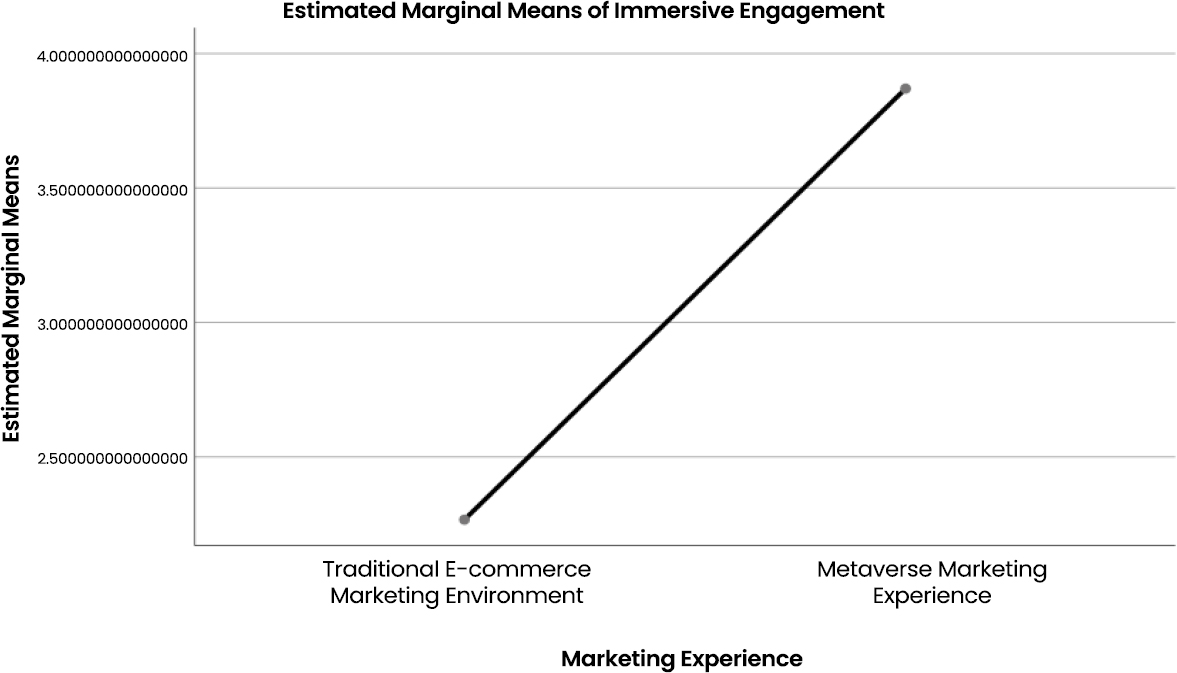
Fig. (1). Immersive engagement and loyalty as an effect of marketing experience.
The results in Fig. (2) illustrate a robust impact of the marketing environment on customer purchase intent. For instance, the marginal means depicts that the metaverse marketing experience led to significantly higher purchase intent (mean: 4) likened with traditional marketing environment (mean: 2.4). Overall, the results confirmed metaverse marketing experience is related with higher likelihood of the consumer purchase intention.
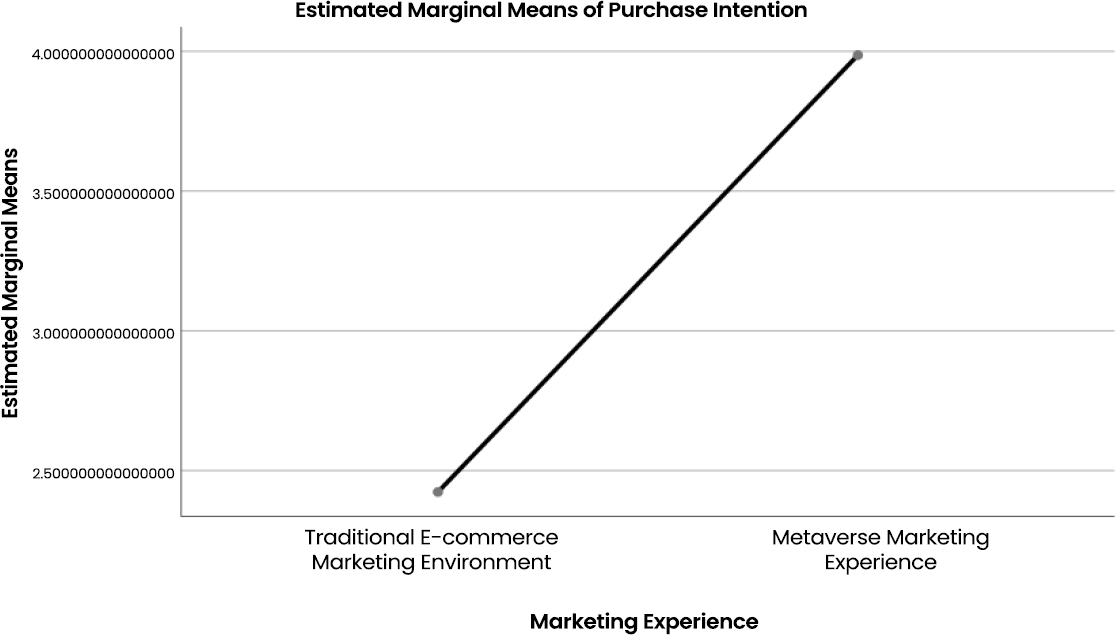
Fig. (2). Purchase intention as an effect of marketing experience.
The plot in Fig. (3) depicts a robust impact of marketing on the brand recall. As indicated by the results, the marginal means depicted that metaverse marketing experience drove higher brand recall of the customers (mean: 4.2) as compared to the traditional marketing environment (mean: 2.2). This shows the metaverse environment is related with substantially higher consumer brand recall.
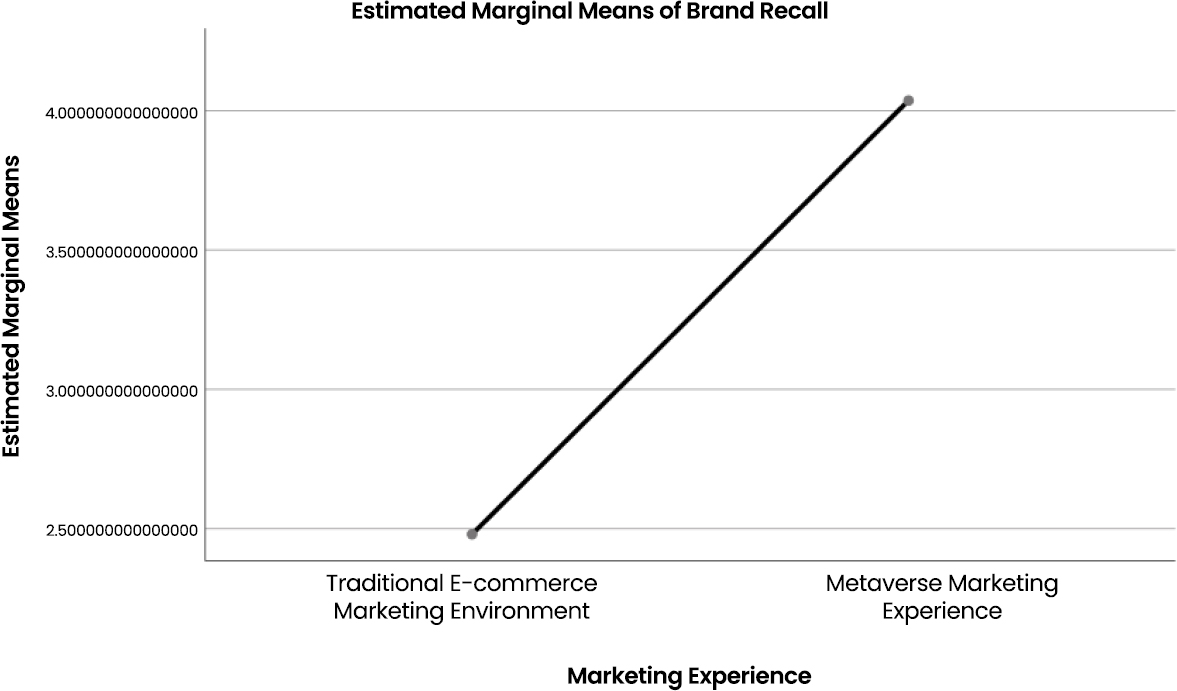
Fig. (3). Brand recall as an effect of marketing experience.
4.3. Regression Analysis
A multiple linear regression was performed to test the predictive value of technology readiness and personalisation on immersive engagement and loyalty, purchase intention, and brand recall. Multicollinearity Before analysis, VIF was used to assess multicollinearity and ensure that predictors contribute independently. The strength and direction of effects were to be interpreted using standardised coefficients (b) and significance levels (p), and R2 values were computed to assess the proportion of variance explained by the model. This method is used to precisely measure the effects of individual and joint predictors on each outcome variable.
Before applying regression analysis to examine causality among variables, it is important to rule out multicollinearity using the Variance Inflation Factor (VIF) Table 4, as (Jeng, 2023) also suggests constructs of the study such as immersive engagement and loyalty, purchase intention and brand recall, the value of VIF lies within acceptable threshold of 1 to 5 that is between 1.872 and 2.30 which shows no issue of multicollinearity in the model.
Table 4. Variance inflation factor.
| Coefficients | ||
| – | Collinearity Statistics | |
| – | Tolerance | VIF |
| Immersive Engagement and Loyalty | ||
| (Constant) | – | – |
| Technology Readiness | 0.464 | 2.156 |
| Personalisation | 0.534 | 2.304 |
| Purchase Intention | ||
| Technology Readiness | 0.534 | 2.304 |
| Personalisation | 0.534 | 2.304 |
| Brand Recall | ||
| Technology Readiness | 0.534 | 1.872 |
| Personalisation | 0.434 | 2.304 |
The regression model Table 5 shows that technology readiness is statistically significant and a strong predictor of all three dependent variables. It has a positive relationship with immersive engagement and loyalty (β = 0.706, p = 0.000), purchase intention (β = 0.635, p = 0.000), and brand recall (β = 0.612, p = 0.000). These findings verify that consumers who are better prepared in technology can better process and benefit from metaverse shopping spaces, which supports the S-O-R perspective that readiness enhances the stimuli of experiences. Personalisation, in contrast, reveals smaller, statistically insignificant predictive relationships. It does not appear significant (β = 0.184, p = 0.306) in terms of its predictive relationship with immersive engagement and loyalty, as well purchase intention (β = 0.264, p = 0.127), however, on brand recall (β = 0.290, p = 0.090), it is significant at 10%. The fact of the matter is that despite the positive trend that is indicated by the beta values, the argument points to the fact that personalisation alone does not seem to have enough power in effecting any outcomes that would be of any substance when it comes to strengthening the contextual alignment suggested by (Yang et al., 2024a) also. Lastly, the R-square values indicate that 78% of the variation in immersive engagement and loyalty can be predicted by personalisation and technology readiness. Moreover, 80% variation in each, purchase intention and brand recall can be predicted by personalisation and technology readiness.
Table 5. Regression.
| Coefficients | ||||||
| Effect on Immersive engagement and Loyalty | ||||||
| – | Unstandardized Coefficients | Standardized Coefficients | t | Sig. | R-square | |
| B | Std. Error | Beta | ||||
| (Constant) | 0.142 | 0.114 | – | 1.252 | 0.212 | 0.78 |
| Technology Readiness | 0.697 | 0.176 | 0.706 | 3.954 | 0.000 | |
| Personalisation | 0.183 | 0.178 | 0.184 | 1.027 | 0.306 | |
| Effect on Purchase Intention | ||||||
| (Constant) | 0.230 | 0.110 | – | 2.091 | 0.038 | 0.8 |
| Technology Readiness | 0.629 | 0.171 | 0.635 | 3.688 | 0.000 | |
| Personalisation | 0.264 | 0.172 | 0.264 | 1.534 | 0.127 | |
| Effect on Brand Recall | ||||||
| (Constant) | 0.381 | 0.105 | – | 3.626 | 0.000 | 0.8 |
| Technology Readiness | 0.585 | 0.163 | 0.612 | 3.593 | 0.000 | |
| Personalisation | 0.280 | 0.164 | 0.290 | 1.703 | 0.090 | |
4.4. Qualitative Findings
Theme 1: Perceived Realism and Interaction in Digital Shopping
This theme was based on participants’ views on their experiences with digital shopping spaces and their engagement with them, as depicted in Table 6. It centres on their understanding of realism, sensory perception, and interactive control over that understanding, rather than making it explicit in metaverse marketing.
In response to a question related to this theme, R1 states: “Navigating the virtual store felt surprisingly lifelike; I could judge the fabric and size of clothes almost as if I were physically present, which made me pay more attention to details than usual.” Table 6.
This response underscores the importance of realistic representation and sensory stimuli in engaging participants. The S-O-R model demands that external stimuli trigger cognitive and affective reactions in this case, the visual and spatial realism (Al-Adwan et al., 2025). It also shows that immersion experience depends on the user’s perception, meaning that the willingness to engage with technology can moderate the extent to which participants process these environmental components.
Similarly, Table 6 shows that R5 notes: “Being able to move items around, try different combinations, and instantly see changes in colour or size made me feel in control of the experience, which kept me focused longer than standard online shopping.”
This stresses the significance of being interactive and participatory in control. Those who participate actively manipulate the environment rather than passively visualise it, which also adds to the involvement and mental processing suggested by (Rane et al., 2023). Analysis indicates that the immersion is based on a set of the perceived realism and interactive engagement, which presents a participant-driven assessment of the digital shopping interaction.
Theme 2: Technology Readiness and User Confidence
As indicated in Table 6, this theme is based on participants’ responses regarding their familiarity with VR technology, which reflect their skills in using digital platforms.
In response to a question related to this theme, R2 states: “I was initially hesitant about using the headset, but after a few minutes, I felt confident and could easily explore different features without assistance.” Table 6.
This highlights that technology readiness directly impacts user engagement and experience, in line with (Becan & Ceber, 2025), who found that technological readiness enhances interaction with AI-driven interfaces and elicits positive behavioural responses. The lack of confidence at the beginning may serve as an obstacle, and the study shows that brief exposure and even the design of VR can overcome reluctance, demonstrating practical application in a VR-based shopping environment.
R7 adds: “Even though I am not very tech-savvy, the personalized guidance and step-by-step prompts made the experience manageable and enjoyable.”
This response indicates that personalisation and readiness are interacting, which is consistent with (Sabaa et al., 2025), in which the user ability owned the influence of AI and gamified stimuli on engagement. Adaptive design integration enables decreased cognitive load, meaning that within the VR marketing setting users with an unequal range of digital literacy can attain immersion and meaningful engagement, which is an essential determinant of consumer retention.
Theme 3: Personalized Experience and Its Role in Fostering Immersive engagement and Loyalty
As Table 6 shows, this theme emerged from participants’ consideration of the impact of customised content and interactive customisation on emotional engagement and loyalty to the shopping environment in VR.
In response to a question related to this theme, R3 states: “I felt more connected when the system remembered my favourite styles and suggested outfits accordingly; it made me want to revisit the store in the future.”, as depicted in Table 6.
This underscores the fact that interpersonal stimulus is a relational cue that increases organismic responses, such as immersion and loyalty, in line with S-O-R theory, where pertinent stimulus intensifies emotional and cognitive reactions, as argued by (Arunchoknumlap & Jonpradit, 2023) as well.
Similarly, R6 notes: “Being able to customize textures and accessories made me feel that the brand values my preferences, which increased my trust and attachment.”.
This responses evidence that interactivity and personalisation put consumers in a position of power, generating positive experience value, emotional attachment and loyalty. These results align with (Riegger et al., 2022), who argue that personalisation based on technology can enhance consumer receptivity, and with (Azmi et al., 2023), who argue that enjoyment, control, and relevance have a direct impact on behavioural intentions. The qualitative evidence reveals that immersive engagement and loyalty are not immediate responses but a multidimensional process that includes emotional bonding, trust, and loyalty in the Malaysian clothing industry.
Theme 4: Brand Recall and Memory Retention
Table 6 shows that this theme was determined from questions about immersive experiences and the effects of technological stimuli on participants’ capacity to recall the brand and specific products.
R4 states: “I can vividly remember the brand logo and the layout of the virtual store; it felt more memorable than a regular e-commerce page.”
This points to the fact that VR settings positively affect the encoding and recall of brand details, as they involve multisensory associations, which aligns with (Hanji et al., 2024), who argue that immersive interfaces increase cognitive processing. The outcome confirms the S-O-R hypothesis according to which sensory stimuli (S) trigger more serious internal efforts (O), which result in more serious behavioural or memory consequences (R).
R8 adds: “Even after a day, I could recall specific items I interacted with, especially those highlighted through personalized recommendations.”
This argument in R8 underscores the collaboration between customization and immersive design to reinforce memory, aligning with (Salhab, 2025), who found that technology readiness and customized digital content enhance brand awareness and recall. The discussion indicates that VR strategic application, coupled with customised features, can greatly enhance brand-level retention in consumer memory, which plays a pivotal role in planning effectiveness in the clothing retail industry.
The results of VIF signifies that for all the dependent.
Table 6. Themes.
| Theme | Participant Response | Codes |
| Perceived Realism and Interaction in Digital Shopping | R1 states: “Navigating the virtual store felt surprisingly lifelike; I could judge the fabric and size of clothes almost as if I were physically present, which made me pay more attention to details than usual”. | VR presence, Attention, Immersion |
| “R5 notes: “Being able to move items around, try different combinations, and instantly see changes in colour or size made me feel in control of the experience, which kept me focused longer than standard online shopping” | Enhanced Experience, Control of Experience, Diverse Combinations | |
| Technology Readiness and User Confidence | “I was initially hesitant about using the headset, but after a few minutes, I felt confident and could easily explore different features without assistance.” | Initial hesitancy, Confidence, Technology readiness |
| “Even though I am not very tech-savvy, the personalized guidance and step-by-step prompts made the experience manageable and enjoyable.” | Supportive guidance, Ease of use, Readiness facilitation | |
| Personalized Experience and Its Role in Fostering Immersive engagement and Loyalty | R3 states: “I felt more connected when the system remembered my favourite styles and suggested outfits accordingly; it made me want to revisit the store in the future.” | Brand Connection, Repeated Purchase, Revisits |
| R6 notes: “Being able to customize textures and accessories made me feel that the brand values my preferences, which increased my trust and attachment.” | Customization, preferences, Autonomy, Trust | |
| Brand Recall and Memory Retention | “I can vividly remember the brand logo and the layout of the virtual store; it felt more memorable than a regular e-commerce page.” | Brand memory, Visual cues, Spatial recall |
| “Even after a day, I could recall specific items I interacted with, especially those highlighted through personalized recommendations.” | Product recall, Personalisation effect, Memory retention |
5. DISCUSSION
The quantitative results support H1, indicating that the metaverse marketing experience has a significant effect on purchase intention. The quantitative findings indicate that consumers purchase intention is high when they are exposed to immersive metaverse environments. This is reinforced by qualitative findings, which show that participants reported their decisions were more informed and that the use of virtual try-on and outfit customization was engaging. This proves that immersive stimuli are best processed at the organism stage of the S-O-R model, which is translated into behavioural intention. Immersive environments promote purchasing behaviour, as (Al-Adwan et al., 2025) also suggests.
Nevertheless, there is discrepant evidence, as (Sabaa et al., 2025) emphasised that such stimuli do not affect consumers who lack technological preparedness or intrinsic motivation. In Malaysia, cultural aspects (including risk-averse shopping behaviour and the need for social approval) can also moderate the efficacy of a personalised immersive experience. Therefore, although metaverse marketing have a positive effect on the purchase intention, these effects depend on the situation. The results add to the understanding of VR-based involvement in the Malaysian clothing industry; however, the statements about the overall loyalty enhancement need to be optimised, with references to the technological and cultural boundary conditions.
The findings support H2 as the experience of immersion was significantly predicted by the metaverse experience. The quantitative and qualitative findings indicate that participants in the metaverse condition had additional time to engage with products and reported higher levels of immersion and loyalty than those in the traditional e-commerce setting. Responses to the interviews indicated that the VR environment provided more sensorial and interactive stimuli, increasing cognitive and emotional engagement. This can be shown to have a direct impact on the organismic states of the S-O-R model, as metaverse stimuli may be more deeply involved in the psychological engagement with the interaction and the space. Nevertheless, the effect was not equally evident across all participants; they reported issues with VR interfaces, demonstrating the drawbacks associated with technological expertise, as (Sabaa et al., 2025) affirm. This is also in line with (Uwaoma et al., 2023), who highlighted that user competence is a moderating factor of the effectiveness of mixed-reality environments. The outcomes are further contextualised by cultural factors shaping the adoption of new technologies in Malaysia, where the adoption process is cautious and decisions are made in groups (Asfaw & Menon, 2025). Although (Alexander & Van Volkinburg, 2025) confirms the theoretical hypothesis that immersive stimuli induce an effective organismic response, the scope of engagement and loyalty scaling is limited by technological capacity and socio-cultural attributes, indicating that VR efficacy is not universal but conditional.
Results of the study also evidenced H3, which states that the metaverse experience enhances brand recall. Visual cue reinforcement through cognitive means; the participants also underlined the rich memory of the store layout, logos, and individual product experience. The results indicate that metaverse experiences have the potential to enhance brand recall through the use of strong sensational stimuli that enable the encoding of memories, which aligns with S-O-R framework. The respondents were better able to recall store layouts, store logos, and product interactions, which aligns with (Chottechathammanee & Patchimnan, 2024), who said that immersive interfaces improve the retention of the impression because of physical-like digital experiences. Nevertheless, the answers are not always qualitative; not every participant has memory lapses or fails to recall details, and this is a feature of individual differences. This brings out the fact that the stimuli, which are immersive, may not always result in a steady improvement of memory. As (Uwaoma et al., 2023) also emphasized, organizational aspects like attention span, previous exposure to VR and technological preparedness moderate the effectiveness of immersive experience. Moreover, cultural aspects in Malaysia, including preference to get accustomed with the familiar brands and reservedness in approaching new digital areas, can influence the encoding of brand-related cues, which is similarly found by (Asfaw & Menon, 2025). Thus, though S-O-R theory provides an opportunity to make the hypothesis that the fact that VR stimulus is highly sensory can support the phenomenon of cognitive retention correct, the statements about the unconditionally superior brand recall should be considered in terms of technological and socio-cultural conditions.
The results of regression analysis show that technology readiness has a significant effect on purchase intention, but the effect of personalisation is insignificant, leading to partial acceptance of H4. The qualitative responses revealed that more technological confident users were more likely in exploring virtual features thus more eager to purchase, as resurfaced in (Jiang et al., 2024) which emphasised the importance of ability readiness as an engagement determinant. The non-significance of personalisation, however, is contrary to their results, which showed that personalisation improved behavioural outcomes. This difference could be explained by the fact that Malaysian consumers are more concerned with navigation convenience than with individual recommendations when encountering unknown VR worlds, as argued by (Liang & Wu, 2024) as well. Similarly, (Samsudin et al., 2024) observed that the effects of technology are mediated by cultural alignment; in this case, personalisation does not necessarily result in intention, since people have different preferences regarding algorithmic suggestions. In relation to S-O-R theory, preparedness enhances stimulus processing, and personalisation may require greater trust and more platform maturity to be impactful in purchase decisions. Before becoming reliant on complex personalisation algorithms, Malaysian clothing retailers should focus on making the training process easier and on building user-friendly onboarding interfaces first.
The result shows that the effect of technology readiness is significant compared to personalisation, indicating that H5 is partially accepted. Qualitative insights also revealed that initial hesitation was minimal after participants became familiar with the interface and had a chance to interact more with the technology, confirming that readiness moderates the intensity of the technology response, justifying the proposal by (Yang et al., 2024a) that readiness is the moderator of technology response. (Yang & Xiao, 2024b) points out that interactive experiences are required for users to be competent enough to use them and create engagement. Still, the low impact of personalization in this research suggests that the use of customised stimuli may not, by itself, be effective. According to (Willems & Brengman, 2023), consumer behaviour in the Malaysian environment prioritizes novelty and immersion in the environment over algorithmic personalization. The richness of the sensory experience and the interactivity of the VR environment have a greater impact on participants than customised prompts. In the case of clothing brands, it means that intuitive onboarding, accessible controls, and a rich interface design are valued, and granular personalization is an additional, not the core, of engagement.
The results of the regression indicate that technology readiness is a strong predictor of brand recall, but personalisation is significant only for brand recall. Thus, H6 is partially accepted. Qualitative findings demonstrated that the experience of brand elements and product information was best when the user felt confident navigating the virtual store, suggesting that readiness improves cognitive encoding. These findings suggest that technology readiness is an important factor in cognitive encoding. As noted by (Alexander & Van Volkinburg, 2025), increased technological competence improves interaction and memory performance. According to the S-O-R framework, in this case, user preparedness reinforces the processing of immersive stimuli.
In contrast, personalization is not as a significant factor in the initial metaverse retail. The cultural and contextual differences in Malaysia, such as the tendency to seek novelty and adopt it cautiously, imply that emphasizing stable, intuitively designed VR interfaces would be more effective at increasing brand recall than excessive personalization options. This delicacy moderates general assertions regarding the generic effectiveness of personalised stimulation. According to S-O-R theory, readiness enables the organism to deepen processing and strengthen recall, whereas personalisation is not salient. In the Malaysian clothing market, emphasising stable, intuitive user interfaces tends to build brand memory better than heavy personalisation functionality given the current level of digital maturity.
The findings have broader sustainability implications beyond engagement and purchase intention. A higher level of immersive interaction and virtual environment may decrease post-purchase dissatisfaction and, thus, the rate of returns in clothing stores, as supported by (Al-Adwan et al., 2025) as well. As noted, since apparel returns generate significant transportation emissions, repackaging waste, and reverse logistics costs, immersive pre-purchase analysis can indirectly contribute to environmental efficiency. Also, if metaverse spaces replace a portion of physical store traffic, companies can gradually reduce their footprint, energy consumption, and operational overhead. As indicated by (Azmi et al., 2023), this transformation is also relevant to the goals of sustainable consumption, as it encourages informed decisions and reduces material waste. These sustainability benefits, however, rely on conscientious digital infrastructure, i.e., energy-efficient servers and platform optimization. As such, when applied strategically, then metaverse marketing should be placed as a brand engagement strategy and as a possible contributor to the creation of greener retail ecosystems.
CONCLUSION
This study provides detailed evidence that metaverse marketing is likely to enhance retail experiences in the Malaysian clothing sector, particularly through immersive engagement, loyalty, and brand recall. Nevertheless, the findings indicate that such effects are neither universal nor consistent. Rather, consumers’ responses seem to be conditioned by readiness to use the technology, knowledge of immersive interfaces, and the overall cultural context, which shape comfort with new digital environments. The unpredictable effects of personalisation also indicate that algorithmic customisation is not always associated with better behavioural outcomes, particularly when relevance and cultural fit are poorly represented. On the whole, the results place metaverse marketing neither as a decisive performance driver nor as an item whose efficacy is determined by the integration of technological design with users’ possibilities and market expectations. This highlights the need to be gradual and to integrate on evidence, rather than on assumptions of certain effects.
LIMITATIONS AND FUTURE DIRECTIONS
The reliance on self-reported survey data tends to exaggerate behavioural intentions relative to actual purchasing behaviour. In addition, the target population of Malaysian clothing customers limits the extrapolation of the findings to other sectors or even other cultural backgrounds, where digital maturity, shopping preferences, and technology use can vary. The qualitative evidence, though useful, is based on the small sample of experts and might fail to represent consumers diversity. It should therefore not be overstated that metaverse marketing is ineffective in general. Future research must focus on cross-cultural comparisons, broader industry samples, and longitudinal or experimental studies to more accurately define the circumstances under which immersive marketing affects engagement, loyalty, and purchase intention.
POLICY IMPLICATIONS
The results indicate that Malaysian policymakers should accelerate progress on digital infrastructure and set standards for immersive commerce to enable fair metaverse adoption. Strong regulatory policies on data privacy, consumer protection, and AI personalisation should be established to minimise barriers to trust and encourage responsible innovation. In the case of the clothing industry, the outcomes indicate that the company should invest in VR-enabled shopping settings, improve its personalisation algorithms, and implement a digital literacy programme to increase the technology preparedness of various consumer groups. Public-private programmes can also be used to incentivize SMEs to use immersive tools that can achieve competitive parity and create a digitally resilient fashion ecosystem in Malaysia.
LIST OF ABBREVIATIONS
VR | = | Virtual Reality |
VIF | = | Variance Inflation Factor |
AUTHOR’S CONTRIBUTION
T.S. has contributed to conceptualization, idea generation, problem statement, methodology, results analysis, results interpretation.
ETHICAL STATEMENT & INFORMED CONSENT
All procedures were conducted in compliance with the guidelines of the institutional research ethics committee and adhered to the principles outlined in the Declaration of Helsinki. Informed consent was obtained from all participants prior to their inclusion in the study. To protect participant confidentiality, all data were anonymized at the time of collection, and no personally identifiable information was recorded.
AVAILABILITY OF DATA AND MATERIALS
The data will be made available on reasonable request by contacting the corresponding author [T.S.].
FUNDING
None.
CONFLICT OF INTEREST
The author declares no conflicts of interest, financial or otherwise.
ACKNOWLEDGEMENTS
Declared none.
DECLARATION OF AI
During the preparation of this manuscript, the author used ChatGPT for language polishing. After utilizing this tool, the author carefully reviewed and refined the content as necessary and accept full responsibility for the accuracy and integrity of the published work.
APPENDIX A
Survey QuestionnaireDemographic factors/Control Variables
| Variable | Question | Response Options | Coding |
| Age | Please indicate your age group. | 1. Younger adults (18–35 years) | Younger adults = 0 |
| Age | Please indicate your age group. | 2. Older adults (36 years and above) | Older adults = 1 |
| Gender | Please indicate your gender. | 1. Male | Male = 0 |
| Gender | Please indicate your gender. | 2. Female | Female = 1 |
| VR Familiarity | Are you familiar with or have you used Virtual Reality (VR) technology before? | 1. Yes | Yes = 0 |
| VR Familiarity | Are you familiar with or have you used Virtual Reality (VR) technology before? | 2. No | No = 1 |
| Construct | Item Code | Measurement Statement | Scale |
| Immersive engagement and loyalty | IE1 | I felt fully engaged with the marketing environment during the experience. | 1–5 |
| Immersive engagement and loyalty | IE2 | The environment captured my attention throughout the session. | 1–5 |
| Immersive engagement and loyalty | IE3 | I felt immersed and absorbed in the experience provided. | 1–5 |
| Purchase Intention | PI1 | I am likely to consider purchasing clothing from this brand. | 1–5 |
| Purchase Intention | PI2 | The experience increased my willingness to buy the products. | 1–5 |
| Purchase Intention | PI3 | I would purchase items from this brand in the near future. | 1–5 |
| Brand Recall | BR1 | I can clearly remember the brand presented during the experience. | 1–5 |
| Brand Recall | BR2 | I can recall key features of the products shown. | 1–5 |
| Brand Recall | BR3 | I can easily recognize this brand if I see it again. | 1–5 |
| Technology Readiness | TR1 | I am comfortable using new technologies when shopping online. | 1–5 |
| Technology Readiness | TR2 | I usually try technological innovations before others. | 1–5 |
| Technology Readiness | TR3 | I feel confident navigating digital and interactive platforms. | 1–5 |
| Personalisation | PZ1 | The experience felt personalised to my preferences. | 1–5 |
| Personalisation | PZ2 | The content shown matched my interests and needs. | 1–5 |
| Personalisation | PZ3 | I felt the environment was tailored specifically for me. | 1–5 |
- How would you describe your overall experience interacting with the virtual reality (VR) marketing environment of this clothing brand?
- In what ways did the VR or metaverse experience capture your attention and make you feel immersed compared to traditional online shopping?
- Can you share how personalized elements in the virtual experience influenced your engagement or interest in the products?
- How confident and comfortable did you feel using VR technology during the experience? Did your familiarity with technology affect this?
- To what extent did the metaverse experience influence your intention to purchase clothing items from the brand?
- How well do you remember the brand or specific products after interacting with the VR experience?
- Which features of the virtual experience (e.g., interactivity, personalisation, gamification) were most effective in shaping your perception of the brand?
- What challenges, difficulties, or negative aspects did you experience while using the VR marketing environment, and how did they affect your engagement or interest?
REFERENCES
Abbuhl, R., Gass, S., Mackey, A., Podesva, R.J. & Sharma, D. (2013). Experimental research design. Research Methods in Linguistics, 5, 116-134. https://doi.org/10.1017/cbo9781139013734.008.
Adke, V., Bakhshi, P., & Askari, M. (2024). Impact of digitalisation on customer experience management in retail banking. International Journal of Electronic Banking, 4(2), 154-167. https://doi.org/10.1504/IJEBANK.2024.136840.
Adeoye‐Olatunde, O. A., & Olenik, N. L. (2021). Research and scholarly methods: Semi‐structured interviews. Journal of The American College of Clinical Pharmacy, 4(10), 1358-1367. https://doi.org/10.1002/jac5.1441.
Ahmad, N., Alias, F. A., Hamat, M., & Mohamed, S. A. (2024). Reliability analysis: application of cronbach’s alpha in research instruments. Pioneering the Future: Delving Into E‐Learning’s Landscape, 114-119. Available from: https://appspenang.uitm.edu.my/sigcs/2024-2/Articles/20244_ReliabilityAnalysis-ApplicationOfCronbachsAlphaInResearchInstruments.pdf.
Al-Adwan, A. S., Yaseen, H., Alkhwaldi, A. F., Jafar, R. M. S., Fauzi, M. A., & Abdullah, A. (2025). Treasure hunting for brands: metaverse marketing gamification effects on purchase intention, WOM, and loyalty. Journal of Global Marketing, 38(4), 392-416.https://doi.org/10.1080/08911762.2025.2463897.
Alexander, B., & Van Volkinburg, N. (2025). Exploring Generation Z Behaviour Towards Different Digital Fashion and Immersive Technologies: A Stimulus-Organism-Response Approach. In The Future of Retail and Service Design (pp. 92-120). Routledge. Available from: https://www.taylorfrancis.com/chapters/edit/10.4324/9781003507338-9/exploring-generation-behaviour-towards-different-digital-fashion-immersive-technologies-bethan-alexander-nina-van-volkinburg.
Amer, A., Ibrahim, I., Selamat, H. S., Apandi, A. A. A., & Sundram, V. P. K. (2025). Aesthetic Coherence in Omnichannel Retail: Visual Arts and Consumer Engagement in Malaysia. International Journal of Art and Design, 9(2), 77-97. https://doi.org/10.24191/ijad.v9i2.6474.
Arunchoknumlap, P., & Jonpradit, S. (2023). The impact of augmented reality (AR) advertising on consumer behavior: A comparative study of traditional and immersive marketing approaches. Journal of Management Science, Rajabhat Sakon Nakhon University, 3(3), 91-104. Available from: https://so08.tci-thaijo.org/index.php/JMSSNRU/article/view/2181.
Asfaw, B. W., & Menon, F. (2025). Exploring the impact of virtual reality on consumer purchase decisions: A strategic perspective on immersive digital marketing in the luxury fashion industry. The Business & Management Review, 16(1), 144-149. https://doi.org/10.24052/BMR/V16NU01/ART-15.
Azmi, A., Ibrahim, R., Ghafar, M. A., & Rashidi, A. (2023). Metaverse for real estate marketing: The impact of virtual reality on satisfaction, perceived enjoyment and purchase intention. 1-21. https://doi.org/10.21203/rs.3.rs-2584882/v1.
Becan, C., & Çeber, B. (2026). How technology readiness influences behavioral and purchasing intention: serial multiple mediating role of attitude toward AI and AI-driven consumer chatbot experience. Digital Transformation and Society, 5(1), 78-104. https://doi.org/10.1108/DTS-04-2025-0082.
Bhattacharyya, A., Maiti, N. C., & Halder, M. K. (2015). Construction of a Five-Point Likert Type Scale to Measure the Perception of Teacher Educators about ICT. Volume IV March 2015, 2277, 59-77. Available from: https://www.caluniv.ac.in/academic/Education/Edu-Indian-Journal-Vol-4.pdf#page=67.
Braun, V., & Clarke, V. (2023). Toward good practice in thematic analysis: Avoiding common problems and be (com) ing a knowing researcher. International Journal of Transgender Health, 24(1), 1-6. https://doi.org/10.1080/26895269.2022.2129597.
Chin, C. H., Wong, W. P. M., Cham, T. H., Ngian, E. T., Sim, S. C., & Ling, J. P. W. (2023). Understanding the effects of social media advertising on purchase intention through Metaverse. In Current and Future Trends on Intelligent Technology Adoption: Volume 1 (pp. 121-144). Cham: Springer Nature Switzerland. https://doi.org/10.1007/978-3-031-48397-4_7.
Chottechathammanee, P. D. P., & Patchimnan, A. P. D. M. (2024). Influencing the Virtual Realm: The Impact of Virtual Influencers on Brand Awareness and Consumer Purchasing Decisions in Thailand’s Digital Marketplace. International Journal of Operations and Quantitative Management, 30(1), 127-141. Available from: https://submissions.ijoqm.org/index.php/ijoqm/article/view/323/134.
Chowdhury, R. H., Alam, M. I., Pasha, S. H. A., Hossain, M. D., Plabon, F. W., Saha, U. S., & Faruk, M. I. (2023). Immersive brand innovation in the metaverse: Virtual reality as a catalyst for strategic, technological, and consumer transformation. World Journal of Advanced Engineering Technology and Sciences, 9(2), 435-452. https://doi.org/10.30574/wjaets.2023.9.2.0219.
Erensoy, A., Mathrani, A., Schnack, A., Elms, J., & Baghaei, N. (2024). Consumer behavior in immersive virtual reality retail environments: A systematic literature review using the stimuli‐organisms‐responses (S‐O‐r) model. Journal of Consumer Behaviour, 23(6), 2781-2811. https://doi.org/10.1002/cb.2374.
Hanji, S.V., Navalgund, N., Hanji, S.S., Jeyanthi, P.M., Raikar, R.V. & Pol, N., (2024). Immersive experiences and brand recall in the metaverse: a comparative analysis of virtual reality and 3D interfaces. In International Conference on Smart Computing and Communication (pp. 249-259). Singapore: Springer Nature Singapore. https://doi.org/10.1007/978-981-97-1323-3_21.
Hochreiter, V., Benedetto, C., & Loesch, M. (2022, September). The stimulus-organism-response (SOR) paradigm as a guiding principle in environmental psychology: comparison of its usage in consumer behavior and organizational culture and leadership theory. In Global Business Conference 2022 Proceedings (Vol. 42). https://doi.org/10.18775/jebd.2806-8661.2021.31.5001.
Muhammad Sohail Jafar, R., Ahmad, W., & Chen, Y. (2024). Metaverse in human behavior: The role of telepresence and flow experience on consumers’ shopping behavior in the metaverse. Sage Open, 14(2), 21582440241261256. https://doi.org/10.1177/21582440241261256.
Jiang, S., Zhang, Z., Xu, H., & Pan, Y. (2024). What influences users’ continuous behavioral intention in cultural heritage virtual tourism: Integrating experience economy theory and stimulus–organism–response (SOR) model. Sustainability, 16(23), 10231. https://doi.org/10.3390/su162310231.
Jeng, C. C. (2023). Why a variance inflation factor of 10 is not an ideal cutoff for multicollinearity diagnostics. Journal of Education Studies, 57(2), 67-93. https://doi.org/10.53106/199044282023105702004.
Liang, Y., & Wu, J. (2024). Study on the Influence Mechanism of Metaverse Virtual Live Broadcasting Based on SOR Model on Consumers’ Participation Intention. Academic Journal of Business & Management, 6(5), 220-227. https://doi.org/10.25236/AJBM.2024.060530.
Malaysian Investment Development Authority. (2024). Malaysian Investment Development Authority. Available from: https://www.mida.gov.my/mida-news/malaysias-e-commerce-income-hits-rm918-2bil-in-first-nine-months-of-2024/ (Accessed on: November 19, 2025).
Naeem, M., Ozuem, W., Howell, K., & Ranfagni, S. (2024). Demystification and actualisation of data saturation in qualitative research through thematic analysis. International Journal of Qualitative Methods, 23, 16094069241229777. https://doi.org/10.1177/16094069241229777.
Pratas, J. M., Moreira, G. D., Garcez, J. G., Simões, I., Andrade, L. R. N., & Martins, J. M. D. S. (2025). Analysis of the Impact of Metaverse on the Retailer’s Brand Perceptions: The Example of Nike With Nikeland. In Cases on Metaverse and Consumer Experiences (pp. 141-174). IGI Global Scientific Publishing. https://doi.org/10.4018/979-8-3693-7245-6.ch006.
Rane, N., Choudhary, S., & Rane, J. (2023). Metaverse for enhancing customer loyalty: Effective strategies to improve customer relationship, service, engagement, satisfaction, and experience. Service, Engagement, Satisfaction, and Experience, 4624197. http://dx.doi.org/10.2139/ssrn.4624197.
Rahman, M. M., Tabash, M. I., Salamzadeh, A., Abduli, S., & Rahaman, M. S. (2022). Sampling techniques (probability) for quantitative social science researchers: A conceptual guideline with examples. Seeu Review, 17(1), 42-51. https://doi.org/10.2478/seeur-2022-0023.
Riegger, A. S., Merfeld, K., Klein, J. F., & Henkel, S. (2022). Technology-enabled personalization: Impact of smart technology choice on consumer shopping behavior. Technological Forecasting and Social Change, 181, 121752.
Riva, G., Davide, F., & IJsselsteijn, W. A. (2003). Being there: The experience of presence in mediated environments. Being there: Concepts, Effects and Measurement of User Presence in Synthetic Environments, 5, 2003. Available from: https://www.academia.edu/996915/Being_There_The_experience_of_presence_in_mediated_environments.
Sabaa, S., Sumarmi, S., Al-Hariry, B., Soliman, A., & Elwakeel, N. (2025). The role of gamification and artificial intelligence stimuli in driving customer engagement: A study on Saudi telecom users’ ability readiness. American Journal of Business Science Philosophy, 73-85. https://doi.org/10.70122/ajbsp.v2i1.28.
Sadeghi, N., Fallahzadeh, H., Dafei, M., Sadeghi, M., & Mirzaei, M. (2022). Evaluation of multiple linear regression function and generalized linear model types in estimating natural menopausal age: A cross-sectional study. International Journal of Reproductive BioMedicine, 20(5), 377. https://doi.org/10.18502/ijrm.v20i5.11052.
Salhab, H. A. (2025). Augmented reality and consumer behavior in Jordan’s telecom sector: Cultural and technological determinants. Innovative Marketing, 21(3), 103. https://doi.org/10.21511/im.21(3).2025.08.
Slater, M., (2003). A note on presence terminology. Presence Connect, 3(3), 1-5. Available from: https://s3.amazonaws.com/publicationslist.org/data/melslater/ref-201/a%20note%20on%20presence%20terminology.pdf.
Samsudin, S. N., Ishar, N. I. M., & Thurasamy, R. (2024). A mediating effect of customer experience on the relationship between metaverse usage and purchase intention: A conceptual development. Journal of Digitainability, Realism & Mastery (DREAM), 3(09), 86-95. https://doi.org/10.56982/dream.v3i09.261.
Statista. (2025). Statista. Available from: https://www.statista.com/outlook/amo/metaverse/malaysia?srsltid=AfmBOoo5L7sNIuIFzwQGdZtByiXJFEwNwLnDKtiPxwWnKvYE8dH-5JGo (19 November, 2025).
Stratton, S. J. (2021). Population research: convenience sampling strategies. Prehospital and disaster Medicine, 36(4), 373-374. https://doi.org/10.1017/S1049023X21000649.
Tang, Y. M., Wong, J. K. N., & Ho, G. T. S. (2025). Exploring consumer acceptance of metaverse marketing for branding activities and the pre-purchase stage. Journal of Theoretical and Applied Electronic Commerce Research, 20(3), 159. https://doi.org/10.3390/jtaer20030159.
Uwaoma, P. U., Eboigbe, E. O., Eyo-Udo, N. L., Ijiga, A. C., Kaggwa, S., & Daraojimba, A. I. (2023). Mixed reality in US retail: A review: Analyzing the immersive shopping experiences, customer engagement, and potential economic implications. World Journal of Advanced Research and Reviews, 20(3), 966-981. https://doi.org/10.30574/wjarr.2023.20.3.2495.
Wang, J., Du, B., & Cao, X. (2023, November). A study of the impact of metaverse marketing characteristics on consumers’ purchase intention. In DMI (pp. 106-119). https://doi.org/10.3233/FAIA230722.
Willems, K., & Brengman, M. (2023). The impact of virtual reality on customer engagement in tourism marketing: do age, gender and buyer readiness matter? In Handbook of Customer Engagement in Tourism Marketing (pp. 170-186). Edward Elgar Publishing. https://doi.org/10.4337/9781802203943.00021.
Witmer, B. G., & Singer, M. J. (1998). Measuring presence in virtual environments: A presence questionnaire. Presence, 7(3), 225-240. Available from: https://www.cs.ryerson.ca/aferworn/courses/CPS841/CLASSES/CPS841CL09/questionnairepaper.pdf.
Yang, H. P., Fan, W. S., & Tsai, M. C. (2024a). Applying stimulus–organism–response theory to explore the effects of augmented reality on consumer purchase intention for teenage fashion hair dyes. Sustainability, 16(6), 2537. https://doi.org/10.3390/su16062537.
Yang, L., & Xiao, D. (2024b). Embodied echoes: navigating the familiarity in continued intention to play VR game. Frontiers in Human Neuroscience, 18, 1495845. https://doi.org/10.3389/fnhum.2024.1495845.


Latest Articles
Author Ishaq Kalanther1 ,* 1Jubail Industrial College, Jubail Industrial City, Jubail, Kingdom of Saudi Arabia Article History: Received: 09 February,...
Author Abu-Shariq1 ,* 1Jubail Industrial College, Jubail, Kingdom of Saudi Arabia Article History: Received: 09 February, 2026 Accepted: 08 April,...