

Retail Media Personalisation and Consumer Response: The Mediating Role of Perceived Ad Relevance and Moderating Role of Algorithmic Transparency Among Indonesian Gen Z Consumers
 DOI:
DOI:
 PDF
PDF
⬇ Downloads: 15
1EMAAN Institute of Management and Sciences (EIMS), Karachi, Pakistan
2Commecs Institute of Business and Emerging Science, Karachi, Pakistan
Received: 17 June, 2026
Accepted: 22 August, 2026
Revised: 29 July, 2026
Published: 22 September, 2026
ABSTRACT
Introduction: This study examined the moderating effect of algorithmic transparency and the mediating effect of perceived ad relevance on the relationship between retail media personalisation and consumer response among Indonesian Gen Z consumers.
Methodology: This study employed a quantitative research design, and data were collected from 380 Indonesian consumers who engaged in online shopping. Data analysis was performed using Partial Least Squares Structural Equation Modelling (PLS-SEM).
Results: The findings revealed that retail media personalisation has a direct and indirect influence on consumer responses through perceived ad relevance. However, the positive direct link between retail media personalisation and consumer response was significantly reduced by this transparency.
Conclusion: This study combined information processing and signalling theories to understand consumer responses to retail media personalisation. The results showed that algorithmic transparency slightly weakened the direct link between personalisation and consumer response.
Keywords: Retail media personalisation, perceived ad relevance, algorithmic transparency, Indonesia, Gen Z consumers.
1. INTRODUCTION
Digital advertising has been developing rapidly, changing the way brands interact with consumers, especially with the emergence of retail media platforms that allow highly targeted communication (Dwivedi et al., 2021). The concept of retail media personalisation, which uses consumer data to create customised advertising messages, has emerged as a core approach to increasing the effectiveness of marketing and improving consumer response (Pauwels & Fagbola, 2025). Companies attempt to tailor ads to individual preferences and behaviours to make them more personalised and likely to be evaluated positively, and to attain positive behavioural intentions towards personalised advertising (Ho Nguyen et al., 2022). Nevertheless, this conventional logic of individualisation is being disputed in modern digital spaces with a strong emphasis on privacy issues and regulatory demands (He & Chen, 2025; Wang et al., 2021).
Over the past few years, the digital ecosystem has moved towards a privacy-conscious digital context, where consumers are increasingly concerned about the manner in which their data are gathered and leveraged (Gawer, 2022). According to (Huang & Liu, 2025), this change has created a culture of algorithmic transparency, a trend in which sites reveal the reason behind the personalised delivery of content (e.g. ‘you are seeing this ad because’ and ‘why am I seeing this ad’). Although transparency is meant to generate trust and empower users, it creates a paradoxical relationship (Sansome et al., 2025). Transparency can enhance trust and increase perceptions of fairness regarding personalised advertising; however, it can also trigger discomfort or perceptions of surveillance, potentially undermining the effectiveness of personalisation strategies (Strycharz & Segijn, 2024). This tension indicates that the effectiveness of retail media personalisation can no longer be assumed and must be assessed in the wider context of transparency and awareness of privacy.
Although existing research has primarily focused on personalisation and ad effectiveness in Western and heavily regulated digital markets, little is known about how these mechanisms work in emerging digital markets with different regulatory environments (less enforcement) and cultural backgrounds. Indonesia is an interesting case where data protection regulations are still in development, and enforcement is weak compared to GDPR compliance. In these settings, consumer attitudes towards privacy and transparency differ.
In this changing environment, perceived ad relevance is an important psychological process that connects personalisation activities to consumer reactions. It shows how useful, meaningful, and relevant an advertisement is perceived to be by consumers (Madane & Azeroual, 2025). Nevertheless, as noted by (Hu & Min, 2025), the use of perceived relevance is mediated by the degree of transparency in the algorithm, especially in privacy-related situations. Although transparency is essential, the interaction between transparency and personalisation in determining perceived relevance and consequent consumer behaviour has received little research, particularly in emerging markets.
The current study fills this gap by concentrating on Generation Z consumers in Indonesia as a demographic group that is highly digitally literate, highly active on retail media platforms, and becoming more aware of the problem of data privacy (Gentina & Parry, 2020).
Indonesia is a relevant country for the study of personalised digital advertising because of its fast-growing digital economy, high social commerce uptake, and developing data governance framework. Indonesia is one of the largest digital consumer markets in Southeast Asia, and the presence of e-commerce platforms such as Shopee, Tokopedia, and TikTok Shop has a significant influence on daily buying habits. Indonesia has adopted a national personal data protection framework in the form of Law No. 27 of 2022, which is an ongoing institutional process (Republic, 2022). Moreover, previous studies have revealed that Indonesian people tend to make decisions in a group-oriented way, where peer influences, social interactions, and platform trust can affect buying behaviour when purchasing online (Mariani & Lamarauna, 2017; Widodo et al., 2026). These context-specific features enable the study of the interpretation of algorithmic transparency and personalised advertising from a Generation Z perspective.
Therefore, this study adds value to the existing literature by exploring the relationship between personalisation and consumer response in the digital retail environment in Indonesia, where the regulatory environment, cultural features, and platform conditions are relevant contextual factors. This study contributes to the understanding of the personalisation–consumer response relationship by investigating the transparency paradox using a conditional relevance mechanism. This study also illustrates how algorithmic transparency acts as a moderator between retail media personalisation and consumer response by reducing the strength of the direct relationship. Perceived ad relevance was found to be a mediator between personalisation and consumer response, whereas algorithmic transparency was a moderator of the personalisation consumer response relationship. Therefore, this study extends previous research by exploring how perceived algorithmic transparency moderates the impact of retail media personalisation on consumer responses in digital retail channels. Therefore, a privacy-conscious environment is considered a contextual phenomenon observed in the current retail digital environment in which the proposed relationships are studied and not as an empirical construct placed in the structural model.
This study makes three major contributions. First, it builds on the existing literature on retail media personalisation which has largely taken a behavioural approach, introducing the cognitive mechanism of perceived ad relevance as a mediator between personalisation and consumer response, and algorithmic transparency as a boundary condition that moderates the direct effect of personalisation on consumer response. Second, this study provides contextual insights into the fast-changing digital retail context in Indonesia, which illustrates the nature of these relationships in the context of privacy concerns. Third, the results offer insights to digital retailers on how to meet the goals of personalising advertising while also achieving transparency in data practices to ensure consumer acceptance.
2. THEORETICAL FRAMEWORK
This study brings together several theories to explain the links between personalisation, perceived ad relevance, transparency, and consumer response. The personalisation of retail media is based on relevance theory and fit theory, which propose that communication is more effective when it is relevant to individuals’ preferences and situational needs (Schapsis & Chiagouris, 2019). Personalisation in this study increased the perceived fit between the ad message and consumer needs.
Each theoretical perspective has its own role in the proposed model. Relevance Theory describes how retail media personalisation improves the sense of relevance of advertising messages (Jensen et al., 2024). Perceived ad relevance acts as a cognitive mechanism between personalisation and consumer response, as determined by Information Processing Theory (Yoon et al., 2020). Signalling Theory describes how algorithmic transparency facilitates informational signals for consumers that help them assess platform practices.
Ad relevance is rooted in the information processing theory, which suggests that consumers devote more cognitive resources and form positive responses to stimuli that are relevant and valuable. The mediating role of perceived ad relevance is thus explained by Information Processing Theory, while the role of transparency is explained using complementary theories that focus on assessing the information provided by the platform instead of the ad’s relevance. Algorithmic transparency can be seen as an informational signal in Signalling Theory, which helps to diminish uncertainty by informing users how and why ads are personalised in the first place.
In summary, these views suggest that perceived ad relevance is the key cognitive process in which retail media personalisation affects consumer response, and algorithmic transparency is an informational boundary condition that weakens the direct effect of retail media personalisation. The empirical model thus examines the relationships among retail media personalisation, perceived ad relevance, algorithmic transparency, and consumer response. This relationship is also contextually interpreted by privacy considerations but is not measured or modelled in the present study. References to these factors are, therefore, only made for the purposes of contextual and theoretical interpretation of the relationships that are observed, and not as direct empirical explanations of the estimated paths.
2.1. Retail Media Personalisation and Consumer Response
Personalisation in retail media increases the effectiveness of digital advertising by providing content that appeals to individual consumer interests, behaviours, and preferences (McKee et al., 2026; Pauwels & Fagbola, 2025). According to (An & Ngo, 2025), personalised messages are more likely to attract attention, reduce information overload, and facilitate decision-making. Consequently, consumers respond to advertisements that align with their individual needs and consumption patterns (Aydin, 2026; Mo et al., 2023; Sreejesh et al., 2020).
Empirical studies have repeatedly shown that personalisation has a positive effect on the most important consumer outcomes, such as attitudes towards ads, involvement, and behavioural responses (An & Ngo, 2025). Personalisation creates a deeper engagement in consumer-brand interactions by enhancing the perceived usefulness and fit of advertising content to the context (Yeo et al., 2025). Existing research also indicates that responses to personalisation in advertising are moderated by intrusiveness and relevance (Ghanbarpour et al., 2022). However, in environments where privacy is preferred, this association depends on whether consumers view personalisation as a positive or negative factor (Markou et al., 2025). When executed appropriately, personalisation can enhance trust and strengthen consumer-platform relationships, ultimately leading to more positive consumer behavioural responses (Anić et al., 2019).
In this study, Consumer Response serves as an overall umbrella outcome label that encompasses the overall responses represented by the retained measurement items. The items were derived from (Anić et al., 2019) study on online privacy concerns and their antecedents and consequences. The retained indicators reflect various reactions across the different dimensions of personalised advertising, such as privacy-related evaluations, trust-related responses, avoidance tendencies, disclosure expectations, and behavioural intentions. This study does not claim to validate the indicators as a single higher-order construct of consumer response, as they are conceptually distinct. Rather, the term consumer response was applied to the general outcome term for the overall scale used in the present study.
Personalisation strategies are not always equally effective but are dependent on institutional and cultural factors (Khan et al., 2025). The Indonesian context focuses on the presence of personalised digital services and the developing data-governance landscape. Furthermore, prior studies, such as (Barnes et al., 2024), have shown that social influence and interpersonal factors play a significant role in consumers’ online behaviour, but the current study did not directly measure them, especially in the Indonesian cultural context.
In addition to relevance-related cognitive processes, personalisation can shape consumer reactions by fostering perceptions of convenience, engagement, and platform responsiveness. Personalised advertising can elicit positive behavioural intentions without the need for critical cognitive processing, especially when consumers see it as efficient and congruent with their consumption patterns, as reported by (Sreejesh et al., 2020). The results indicate that, in addition to its indirect effect on perceived ad relevance, personalisation can have an independent and direct effect on consumer response. Accordingly, the following hypothesis is proposed.
H1: Retail media personalisation positively influences consumer response among Indonesian Generation Z consumers.
2.2. Mediating Role of Perceived Ad Relevance
Perceived ad relevance is a very important cognitive process in which personalisation affects consumer response (Chen et al., 2023b; Kim & Huh, 2017). Based on the information processing theory, consumers tend to be more attracted to and respond favourably to advertisements that they view as relevant, meaningful, and applicable to their needs (Chen et al., 2023a). Personalisation strengthens this perception because it is possible to customise content to personal preferences thus, consumers are more likely to perceive such advertisements as useful and valuable (Noor et al., 2024).
Previous research indicates that perceived relevance is a significant mediator between personalisation and advertising effectiveness (De Keyzer et al., 2015; Kim & Huh, 2017; Yeo et al., 2025). The perceived relevance of personalised advertisements has a higher chance of creating positive attitudes and consumer responses (An & Ngo, 2025; Yeo et al., 2025). On the other hand, unsuccessful advertisements can lead to dismissal or even negative attitudes towards very personalised content (Yaprak & Haşıloğlu, 2025). Thus, perceived ad relevance is a key cognitive pathway between personalisation efforts and consumer responses.
The perceived relevance of the mediating role is further heightened in the context of increasing privacy awareness. Consumers can judge the content of advertisements and the suitability of the data on which they are based (Garg et al., 2023; Kim & Huh, 2017). When personalisation results in advertisements that are perceived to be relevant and respectful of privacy, the chances of a positive consumer response are high (Boerman et al., 2021). Based on this logic, the following hypotheses are proposed:
H2: Retail media personalisation positively influences perceived ad relevance.
H3: Perceived ad relevance positively influences consumer response among Indonesian Generation Z consumers.
H4: Perceived ad relevance mediates the relationship between retail media personalisation and consumer response.
2.3. Moderating Role of Algorithmic Transparency
Algorithmic transparency has become an important characteristic of modern digital platforms, especially regarding personalised advertising (Gao et al., 2025; Rahman, 2026). Transparency seeks to mitigate information asymmetry and increase perceived fairness by informing users of the means and reasons for targeting particular advertisements (Choi et al., 2026). In theory, transparency shapes consumer evaluations of the fairness and credibility of platforms, amplifying the beneficial impact of personalisation (Rahman, 2026; Wang et al., 2025). Algorithmic transparency can also directly affect consumer responses by changing their assessment of fairness, credibility, and trust in personalised advertising practices. These informational cues can affect consumers’ overall evaluation and their behaviour in response to personalised ads when they feel more transparent about how and why ads are shown (Cambier & Poncin, 2020; Wang et al., 2025).
While algorithmic transparency theoretically affects perceptions of ad relevance, the present study focuses on algorithmic transparency as an evaluative boundary condition through which consumers interpret personalised experiences as a whole to guide their overall behavioural reactions. Within this model, the perceived relevance of the ad is the most salient cognitive mechanism that leads to personalisation; in the evaluative phase, transparency acts as a moderator by triggering more privacy-related interpretations linked to data usage practices (An & Ngo, 2025). This, in turn, can result in increased consumer reactions, such as increased engagement and engagement-oriented responses.
However, transparency can have unintended outcomes. Increased visibility of data practices can heighten awareness of data collection and usage, potentially triggering privacy concerns and perceptions of surveillance (Wieringa et al., 2021). Transparency can undermine the effectiveness of personalisation in these situations by diminishing trust and the perceived suitability of targeted advertisements (Markou et al., 2025). This two-fold impact suggests that algorithmic transparency may have both a direct association with consumer response and a moderating effect on the relationship between retail media personalisation and consumer response.
Algorithmic transparency affects the direct link between retail media personalisation and consumer reactions. The perceived relevance of ads is boosted by personalisation, and the strong interaction suggests that the direct effect of personalisation on consumer response is weakened when ads are more algorithmically transparent. In this context, perceived ad relevance serves as the cognitive mechanism through which personalisation acts directly on consumers, while algorithmic transparency occurs during the evaluative process, influencing the effectiveness of personalisation in triggering positive consumer responses. Accordingly, this study hypothesises the following:
H5: The relationship between retail media personalisation and consumer response is moderated by algorithmic transparency, such that the positive relationship between the two decreases as algorithmic transparency increases.
Considering the theoretical arguments presented above, the conceptual framework of this study is presented in Fig. (1).
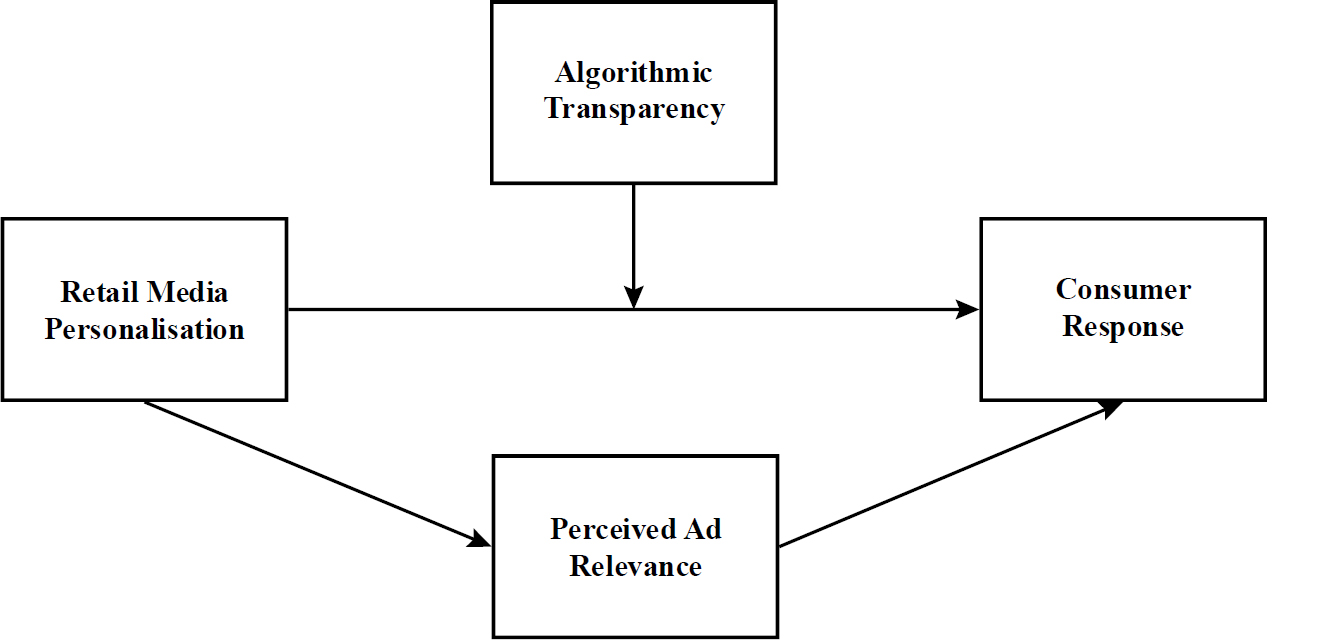
Fig. (1). Conceptual framework.
3. METHODOLOGY
This study follows a quantitative research design to empirically investigate the connections between retail media personalisation, perceived ad relevance, algorithmic transparency, and consumer response. A survey-based approach was employed because it allows for the systematic collection of standardised data from a large sample, enabling systematic statistical analysis of the hypothesised relationships. This study targets individual consumers of Generation Z in Indonesia, a generation that is highly digital and possesses experience with personalised advertising spaces.
3.1. Data Collection and Sampling
Data were collected using a structured questionnaire administered to Indonesian Gen Z consumers who were active users of online shopping platforms and digital retail media. A total of 500 questionnaires were sent to the selected sample; however, 380 final responses were obtained after omitting incomplete responses. To determine the sample size necessary for the structural model, an a priori power analysis was performed using GPower 3.1. Given the maximum number of three predictors for Consumer Response, a significance level of α = 0.05, a statistical power of 0.80, and a medium anticipated effect size (f² = 0.15), the analysis revealed a minimum required sample of 77 respondents. The final sample of 380 valid responses was well above the minimum requirement, thus ensuring sufficient statistical power for estimating the proposed structural relationships.
A purposive sampling approach was adopted to select respondents who fulfilled certain criteria pertinent to the research goals. In particular, the participants had to (1) be representatives of the Generation Z group (usually between 18 and 26), (2) be based in Indonesia, and (3) have previously experienced online shopping platforms wherein individualised advertising was utilised. The study focuses on users of dominant Indonesian retail media platforms such as Shopee and Tokopedia, where algorithm-driven personal advertising is extensively implemented. These platforms provide a relevant context for examining consumer responses to retail media personalisation. Given the use of purposive sampling, the findings are not statistically representative of the broader population. Instead, the sampling approach ensured that respondents possessed relevant experience with retail media personalisation, thereby enhancing the study’s contextual validity.
Recognising the potential limitations associated with non-probability sampling, several measures were implemented to mitigate the sample bias. First, the sample was made diverse by distributing the questionnaire over a variety of digital platforms, such as social media and online communities, to include respondents with diverse geographic and socioeconomic backgrounds across Indonesia. Second, screening questions were added to ensure that respondents were qualified and familiar with personal advertising, which increased the relevance and accuracy of their responses. Third, response patterns were reviewed to detect and discard unfinished or incongruent questionnaires. All these measures improved the validity and reliability of the findings, even when purposive sampling was used.
At the study design level, several measures were taken to reduce common method bias, such as maintaining respondent anonymity, using short and straightforward questionnaire items, and eliminating evaluation apprehensions.
3.2. Measurement Instrument
To achieve content validity and reliability, the research tool was created by modifying existing scales of measurement used in previous research. All constructs were measured using multiple items based on previously validated questionnaires with minor adjustments to the context of retail media personalisation, as shown in the Appendix A. Retail media personalisation items were modified based on (Aydin, 2026), and perceived ad relevance items were modified based on (Kim & Huh, 2017). Consumer response measures were adapted from (Anić et al., 2019). Although privacy concerns were not directly assessed as a construct, the current study is positioned in a privacy-conscious online environment in which consumer privacy concerns with data use and platform transparency are increasing. Therefore, the use of the term privacy-conscious environment in this study does not refer to a construct that needs to be statistically tested but rather to the context in which the personalised advertising experience was realised. In this study, consumer response is defined as a broad indicator of consumers’ total evaluative and behavioural responses to personalised advertising. The consumer response scale was adapted from (Anić et al., 2019). The original study focused on online privacy concerns and their antecedents and consequences, and the retained indicators represent various aspects of consumer responses to personalised advertising, such as evaluations related to privacy, trust, avoidance, disclosure expectations, and behavioural intentions. These indicators are conceptually different, but the original items were retained in this study, and consumer response was used as an umbrella indicator of the overall response measured by the scale.
For algorithmic transparency, the measures were adapted from (Rahman, 2026). In this study, algorithmic transparency is operationalised as perceived transparency, which captures consumers’ perceived knowledge and understanding of why certain ads are presented to them (Shin, 2020). This definition is consistent with that of a previous study that focused on perceived explanations from the user’s perspective rather than the system’s objective transparency (Bitzer et al., 2023). This construct mainly relates to perceived disclosure and explainability rather than data usage control.
All items were measured using a five-point Likert scale ranging from 1 (strongly disagree) to 5 (strongly agree). A Likert scale is suitable for measuring the perceptions, attitudes, and intentions of the respondents concerning their behaviour in a uniform and measurable way. The questionnaire was tested for clarity, relevance, and contextual appropriateness before full-scale data collection to ensure that respondents found it easy to understand and interpret the questions properly.
3.3. Data Analysis Technique
Partial Least Squares Structural Equation Modelling (PLS-SEM) was employed to analyse the data, as a variance-based method that is adequate for complex research models that include mediation and moderation effects. PLS-SEM is especially suitable for the given research, considering that the technique can accommodate non-normal data distributions, is applicable in predictive analysis, and is powerful in approaching multiple latent constructs and indicators in a model.
The analysis was performed in two steps. First, the measurement model was assessed to evaluate the reliability and validity of the constructs used. This encompassed the analysis of indicator loadings, composite reliability, Cronbach’s alpha, and Average Variance Extracted (AVE) to determine internal consistency and convergent validity. Discriminant validity was evaluated by applying a set of criteria for the Heterotrait-Monotrait (HTMT) ratio.
Second, the structural model was tested to examine the hypothesised relationships between the constructs. Bootstrapping procedures were used to evaluate the path coefficients, t-values, and significance levels. Appropriate interaction terms and indirect effect analyses were used to test the mediating impact of perceived ad relevance and the moderating effect of algorithmic transparency. Overall, PLS-SEM provides a comprehensive and rigorous framework for testing the proposed research model and deriving meaningful insights from the data.
To test for Common Method Bias (CMB), full collinearity Variance Inflation Factor (VIF) values were calculated as suggested by (Kock, 2015). CMB explains whether the covariance among the constructs is explained by a single latent factor. VIF values below 3.3 indicate that common method bias is unlikely to pose a substantial concern. The VIF values for all constructs in this study were well below the threshold, suggesting that common method bias was not a concern. Moreover, Harman’s single-factor test was conducted to assess the presence of common method biases. The results indicated that a single factor did not account for the majority of the variance, as the first factor explained less than 50% of the total variance. This suggests that common method bias is unlikely to threaten the validity of these findings.
4. RESULTS
4.1. Demographic Profile of Respondents
A total of 380 valid responses were obtained from Indonesian Generation Z consumers. Table 1 presents the demographic characteristics of the respondents.
Table 1. Demographic profile.
| Variable | Category | Frequency | Percentage (%) |
| Gender | Male | 182 | 47.9 |
| Female | 198 | 52.1 | |
| Age | 18–20 years | 124 | 32.6 |
| 21–23 years | 156 | 41.1 | |
| 24–26 years | 100 | 26.3 | |
| Education | High School | 98 | 25.8 |
| Undergraduate | 214 | 56.3 | |
| Postgraduate | 68 | 17.9 | |
| Online Shopping Frequency | Weekly | 142 | 37.4 |
| Monthly | 168 | 44.2 | |
| Occasionally | 70 | 18.4 |
As shown in Table 1, the sample was fairly balanced in terms of gender representation, with a minor predominance of female respondents. Most respondents were aged between 21 and 23 years, which represents the centre of the age group of Generation Z. Most respondents had undergraduate education and regularly shopped using digital platforms.
4.2. Full Collinearity VIF Assessment
Following (Kock’s, 2015) recommendation, full collinearity Variance Inflation Factors (VIFs) were reviewed to further assess the potential for common method bias.
The full collinearity VIF values were between 2.17 and 2.89 and did not exceed the recommended value of 3.3, as shown in Table 2. The results showed that there was no significant concern with common method bias or multicollinearity in the current study. Thus, common method variance was not likely to have significantly affected the observed correlations between retail media personalisation and ad relevance, algorithmic transparency, and consumer response, thereby bolstering the robustness and validity of the structural model estimates.
Table 2. Full collinearity assessment.
| Construct | Full Collinearity VIF |
| Retail Media Personalisation | 2.48 |
| Consumer Response | 2.89 |
| Perceived Ad Relevance | 2.35 |
| Algorithmic Transparency | 2.17 |
4.3. Measurement Model Assessment
The measurement model was evaluated using factor loading, internal consistency reliability, and convergent and discriminant validity. The results are presented in Table 3.
Table 3. Measurement model assessment.
| Latent Variables | Items | Factor Loadings | VIF | Cronbach’s α | Composite Reliability | AVE |
| Algorithmic Transparency | AT1 | 0.782 | 1.965 | 0.866 | 0.870 | 0.652 |
| AT2 | 0.835 | 2.410 | ||||
| AT3 | 0.870 | 2.527 | ||||
| AT4 | 0.759 | 1.637 | ||||
| AT5 | 0.785 | 1.722 | ||||
| Consumer Response | CR1 | 0.843 | 3.086 | 0.932 | 0.933 | 0.679 |
| CR2 | 0.766 | 2.513 | ||||
| CR3 | 0.823 | 2.728 | ||||
| CR4 | 0.816 | 2.968 | ||||
| CR5 | 0.819 | 3.360 | ||||
| CR6 | 0.815 | 2.998 | ||||
| CR7 | 0.843 | 3.456 | ||||
| CR8 | 0.861 | 3.608 | ||||
| Perceived Ad Relevance | PAR1 | 0.851 | 2.652 | 0.929 | 0.929 | 0.778 |
| PAR2 | 0.890 | 3.201 | ||||
| PAR3 | 0.889 | 3.166 | ||||
| PAR4 | 0.903 | 4.251 | ||||
| PAR5 | 0.877 | 3.556 | ||||
| Retail Media Personalisation | RMP1 | 0.845 | 2.494 | 0.918 | 0.920 | 0.753 |
| RMP2 | 0.881 | 3.186 | ||||
| RMP3 | 0.891 | 3.217 | ||||
| RMP4 | 0.892 | 3.144 | ||||
| RMP5 | 0.829 | 2.249 |
All indicator loadings were above the required level of 0.70, implying a high level of item reliability, as reported by (Ali et al., 2018). The alpha values were between 0.866 and 0.932, whereas the composite reliability values were between 0.870 and 0.933, which is higher than the acceptable value of 0.70, and if the values are over 0.80, they are considered very satisfactory, as reported by (Purwanto & Sudargini, 2021). This establishes a good internal consistency for all constructs. The Average Variance Extracted (AVE) values were between 0.652 and 0.778, which were all higher than the recommended value of 0.50, as considered by (Usakli & Kucukergin, 2018); thus, there was sufficient convergent validity. Furthermore, the VIF values were analysed to check for possible multicollinearity and common method bias. Table 3 indicates that all indicator VIF values were lower than the conservative value of 5.0, suggesting that collinearity effects were not significant.
The measurement results showed good reliability and convergent validity for the constructs indicated in the model. This proves that the measurement model is robust and can be further structurally analysed.
4.4. Discriminant Validity
The heterotrait-monotrait ratio was used to determine discriminant validity, as indicated in Table 4. The cut-off points for evaluating discriminant validity using the HTMT is 0.85 (Yusoff et al., 2020).
Table 4. Discriminant validity (HTMT ratio).
| – | Algorithmic Transparency | Consumer Response | Perceived Ad Relevance |
| Consumer Response | 0.807 | – | – |
| Perceived Ad Relevance | 0.571 | 0.686 | – |
| Retail Media Personalisation | 0.589 | 0.713 | 0.789 |
Table 4 indicates that all constructs have HTMT values lower than 0.85. These values imply that each construct in the model is distinct from the others and has the ability to capture its theoretical constructs accurately without significant overlap.
4.5. Model Explanatory Power
The consumer response coefficient of determination (R2) is 0.670 which implies that the model explains 67% of the variance in consumer response. Perceived ad relevance had a value of R2 = 0.533.
The values in Table 5 are moderate to substantial, demonstrating the existence of explanatory power, implying that the model is useful in explaining the determinants of consumer behaviour in the Indonesian retail media setting.
Table 5. Model explanatory power.
| – | R-square | R-square Adjusted |
| Consumer Response | 0.670 | 0.666 |
| Perceived Ad Relevance | 0.533 | 0.532 |
4.6. Predictive Relevance
Both the Q2 (perceived ad relevance: 0.529) and the (consumer response: 0.646) are above zero as indicated in Table 6.
Table 6. Predictive relevance.
| – | Q²predict | RMSE | MAE |
| Perceived Ad Relevance | 0.529 | 0.692 | 0.511 |
| Consumer Response | 0.646 | 0.602 | 0.435 |
Table 6 shows the predictive relevance (Q²) and performance (RMSE and MAE) of the model. Both Q² predict values for perceived ad relevance (0.529) and consumer response (0.646) were positive, suggesting predictive relevance. Additionally, the model’s predictive performance was supported by the RMSE and MAE values. The results suggest that the model has predictive relevance for endogenous constructs.
4.7. Path Coefficients and Slope Analysis
After validating the measurement model, the structural model was evaluated based on path coefficients, t-values, p-values, and effect sizes (f2), as presented in Table 7.
Table 7. Path coefficients.
| Hypothesis | Relationship | Β | T | f² | Decision |
| H1 | Retail Media Personalisation → Consumer Response | 0.251*** | 4.747 | 0.083 | Supported |
| H2 | Retail Media Personalisation → Perceived Ad Relevance | 0.730*** | 24.125 | 1.143 | Supported |
| H3 | Perceived Ad Relevance → Consumer Response | 0.185*** | 3.354 | 0.046 | Supported |
| H4 | Retail Media Personalisation → Perceived Ad Relevance → Consumer Response | 0.135*** | 3.322 | – | Supported |
| H5 | Algorithmic Transparency × Retail Media Personalisation → Consumer Response | -0.079*** | 2.992 | 0.033 | Supported |
| – | Algorithmic Transparency → Consumer Response | 0.455*** | 9.945 | 0.391 | – |
Note: *: Significance at 10%; **: Significance at 5%; ***: Significance at 1%
The results of the structural model presented in Table 7 provide evidence of the direct, mediation, and moderation relationships between the variables of retail media personalisation, perceived ad relevance, algorithmic transparency, and consumer response. Consumer response was positively and significantly influenced by retail media personalisation (β = 0.251, t = 4.747, p < 0.001). Furthermore, retail media personalisation exerted a strong and significant effect on perceived ad relevance (β = 0.730, t = 24.125, p < 0.001), meaning that the higher the level of personalisation, the more relevant the information about ads was perceived by consumers. Consumer response was also positively and significantly influenced by perceived ad relevance (β = 0.185, t = 3.354, p = 0.001).
The mediation analysis also revealed that perceived ad relevance significantly mediated the relationship between retail media personalisation and consumer response (β = 0.135, t = 3.322, p = 0.001), which means that personalisation was directly and indirectly related to consumer response through perceived ad relevance. This significant interaction suggests that the positive direct effect of retail media personalisation on consumer response is weakened by algorithmic transparency (β = −0.079, t = 2.992, p = 0.003). This was a small but statistically significant moderating effect (f² = 0.033). When analysed individually, perceived ad relevance significantly mediated the link between retail media personalisation and consumer response. The effect of algorithmic transparency on consumer responses was also measured directly. The results revealed that algorithmic transparency was positively and significantly related to the consumer’s response (β = 0.455, t = 9.945, p < 0.001), suggesting that the higher the perceived algorithmic transparency, the higher the consumer’s response.
A simple-slope analysis was also conducted to further interpret the significant interaction effect associated with low (−1 SD), mean, and high (+1 SD) algorithmic transparency, as presented in Table 8. The positive relationship between retail media personalisation and consumer response was strongest at low algorithmic transparency (β = 0.330, t = 5.218, p < 0.001), significant at the mean level (β = 0.251, t = 4.747, p < 0.001), and weaker at high algorithmic transparency (β = 0.172, t = 3.153, p = 0.002). The results suggest that algorithmic transparency does not eliminate the positive direct link but moderates its strength.
Table 8. Simple slope analysis.
| Level of Algorithmic Transparency | β for RMP → CR | t | p |
| Low (−1 SD) | 0.330 | 5.218 | < 0.001 |
| Mean | 0.251 | 4.747 | <0.001 |
| High (+1 SD) | 0.172 | 3.153 | 0.002 |
Fig. (2) shows the conditional direct effects of Retail Media Personalisation on Consumer Response when Algorithmic Transparency is set to low (−1 SD), mean, and high (+1 SD). The conditional effects were β = 0.330, β = 0.251, and β = 0.172, respectively.
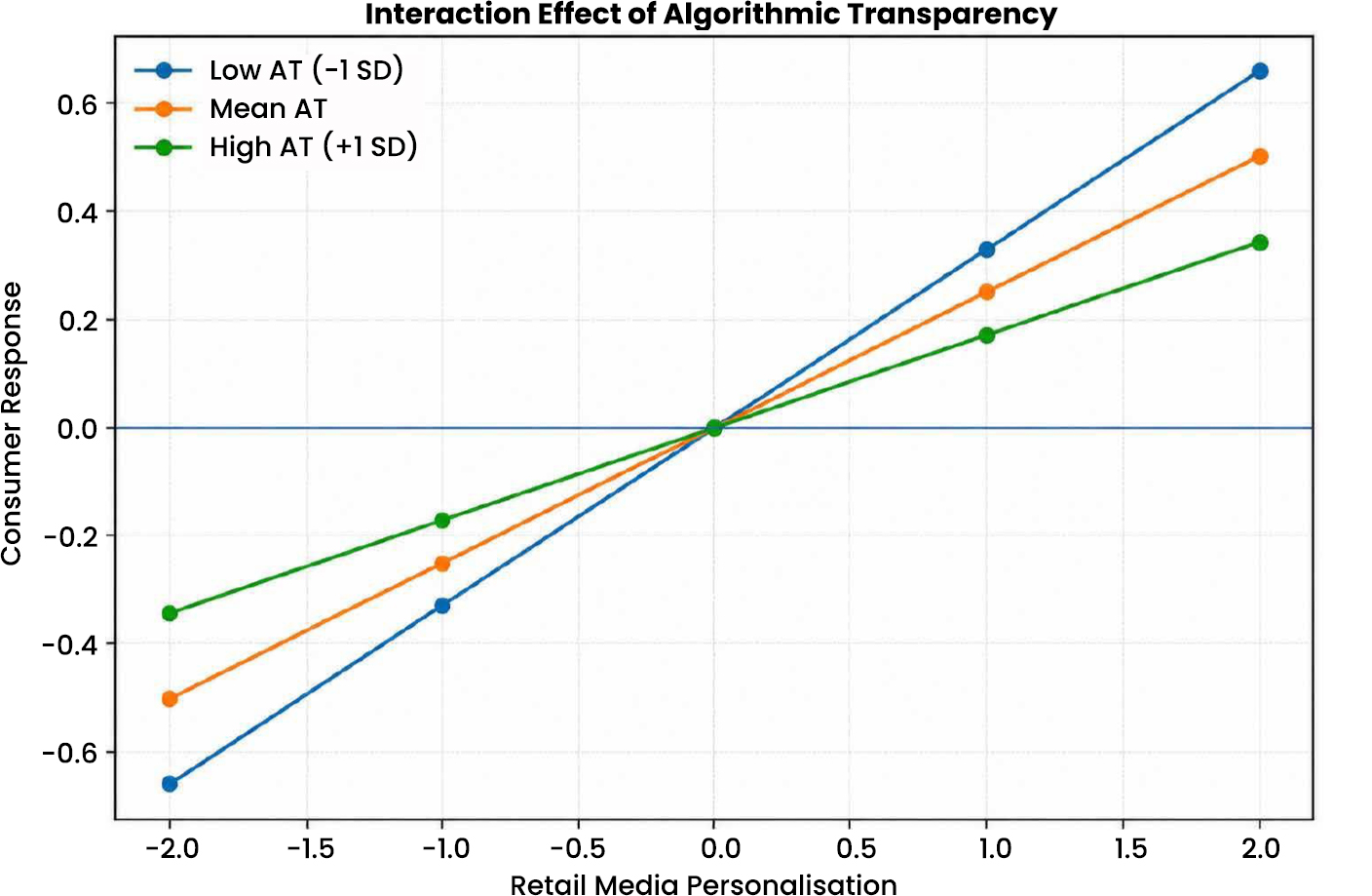
Fig. (2). Interaction effect of algorithmic transparency on the relationship between retail media personalisation and consumer response.
5. DISCUSSION
This research contributes to the literature on personalisation in retail media by identifying not only how but why personalisation affects consumer response, and that the latter becomes contingent on algorithmic transparency. However, this study contributes to the existing research by revealing that the direct link between retail media personalisation and consumer response varies with algorithmic transparency. Although previous research has highlighted the beneficial effects of transparency in terms of reducing information asymmetry and fostering trust (Cambier & Poncin, 2020; Wang et al., 2025), the current study shows a more multifaceted dynamic. In particular, transparency can undermine personalisation, implying that its effects are not always positive.
These results should be viewed in the context of the growing trend towards privacy awareness in Indonesia’s digital marketplace. This contextual characteristic was more conceptual about consumers’ experiences of personalised advertising and was not measured as a separate construct in the empirical model. There is a strong interaction between personalisation and consumer response, indicating that the personalisation-consumer response relationship varies based on perceived algorithmic transparency.
Generation Z consumers add to these dynamics. Gen Z consumers are a highly connected and digitally native generation with extensive exposure to personalised digital experiences. However, their tech-savvy nature also makes them sensitive to the collection and use of their personal data (Gentina & Parry, 2020). The findings suggest that transparency primarily influences consumers’ overall evaluations of personalised advertising practices rather than directly shaping perceptions of ad relevance.
Furthermore, the market conditions in Indonesia offer further insights into these effects. Given the nascent stage of data protection policies and relatively low enforcement in the Indonesian market, consumer responses to personalisation and transparency differ in more mature markets. Although consumers respond more favourably to personalised advertisements because of convenience and networking, the meaning of transparency cues is less clear, potentially reinforcing privacy concerns. This indicates that the role of personalisation strategies is dependent not only on micro-cognitive factors but also on macro-institutional factors. These findings align with the fact that the Indonesian digital marketplace is extensively used for transactions, e-commerce penetration is growing quickly, and the legislative framework regarding personal data protection is also developing. Institutional and market structures impact consumers’ perceptions of personalised advertising and algorithmic transparency vis-à-vis jurisdictions with more developed privacy governance.
Finally, this study makes three theoretical contributions. First, it sheds light on the complementary role of perceived ad relevance and algorithmic transparency in driving consumer response, as perceived ad relevance has been found to mediate the effect of retail media personalisation, while algorithmic transparency is a boundary condition that modifies the direct relationship between them. Second, the findings add to the Information Processing Theory and Signalling Theory literature by demonstrating that the cognitive evaluation of relevance to the ad and the evaluative judgment about transparency run on separate theoretical routes. Third, this study contributes to the retail media literature by offering empirical insights from the Indonesian digital ecosystem, revealing the interplay between personalisation and transparency in a digital economy where consumers are becoming more aware of data usage.
Algorithmic transparency moderated the direct relationship between retail media personalisation and consumer response, while perceived ad relevance was tested as a mediator between the personalisation and consumer response relationship. This study demonstrates that the impact of personalisation on consumer response is mediated by ad relevance and that algorithmic transparency has a minor impact on the direct relationship between personalisation and consumer response. Overall, this study contributes to the literature by offering contextual evidence that the effectiveness of a personalisation approach can differ in terms of algorithmic transparency, although this moderating effect was small in this study.
CONCLUSION
This study investigated the role of personalisation in retail media advertising and its impact on consumer response in the Indonesian digital retail environment in terms of perceived ad relevance (mediating) and algorithmic transparency (moderating). The privacy context was used as a backdrop phenomenon throughout this study to discuss the proposed relationships and not as an explanatory variable measured directly. The results indicate that algorithmic transparency is an intervening factor in the direct link between retail media personalisation and consumer response. The negative interaction coefficient indicates that algorithmic transparency weakens the positive relationship between retail media personalisation and consumer response. However, the moderation effect was small in practical terms. Moderation was not estimated in the indirect pathway; perceived ad relevance was the only mediating pathway assessed in the model. The interaction term between retail media personalisation and perceived algorithmic transparency was significant and negative, indicating that the direct positive relationship between retail media personalisation and consumer response weakened when perceived algorithmic transparency increased. Algorithmic transparency was found to be a moderating factor between the direct effect of retail media personalisation and consumer response. Perceived ad relevance was analysed as a mediating variable between retail media personalisation and consumer response.
The results indicate that digital retailers should consider personalisation and transparency together and not separately. Personalisation was found to be positively related to consumer response, whereas the more transparent the algorithm was perceived, the weaker the direct link. Therefore, managers must communicate the basis of personalised advertising clearly and efficiently without unnecessarily diminishing the perceived value of personalised content. Conversely, the relevance and fit of personalised ads appear to be important managerial considerations, as demonstrated by the significant mediating effect of perceived ad relevance.
While this study yielded valuable insights into the dynamics of personalisation and transparency, some limitations should be noted. First, perceptions of privacy, privacy concerns, privacy awareness, and regulatory perceptions were not measured as constructs in the model. Hence, this study took a contextual approach to the concept of privacy, rather than a psychological approach. Therefore, future research is warranted to include privacy concerns, privacy awareness, privacy calculus, and perceived regulatory protection as latent constructs to explore and understand whether these constructs can explain the mechanisms behind the transparency paradox. Second, purposive sampling and a single-country study can reduce the generalisability of the results, and the cross-sectional design does not allow causal inferences. Another restriction relates to the heterogeneous nature of consumer response indicators. While the retained items were taken from the existing (Anić et al., 2019) scale, they reflect varying dimensions of consumer reactions, such as privacy-related assessments, trust, avoidance, expectations of disclosure, and behavioural intentions. Therefore, consumer response is not broken down into various dimensions but is modelled as an umbrella outcome. Further studies should break them down into individual constructs to examine whether personalisation, ad relevance, and algorithmic transparency work differently for individual consumer outcomes. Future studies can directly incorporate privacy-related constructs, consider longitudinal designs, and study cross-cultural differences to further develop insights into the effectiveness of personalisation in changing digital contexts. The study was conducted in a digital retail environment in Indonesia, but not all cultural orientations were directly operationalised and empirically studied. Therefore, the interpretation of collectivism or other cultural attributes should be viewed as contextual, not causal. Cultural value dimensions can be explicit constructs in future studies and analysed for their effects on consumers’ reactions to personalised advertisements.
LIST OF ABBREVIATIONS
AVE | = | Average Variance Extracted |
CMB | = | Common Method Bias |
HTMT | = | Heterotrait-Monotrait |
PLS-SEM | = | Partial Least Squares Structural Equation Modelling |
VIF | = | Variance Inflation Factor |
AUTHOR’S CONTRIBUTION
A.A. contributed to the conceptualization and design of the study, methodology development, data collection, data analysis and interpretation, manuscript drafting, and critical revision of the manuscript.
ETHICAL STATEMENT & INFORMED CONSENT
This study was conducted using an anonymous questionnaire survey on a voluntary basis. The purpose of the study was explained to the participants, and informed consent was obtained prior to the completion of the questionnaire. The respondents were informed that they could withdraw from the study at any time and that participation was voluntary. The data were anonymised and used for academic research only.
AVAILABILITY OF DATA AND MATERIALS
The data collected through the anonymous questionnaire are available from the corresponding author upon reasonable request, subject to appropriate privacy and confidentiality considerations.
FUNDING
This study received no external funding.
CONFLICT OF INTEREST
The author declares no conflicts of interest.
ACKNOWLEDGEMENTS
Declared none.
DECLARATION OF AI
No Artificial Intelligence (AI) tools were used in the literature search, data extraction, analysis, synthesis, interpretation, or preparation of the findings presented in this manuscript. All review processes were conducted by the author in accordance with the specified methodology.
APPENDIX A
Survey Questionnaire
Demographics
- Gender
- Male
- Female
- Age
- 18–20 years
- 21–23 years
- 24–26 years
- Education
- High School
- Undergraduate
- Postgraduate
- Online Shopping Frequency
- Weekly
- Monthly
- Occasionally
Independent Variable: Retail Media Personalisation (Adapted from Aydin, 2026)
- This platform shows advertisements that are tailored to my interests.
- The advertisements I see on this platform match my personal preferences.
- This platform personalises advertisements based on my browsing or purchase behaviour.
- The ads displayed on this platform are customised specifically for me.
- This platform provides advertising content that fits my needs and interests.
Dependent Variable: Consumer Response (Adapted from Anić et al., 2019)
- Websites that seek information online must transparently disclose how they collect, process and use my data.
- It is important for me to know how my data is being used by the company.
- My control of personal information lies at the heart of my privacy.
- I am reluctant to register with my personal information with a website that I do not completely trust.
- I avoid visiting websites that I do not trust.
- I consider purchasing products from ads that ensure data privacy.
- I am likely to click on ads from trusted websites.
- I only share my private information if it improves my ad experience without compromising my privacy.
Mediating Variable: Perceived Ad Relevance (Adapted from Kim & Huh, 2017)
- These ads I see are important to me.
- These ads I see are meaningful to me.
- These ads I see are worth remembering.
- These ads I see are of value to me.
- These ads I see are relevant to my needs.
Moderating Variable: Algorithmic Transparency (Adapted from Rahman, 2026)
- I tend to use platforms that clearly explain how the ads are relevant for me.
- I use platforms that explain how my data is relevant for them.
- I prefer platforms that explain how the recommendation system works.
- I prefer platforms that openly communicate how my personal information influence the ads I see.
- I prefer platforms which explain how it collects and uses my information for advertising.
REFERENCES
Ali, F., Rasoolimanesh, S. M., Sarstedt, M., Ringle, C. M., & Ryu, K. (2018). An assessment of the use of partial least squares structural equation modeling (PLS-SEM) in hospitality research. International Journal of Contemporary Hospitality Management, 30(1), 514–538.
https://doi.org/10.1108/IJCHM-10-2016-0568
An, G. K., & Ngo, T. T. A. (2025). AI-powered personalised advertising and purchase intention in Vietnam’s digital landscape: The role of trust, relevance, and usefulness. Journal of Open Innovation: Technology, Market, and Complexity, 11(3), 100580.
https://doi.org/10.1016/j.joitmc.2025.100580
Anić, I. D., Škare, V., & Milaković, I. K. (2019). The determinants and effects of online privacy concerns in the context of e-commerce. Electronic Commerce Research and Applications, 36, 100868.
https://doi.org/10.1016/j.elerap.2019.100868
Aydin, S. (2026). Brand trust in AI-driven e-commerce personalisation: The well-being–privacy trade-off. Sustainability, 18(2), 1073.
https://doi.org/10.3390/su18021073
Barnes, A. J., Zhang, Y., & Valenzuela, A. (2024). AI and culture: Culturally dependent responses to AI systems. Current Opinion in Psychology, 58, 101838.
https://doi.org/10.1016/j.copsyc.2024.101838
Bitzer, T., Wiener, M., & Cram, W. A. (2023). Algorithmic transparency: Concepts, antecedents, and consequences—A review and research framework. Communications of the Association for Information Systems, 52(1), 293–331.
https://doi.org/10.17705/1CAIS.05214
Boerman, S. C., Kruikemeier, S., & Bol, N. (2021). When is personalised advertising crossing personal boundaries? How type of information, data sharing, and personalised pricing influence consumer perceptions of personalised advertising. Computers in Human Behavior Reports, 4, 100144.
https://doi.org/10.1016/j.chbr.2021.100144
Cambier, F., & Poncin, I. (2020). Inferring brand integrity from marketing communications: The effects of brand transparency signals in a consumer empowerment context. Journal of Business Research, 109, 260–270.
https://doi.org/10.1016/j.jbusres.2019.11.060
Chen, S., Wu, Y., Deng, F., & Zhi, K. (2023a). How does ad relevance affect consumers’ attitudes toward personalised advertisements and social media platforms? The role of information co-ownership, vulnerability, and privacy cynicism. Journal of Retailing and Consumer Services, 73, 103336.
https://doi.org/10.1016/j.jretconser.2023.103336
Chen, W. K., Ling, C. J., & Chen, C. W. (2023b). What affects users to click social media ads and purchase intention? The roles of advertising value, emotional appeal and credibility. Asia Pacific Journal of Marketing and Logistics, 35(8), 1900–1916.
https://doi.org/10.1108/APJML-01-2022-0084
Choi, J., Kang, S., Moon, J., Jeon, S., & Lim, S. (2026). Algorithmic transparency and consumer trade-offs in AI-based financial e-commerce services. Journal of Theoretical and Applied Electronic Commerce Research, 21(3), 86.
https://doi.org/10.3390/jtaer21030086
De Keyzer, F., Dens, N., & De Pelsmacker, P. (2015). Is this for me? How consumers respond to personalised advertising on social network sites. Journal of Interactive Advertising, 15(2), 124–134.
https://doi.org/10.1080/15252019.2015.1082450
Dwivedi, Y. K., Ismagilova, E., Hughes, D. L., Carlson, J., Filieri, R., Jacobson, J., Jain, V., Karjaluoto, H., Kefi, H., Krishen, A. S., Kumar, V., Rahman, M. M., Raman, R., Rauschnabel, P. A., Rowley, J., Salo, J., Tran, G. A., & Wang, Y. (2021). Setting the future of digital and social media marketing research: Perspectives and research propositions. International Journal of Information Management, 59, 102168.
https://doi.org/10.1016/j.ijinfomgt.2020.102168
Gao, M., Peng, J., & Wang, H. (2025). Algorithmic transparency, financial stability, and enterprise digital transformation. Finance Research Letters, 86(B), 108481.
https://doi.org/10.1016/j.frl.2025.108481
Garg, P., Raj, R., Kumar, V., Singh, S., Pahuja, S., & Sehrawat, N. (2023). Elucidating the role of consumer decision making style on consumers’ purchase intention: The mediating role of emotional advertising using PLS-SEM. Journal of Economy and Technology, 1, 108–118.
https://doi.org/10.1016/j.ject.2023.10.001
Gawer, A. (2022). Digital platforms and ecosystems: Remarks on the dominant organizational forms of the digital age. Innovation, 24(1), 110–124.
https://doi.org/10.1080/14479338.2021.1965888
Gentina, E., & Parry, E. (Eds.). (2020). The new generation Z in Asia: Dynamics, differences, digitalization. Emerald Publishing.
https://doi.org/10.1108/9781800432208
Ghanbarpour, T., Sahabeh, E., & Gustafsson, A. (2022). Consumer response to online behavioral advertising in a social media context: The role of perceived ad complicity. Psychology & Marketing, 39(10), 1853–1870.
https://doi.org/10.1002/mar.21703
He, M., & Chen, Y. (2025). Personal data protection in China: Progress, challenges and prospects in the age of big data and AI. Telecommunications Policy, 49(10), 103076.
https://doi.org/10.1016/j.telpol.2025.103076
Ho Nguyen, H., Nguyen-Viet, B., Hoang Nguyen, Y. T., & Hoang Le, T. (2022). Understanding online purchase intention: the mediating role of attitude towards advertising. Cogent Business & Management, 9(1), 2095950.
https://doi.org/10.1080/23311975.2022.2095950
Hu, Y., & Min, H. K. (2025). Information transparency, privacy concerns, and customers’ behavioral intentions regarding AI-powered hospitality robots: A situational awareness perspective. Journal of Hospitality and Tourism Management, 63, 177–184.
https://doi.org/10.1016/j.jhtm.2025.04.003
Huang, Y., & Liu, L. (2025). The impact of algorithm awareness on the acceptance of personalised social media content recommendation based on the technology acceptance model. Acta Psychologica, 259, 105383.
https://doi.org/10.1016/j.actpsy.2025.105383
Jensen, J. D., Loewen, S., Berger, J., Upshaw, S. J., Christy, K. R., & Lillie, H. M. (2024). Targeted communication and race: Explicating perceived message relevance. Psychology & Health, 39(9), 1200–1217.
https://doi.org/10.1080/08870446.2022.2132502
Khan, M., Ahmad, M., Alidjonovich, R. D., Bakhritdinovich, K. M., Turobjonovna, K. M., & Odilovich, I. J. (2025). The impact of cultural factors on digital marketing strategies with machine learning and honey bee algorithm (HBA). Cogent Business & Management, 12(1), 2486590.
https://doi.org/10.1080/23311975.2025.2486590
Kim, H., & Huh, J. (2017). Perceived relevance and privacy concern regarding online behavioral advertising (OBA) and their role in consumer responses. Journal of Current Issues & Research in Advertising, 38(1), 92–105.
https://doi.org/10.1080/10641734.2016.1233157
Kock, N. (2015). Common method bias in PLS-SEM: A full collinearity assessment approach. International Journal of e-Collaboration, 11(4), 1–10.
https://doi.org/10.4018/IJEC.2015100101
Madane, Y., & Azeroual, M. (2025). Perceived intrusiveness vs. relevance: A PLS-SEM analysis of personalised advertising in Morocco. Digital, 5(4), 63.
https://doi.org/10.3390/digital5040063
Mariani, M., & Lamarauna, A. M. I. (2017). The impact of social influence and trust on customer-to-customer online shoppers’ purchase intention: An empirical study in Indonesia. GSTF Journal on Computing, 5(3), 1–6.
https://doi.org/10.5176/2251-3043_5.3.372
Markou, V., Serdaris, P., Antoniadis, I., & Spinthiropoulos, K. (2025). Personalisation, trust, and identity in AI-based marketing: An empirical study of consumer acceptance in Greece. Administrative Sciences, 15(11), 440.
https://doi.org/10.3390/admsci15110440
McKee, K., Dahl, A. J., & Peltier, J. W. (2025). Personalized digital marketing value-in-use: examining the influences on consumers’ continuum of interactive marketing avoidance behaviors. Journal of Research in Interactive Marketing, 20(4), 491–508.
https://doi.org/10.1108/JRIM-03-2025-0136
Mo, L., Zhang, X., Lin, Y., Yuan, Z., & Peng, Z. (2023). Consumers’ attitudes towards online advertising: A model of personalisation, informativeness, privacy concern and flow experience. Sustainability, 15(5), 4090.
https://doi.org/10.3390/su15054090
Noor, U., Mansoor, M., & Shamim, A. (2024). Customers create customers! Assessing the role of perceived personalisation, online advertising engagement and online users’ modes in generating positive e-WOM. Asia-Pacific Journal of Business Administration, 16(2), 392–409.
https://doi.org/10.1108/APJBA-11-2021-0569
Pauwels, K., & Fagbola, L. (2025). Understanding retail media: Perspectives and implications for stakeholders. Journal of Retailing, 101(3), 315–330.
https://doi.org/10.1016/j.jretai.2025.08.005
Purwanto, A., & Sudargini, Y. (2021). Partial least squares structural equation modeling (PLS-SEM) analysis for social and management research: A literature review. Journal of Industrial Engineering & Management Research, 2(4), 114–123.
https://doi.org/10.7777/jiemar.v2i4.168
Rahman, W. (2026). Ethical AI personalization in digital retail: The roles of transparency, privacy, and consumer trust. Strategic Business Research, 2(1), 100020.
https://doi.org/10.1016/j.sbr.2025.100020
Republic of Indonesia. (2022). Law of the Republic of Indonesia Number 27 of 2022 on personal data protection. Available from: https://jdih.komdigi.go.id/monografi_hukum/monografi/t/buku-hukum/108
Sansome, K., Conduit, J., & Wilkie, D. (2025). Consumers demand transparency… but do they actually engage? Exploring motives and interactions with brand transparency information. Journal of Business Research, 194, 115386.
https://doi.org/10.1016/j.jbusres.2025.115386
Schapsis, C., & Chiagouris, L. (2019). Outlining a new approach to study mobile marketing: Relevancy as a primary mediating construct to understand mobile advertising effectiveness. In Proceedings of the 2019 5th International Conference on E-Business and Mobile Commerce (pp. 17–24).
https://doi.org/10.1145/3332324.3332326
Shin, D. (2020). User perceptions of algorithmic decisions in the personalised AI system: Perceptual evaluation of fairness, accountability, transparency, and explainability. Journal of Broadcasting & Electronic Media, 64(4), 541–565.
https://doi.org/10.1080/08838151.2020.1843357
Sreejesh, S., Paul, J., Strong, C., & Pius, J. (2020). Consumer response towards social media advertising: Effect of media interactivity, its conditions and the underlying mechanism. International Journal of Information Management, 54, 102155.
https://doi.org/10.1016/j.ijinfomgt.2020.102155
Strycharz, J., & Segijn, C. M. (2024). Ethical side-effect of dataveillance in advertising: Impact of data collection, trust, privacy concerns and regulatory differences on chilling effects. Journal of Business Research, 173, 114490.
https://doi.org/10.1016/j.jbusres.2023.114490
Usakli, A., & Kucukergin, K. G. (2018). Using partial least squares structural equation modeling in hospitality and tourism: Do researchers follow practical guidelines? International Journal of Contemporary Hospitality Management, 30(11), 3462–3512.
https://doi.org/10.1108/IJCHM-11-2017-0753
Wang, C., Zhang, N., & Wang, C. (2021). Managing privacy in the digital economy. Fundamental Research, 1(5), 543–551.
https://doi.org/10.1016/j.fmre.2021.08.009
Wang, F., Lopez, C., & Okazaki, S. (2025). Signaling transparency in the era of artificial intelligence. Internet Research, 1–25.
https://doi.org/10.1108/INTR-11-2023-1041
Widodo, A., Madiawati, P. N., Wardoyo, H. S., & Affandi, A. (2026). Trust-mediated green brand evangelism: Examining boundary conditions in Indonesian collectivistic consumer markets. Italian Journal of Marketing, 2026(1), 6.
https://doi.org/10.1007/s43039-026-00130-8
Wieringa, J., Kannan, P. K., Ma, X., Reutterer, T., Risselada, H., & Skiera, B. (2021). Data analytics in a privacy-concerned world. Journal of Business Research, 122, 915–925.
https://doi.org/10.1016/j.jbusres.2019.05.005
Yaprak, B., & Haşıloğlu, S. B. (2025). Exploring the role of skippable and personalized ads in shaping click-through intention and reducing ad irritation on YouTube. Asia Pacific Journal of Marketing and Logistics, 1–17.
https://doi.org/10.1108/APJML-01-2025-0173
Yeo, T. E. D., Chu, T. H., & Li, Q. (2025). How persuasive is personalised advertising? A meta-analytic review of experimental evidence of the effects of personalisation on ad effectiveness. Journal of Advertising Research, 65(4), 616–631.
https://doi.org/10.1080/00218499.2025.2467763
Yoon, D., Kim, Y. K., & Fu, R. J. (2020). How can hotels’ green advertising be persuasive to consumers? An information processing perspective. Journal of Hospitality and Tourism Management, 45, 511–519.
https://doi.org/10.1016/j.jhtm.2020.10.014
Yusoff, A. S. M., Peng, F. S., Razak, F. Z. A., & Mustafa, W. A. (2020). Discriminant validity assessment of religious teacher acceptance: The use of HTMT criterion. Journal of Physics: Conference Series, 1529(4), 042045.
https://doi.org/10.1088/1742-6596/1529/4/042045